If you weren’t watching the Olympic Women’s Soccer semifinal between the U.S. and Canada this afternoon, you suck. It was one of the most thrilling, well-played soccer matches I have seen in my twenty-plus years as a fan. Both teams played their guts out, with the U.S. scoring the winning goal in the 123rd minute to win 4-3. The U.S. came back from three one-goal deficits with two goals from Megan Rapinoe, a penalty kick from Abby Wambach, and the last-minute header by Alex Morgan. With the exception of Rapinoe’s first goal, a corner kick straight into the goal which Canada woefully misplayed, all of the goals were superbly taken (even Wambach’s penalty kick, which barely beat the Canadian ‘keeper to the left post). It was the kind of game that you hate to see either team lose, but at the same time it did not deserve to go to the farce of penalty kicks. I will be rooting for the Canadians to beat the French in the bronze medal match, and I hope the U.S. can gain revenge against Japan for their loss in the 2011 World Cup final in the gold medal match.
Chuck Palahniuk’s Invisible Monsters Remix
Chuck Palahniuk’s Invisible Monsters Remix is a fantastic printed object that deserves space in the canon of American postmodern fiction. It is the 1999 version of Invisible Monsters in its original intended form, which asks the reader to jump back and forth throughout the volume, kind of like a Choose-Your-Own-Adventure book from the 1980s. For instance, the end of the introduction instructs the reader to “jump to Chapter Forty-one,” where the novel begins. The end of that chapter directs the reader to another chapter, eventually culminating in the final chapter near the middle of the volume, which is marked “The End” in place of further direction.
However, this chapter sequence only covers the chapters from the original novel. There are around ten (I’m too lazy to go back and count!) new chapters interspersed throughout the book, some that extend the story of the novel and some that describe its original composition and how the idea for the Remix came about. If one has not been paying attention to which chapters have been read, it is easy to miss these new chapters. But the introduction suggests marking each read page with an X, which is what I did, and then I went through the book looking to check if there were any unread pages, thus discovering the new chapters. There are three sequences of new chapters that loop back on themselves, so the reader could begin with any of the chapters in the sequence and still encounter all of the chapters (e.g., I began the first sequence with chapter three because it was the first unread chapter that I discovered, and the last chapter I read in the sequence directed me back to chapter three, so even if I had begun with a different chapter in the sequence I still would have gotten to all of its chapters).
Two of the new sequences involve pages that are printed backwards so that the reader must use a mirror to read them.


Palahniuk acknowledges that readers “older, than, say, twenty-two” will hate this gimmick (104), but I love it! I appreciate books that try to stretch the limit of what a physical book can be, which is why I like the Remix so much. It combines elements of previous postmodern texts such as B.S. Johnson’s The Unfortunates and Mark Z. Danielewski’s House of Leaves. Even if one is not a fan of Palahniuk, the Remix is worth reading because of how it tries to break through the novel’s conventional generic form.
Book Acquired Recently: Fifty Shades of Grey
James, E L. Fifty Shades of Grey. 2011. New York: Vintage, 2012.
I bought this book because a student of mine wants to write an essay about it and its popularity. I have heard that it is written horribly and would not read it on my own, but will do so for professional reasons. I feel a bit embarrassed about publicly admitting that I own it because of its alleged lack of quality (not because of its subject matter).
However, I do find the popularity of the novel in the U.S. quite a fascinating phenomenon. To have a piece of erotica, let alone one in which bondage apparently plays a major role, become a bestseller in our ridiculously prudish culture is noteworthy. For this reason, I am interested in seeing just how non-vanilla Fifty Shades of Grey actually is. Does its popularity portend a wave of people admitting that they have a kinky side instead of the usual horrified reaction to the idea that some people enjoy dominating or being dominated by others? Probably not, and if the book is as badly written as everyone says it is, it does not say much about the general reading public’s standards (if you want to read a well-written bondage novel by a woman from a female character’s perspective, Molly Weatherfield’s Carrie’s Story is an excellent place to start), but I would like to think that maybe Fifty Shades‘s popularity contains some morsel of a move toward more liberated sexual attitudes.
Bought on amazon.com.
Books Acquired Recently
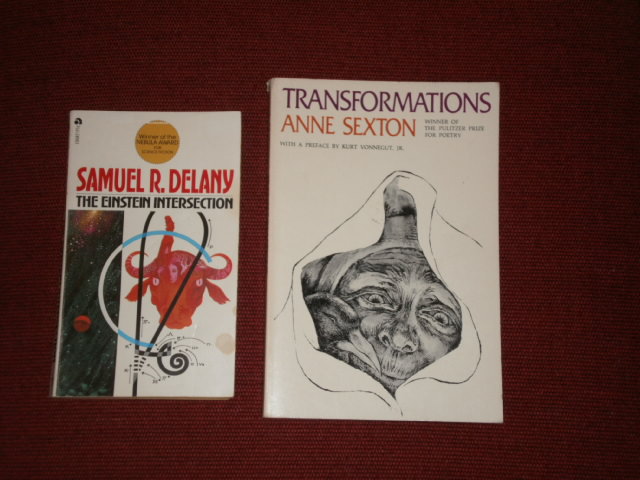
Delany, Samuel R. The Einstein Intersection. New York: Ace, 1967.
I bought this and Anne Sexton’s book for $1.00 each at Savers Thrift Store in Salt Lake City, whose book section was recommended to me by a student. I already have the current Wesleyan University Press edition of this novel, but I collect different printings of Delany’s work because he is my favorite author and because the older paperbacks are often quite aesthetically pleasing. This one’s spine is slanted a little, but is otherwise in good shape. I got very excited when I found it on the shelf.
Himes, Chester. If He Hollers Let Him Go. 1945. Cambridge: Da Capo, 2002.
Himes is a twentieth-century African American novelist who is largely ignored by critics because he wrote mostly mysteries, though he wanted to be a “serious” writer. Due to his marginal canonicity I never encountered him in school, and am thus trying to fill a gap in my knowledge by acquiring and reading this book.
Bought on amazon.com. It is a boring new paperback, which is why it does not get a photograph. The vintage copies that amazon had listed were just as expensive as the one I bought, so I decided to buy it new in order to have the current edition just in case I like it so much that I decide to teach it sometime.
Sexton, Anne. Transformations. Illus. Barbara Swan. Boston: Houghton, 1971.
This collection includes Sexton’s famous poems about fairytales. I love these poems, and they are usually a hit with students. I will appreciate the opportunity to read them in their original context rather than in an anthology. I haven’t read much poetry this summer, but am excited to get back on the wagon.
The Best YouTube Sing-Along Ever
This is a video of Swedish Olympic handball star Isabelle Gullden (driving) and some other woman singing along (well, sort of–maybe “riffing on” is a better term) to Jason Derulo’s “Whatcha Say” in the car, and it is hilarious:
http://www.youtube.com/watch?v=bemIK39WmLA
The video raises so many questions (perhaps all of which would be answered if I knew Swedish):
1. This is obviously premeditated. Whose idea was it? Is it some sort of weird marketing gimmick?
2. Why this song?
3. Who is the other woman, and shouldn’t she be driving her famous Olympian friend around instead of vice versa?
4. What does the hand motion that the women make every time they sing the chorus signify in Sweden? If it’s the same thing it signifies in the U.S., an additional question arises (pun intended!): Why are these women so dirty? (not that I have a problem with it)
5. Not a question, but an observation: the way Gullden is torn between totally rocking out like her friend and being a responsible driver cracks me up! If this video is wrong, I don’t want to be right.
Books Acquired Recently
Palahniuk, Chuck. Invisible Monsters Remix. New York: Norton, 2012.
I am teaching the first edition (1999) of this novel in my Introduction to Literature course this coming semester, which gave me an excuse to buy the Remix (it is essential research!), a version of the novel in its original form along with commentary by Palahniuk. Invisible Monsters is a fun book—I couldn’t put it down the first time I read it—and I am looking forward to experiencing it in a different incarnation.
Steinbeck, John. The Acts of King Arthur and His Noble Knights. 1976. New York: Penguin, 2008.
I have been looking for a copy of this book for around fifteen years in used bookstores. Steinbeck is an excellent storyteller and one of my favorite writers to read for fun, thus I’ve always thought that his retelling of the Arthurian legend would be worth reading. I did not realize that Penguin had reissued it, but discovered a new copy of the book (along with Palahniuk’s) when browsing in Dolly’s Bookstore in Park City, Utah, which I visited for the first time yesterday. I continue to be very impressed with the number of high-quality bookstores in Utah. It has the best bookstore scene I’ve ever encountered outside of New York City.
Thoughts on Yogurt
Yogurt fascinates me. I don’t like eating it because it is just too weird, a bizarre amalgamation of other dairy products: part liquid like milk, part flowing solid like ice cream, part fermentation like cheese. But I really enjoy watching other people eat it because I get to observe someone interacting with the above odd qualities, which are visually fascinating. There is something comforting about the way a metal spoon clicks on a plastic yogurt container as one is scraping up the last few bites. It entrances me.
The epitome of the satisfying nature of this yogurt voyeurism is present in a scene from Stranger Than Fiction, where Dustin Hoffman’s character (who is always eating—one of my favorite running gags ever) is finishing his yogurt and gets a drop on his lip, which he quickly scoops off with his finger and sucks into his mouth. It is so viscerally physical and uninhibited as to be sublime.
(Incidentally, the portrayal of Hoffman’s character, an English professor, drives me nuts! He claims he is swamped that semester because he is teaching four classes as well as directing several dissertations [three, I think]. It is clear from this statement that the movie’s writer has no clue how academia works. First off, no legitimate Ph.D.-granting institution [i.e., real universities, not counting online for-profit “universities” such as the University of Phoenix] would have professors teaching four courses per semester. Secondly, someone with as large of an office as Hoffman has [completely lined with bookshelves!] who has taught the highly-specialized courses that he mentions teaching would be a full professor teaching two courses maximum, with at least one if not both being graduate seminars. This misrepresentation of academia is a problem in television and film in general, with Ross Geller on Friends being perhaps the most egregious example. Good Will Hunting is one of the rare examples which gets it mostly right.)
Avocado is another food which I love to watch people eat because of its texture. I used to hate it, but then I watched a housemate make a batch of guacamole, and it looked so good that I was compelled to try it. Avocado is now one of my favorite foods; I’m having some for lunch today.
Thoughts on the Weekly Reader
The news that Scholastic is shutting down its Weekly Reader elementary school newspaper (read more about it here: http://schoolsofthought.blogs.cnn.com/2012/07/25/the-last-weekly-reader/?hpt=hp_bn13) signifies the loss of another piece of my childhood. We would read through it each week in class for several years of my elementary school career (I want to say third grade and fourth grade, and perhaps also second grade, but I’m not sure), and it was always an enjoyable diversion from regular class activities even though I remember being bored by most of its articles. It felt like a big deal that there was a newspaper being published for kids because it symbolized adults recognizing that our intellects were important and acknowledging that we cared about what was going on in the world, too. The physical nature of it, the fact that you could hold the Weekly Reader in your hands as proof of this recognition, meant something (and similar experiences still mean something–I loved print culture then and I still love it much more than digital culture).
My clearest memory of the Weekly Reader is an article before the 1988 election which explained who the two big-party candidates were and included a ballot that you could cut out in order to have a mini-election in class. Being able to vote was so exciting! I voted for Dukakis, but as was the case in the actual election, Bush won in a landslide, something like 22-9. In hindsight, this landslide seems especially surprising because it was a class of third-graders in the Bronx! The fact that many of us had heard of Bush because he was vice president (I remember arguing that this was an unfair advantage for him), but had not heard of Dukakis swayed the vote. I voted for Dukakis because I knew my parents were voting for him.
It is sad that the Weekly Reader will be no more. What were cooler than the Weekly Reader, though, and are really only associated with it in my mind because they were printed on the same flimsy, full-color newsprint, were the Scholastic book order forms that would come four or five times a year. It was so much fun to look through the four-page catalogues for new titles and figure out whether I had enough money saved from my allowance to buy a book or two (the times when I had spent my money on other things [usually baseball cards] and couldn’t afford anything were sad, indeed). During my first few years of elementary school, the books (virtually all paperbacks) were usually $2.00 or less, then they became slightly more expensive in the upper grades when we had graduated to chapter books. I remember buying novelizations of films such as Superman 4: The Quest for Peace and Back to the Future 2, and a volume that included both Romeo and Juliet and West Side Story which I still have. You would cut out the order form, fill it out, and give it to the teacher in an envelope along with your money (often a smorgasbord of coins), and the books would arrive in about a month, which was long enough to have almost forgot about them, thus making the day when they arrived super-exciting, like a surprise Christmas. The teacher would always wait until the end of the day to hand them out, and the anticipation would be excruciating. I don’t really know any elementary school children these days, but I hope that they still have this wonderful experience.
Some Thoughts on Edgar Allan Poe
Yesterday a friend of mine posted this hilarious cartoon on Facebook: http://i.imgur.com/rlEZr.png. Any time you can combine Edgar Allan Poe and “Bohemian Rhapsody,” you have to do it. I’ve been thinking about the cartoon and chuckling all day, which in turn got me thinking about Poe in general, and how he keeps inserting himself into my life at random intervals. I enjoy his work, though I would not consider him one of my “favorite” authors, but my history with him is longer than my history with any other non-children’s author aside from C.S. Lewis. Here is a brief recounting of some of that history.
My first encounter with Poe was via his famous poem “The Raven.” I don’t remember when I discovered this poem—presumably in school—but I knew it by 1989 when it featured in the first Simpsons Halloween special, with James Earl Jones narrating and the Bart-headed raven saying “eat my shorts” instead of “nevermore.”
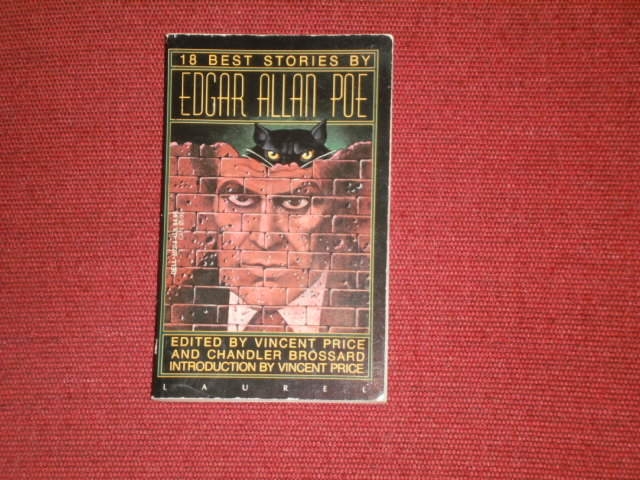
The second encounter with Poe which comes to mind is reading a book of his short stories for eighth-grade English. The stories were cool because of their creepiness, but I got a 72 (or maybe a 74? Anyway, pretty abysmal) percent on the exam that covered them, so didn’t revisit the book for years afterward because it was associated with bad memories. However, I still have it, and just now noticed that it is edited by Vincent Price! Classic. And only $4.95 new.
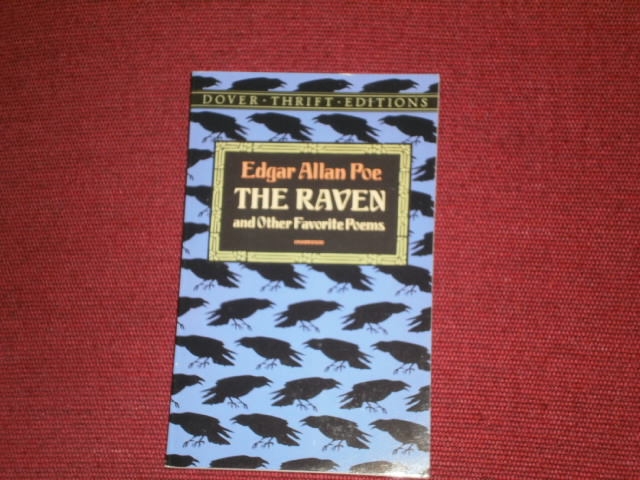
A third strong Poe memory comes from the tail end of my sophomore year of high school. I was in Stratford, Ontario on a school trip to the Stratford Shakespeare Festival (which was a surreal experience, but that is a story for another post). The plays were in the evening, thus we were spending the day browsing Stratford’s shops. I came across a small bookstore and decided to go inside and look for a collection of Poe’s poetry. (Why Poe? Why poetry? I don’t remember my reasons; it was like an unexplainable craving.) This is the earliest instance I can remember of that lovely phenomenon of going into a bookstore wanting a specific book and finding it when you were not sure that you would (Sinclair Lewis’s Main Street and Evelyn Waugh’s Brideshead Revisited are two other examples of this happy synchronicity that I have experienced). In this case, I didn’t even know whether the book I wanted even existed, but there it was, “The Raven” and Other Favorite Poems, for only $1.00.
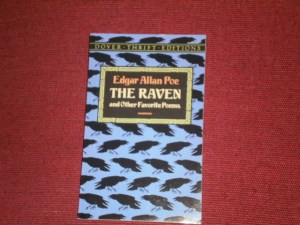
My fourth major Poe memory, and really the last time I thought about him extensively until this weekend (I taught “Annabel Lee” this past semester, but made my students do the thinking about it), is from three or four years ago when I was playing chess with a friend and he observed that in successful attacks the threat of a crushing move is often stronger and more decisive than its actual execution. He compared this to the threat present in “The Purloined Letter,” where the threat of blackmail resulting from the stolen letter is so strong that those who look for it are out of their heads to the point where they miss that it is on the desk, out in the open. I suppose I must add Poe to that ever-increasing mental list of authors that I need to re-read.
Book Acquired Recently: Amy Abugo Ongiri’s Spectacular Blackness
Ongiri, Amy Abugo. Spectacular Blackness: The Cultural Politics of the Black Power Movement and the Search for a Black Aesthetic. Charlottesville: U of Virginia P, 2010.
One of my research interests within African American literature is the Black Arts Movement, which has been mostly ignored by critics until recent years. Most texts from the movement are electric, enjoyable to read because of their energy and their commitment to political change. I bought Ongiri’s book because of this interest.
Bought on amazon.com.