Book Acquired Recently: Frank O’Hara’s Standing Still and Walking in New York

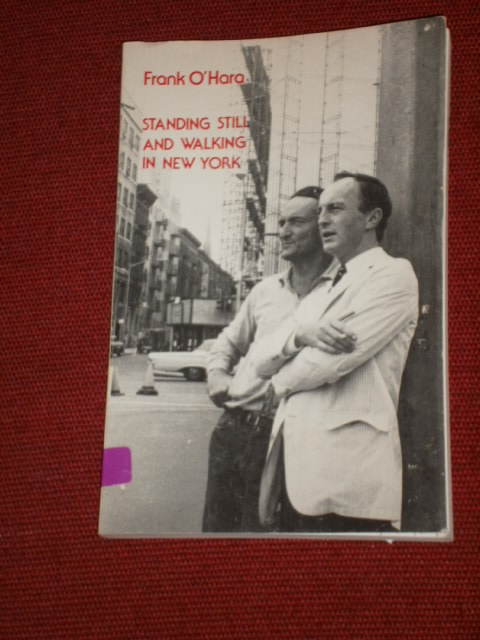
O’Hara, Frank. Standing Still and Walking in New York. Ed. Donald Allen. San Francisco: Grey Fox, 1983.

I am a huge O’Hara fan and collect his books compulsively. However, I am ashamed to admit that I did not know of this book’s existence until I encountered a citation of it in an article several weeks ago. It is a selection of O’Hara’s art and literary criticism as well as occasional prose pieces (e.g., book introductions). I love the zest for aesthetic pleasure that is rampant throughout O’Hara’s poems and plays, and I look forward to experiencing it in this collection.

Bought from Better World Books via amazon.com. The original retail price was $6.95, not bad for a small press paperback even back in 1983.

On Being a Cyborg

My primary computer was infected with a trojan several days ago, so I spent a large chunk of time this weekend working to eradicate it. Aside from feeling annoyed about the process in general–anger at whoever created the malware, trepidation about the damage it caused, frustration at the disruption of my plans in order to deal with the problem–I also found myself, my self feeling unsettled, as though it were actually my body that was infected.

I recognized this dis-ease as a symptom of the state of contemporary life which Donna Haraway describes in her “Cyborg Manifesto,” that is, having one’s selfhood extend outside of one’s physical body into the objects that seem essential to one’s existence (thus creating a cyborg–a being that is part-human, part human-made material), a state that is much more pronounced now than it was when Haraway was writing two decades ago. I have been well-aware for quite some time that my cyborg self extends at least as far as computers (especially as gateways to the internet), my cell phone, and my book collection, but every time I have a fresh reminder it scares me a little bit just how dependent I am on material objects.

The Polymath or, The Life and Opinions of Samuel R. Delany, Gentleman

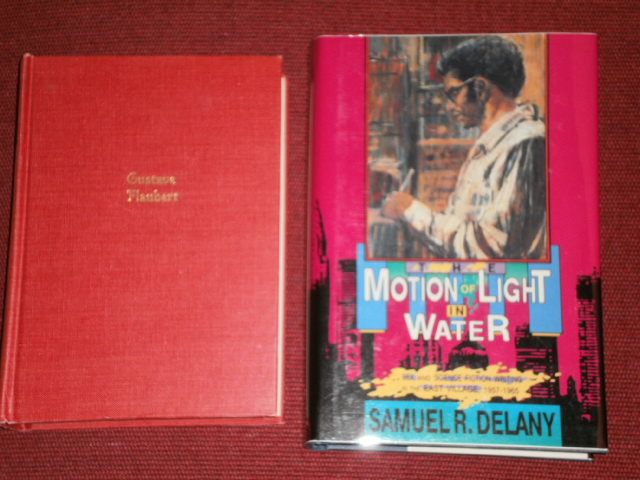
The Polymath or, The Life and Opinions of Samuel R. Delany, Gentleman. Delany is my favorite writer, but I’ve never been fortunate enough to hear him speak, so it was wonderful to see this film, which is made up almost exclusively of Delany talking about his life and writing. Although the film itself is rather amateurishly made–there is no sense of narrative, it uses a lot of mediocre stock footage, the production value is very basic overall–I was mesmerized by it; it felt much shorter than its hour and seventeen minutes. It is clearly a labor of love on Taylor’s part, for which he deserves applause. Delany is such a fascinating person!

A lot of what Delany says in the film he has also said in his nonfiction, but I still learned some things about him/heard him express some of his ideas in exciting new ways. Here are some of my favorite examples:

Early on in the film there is a shot of Delany sitting in his apartment, and it is almost completely covered in bookshelves (there seems to be hardly any space for walking) that are all stuffed with books.

In his 20s, Delany would have 12-15 sexual encounters (as Delany makes clear in his writing, virtually all of this activity consisted of giving and sometimes receiving oral sex) per day while still getting at least eight hours of writing done, and he explains how it was easy for any gay man to do the same at the time if they just knew where to look.

Delany says that he’s “always been drawn to the kinkier side of life,” which is easy to guess judging from his writing, but I wish he had said more about this. “Kinky” as in he enjoys BDSM? Or what?

He believes that heterosexual monogamy is “vicious” because of how close-minded it is, though he respects people’s freedom to make this choice.

Books Acquired Recently

Acker, Kathy. Pussy, King of the Pirates. New York: Grove, 1996.

I really enjoy Acker’s work because of its combination of postmodern form and explicit sexuality. I was wanting to read more of her fiction this summer and saw that Hume’s book has a section on Pussy, King of the Pirates, so I decided to acquire it and read it before beginning Hume.

Hume, Kathryn. Aggressive Fictions: Reading the Contemporary American Novel. Ithaca: Cornell UP, 2012.

I bought this book because, aside from sounding fascinating in general (it discusses numerous writers/texts that I like: Acker, Philip Roth, Alice Walker, Chuck Palahniuk, American Psycho…) it has a section on Samuel R. Delany’s novel Hogg, which is generally ignored by critics. It always surprises me a) how often people write about Delany (they just tend not to write about his sex books), and b) how many literary critics have not heard of him at all, as he is a major voice in numerous fields. These two facts seem to contradict one another, but my guess is that most literary critics who have heard of Delany feel compelled to write about him as I do. He is becoming more and more canonical, and deserves to be so.

Both books bought on amazon.com.

In Praise of Street Food

Today there was an annual Independence Day street fair in my neighborhood. I love street fairs even though they are often hot and overcrowded because they always involve delicious street food! I grew up with high street food standards as a result of living in New York City, where the hot dogs are the best in the world and you could often get a lovely potato knish from the same vendor that sold you the hot dog, or maybe a smoky soft pretzel. Living in the midwest for much of the past decade, I grew used to its heavier, often deep-fried street food: foot-long Italian sausages, corn on the cob, pork chop sandwiches, funnel cakes.

I did not know what to expect today at my first Utah street fair, but I was not disappointed. There was a refreshingly cosmopolitan array of choices (hurray for cities!), including Greek food, Indian food, several panini stands, two taco trucks, a Belgian waffle cart, a sushi truck,  and American standbys like barbecued chicken, pulled pork, and hamburgers. There were so many tantalizing options that I found myself sampling from three vendors, beginning my lunch with a samosa, moving on to a grass-fed burger that was probably the best hamburger I’ve had in Utah, and finishing with a pork taco and part of a chicken quesadilla. All of this fantastic food only cost $14.50 total. I’m often cynical about America, but street food is something that we get right!

Books Acquired Recently

Rivers, Larry, with Arnold Weinstein. What Did I Do? The Unauthorized Autobiography. New York: Harper, 1992.

I am interested in Larry Rivers because of his close friendship/relationship with my favorite poet Frank O’Hara, but I don’t know much about his work. I recently read an essay on O’Hara in the Journal of the Midwest Modern Language Association that cited this book, and I thought to myself “I bet I can get a copy of this for next-to-nothing on amazon.com,” which was the case. Less that five dollars for a brand new hardcover–how could a book-buying addict like me resist?

Shepard, Judy. The Meaning of Matthew: My Son’s Murder in Laramie, and a World Transformed. 2009. New York: Plume, 201o.

I just received this as a belated birthday gift from a friend. I hadn’t heard of it before, but I am interested in the Matthew Shepard story as a part of my interest in all things queer, so I look forward to reading it.

On the Accumulation of Multiple Copies of the Same Book

In an article in the July 12, 2012 New York Review of Books, Michael Chabon writes that he “acquired five copies, of various size and vintage” of James Joyce’s Finnegans Wake during the year that he worked his way through the novel. I love this little detail because I, too, find myself obsessively buying different printings of books that I treasure. Reading isn’t just about encountering ideas in a book, it is also about interacting with a physical object (which is yet another reason why ereaders are evil), and I like that Chabon acknowledges this by ensconcing himself both physically and mentally in the book.

Books that I keep buying include

James Baldwin’s Another Country, which is one of the best novels I’ve ever read about both race and LGBT issues. I think it is Baldwin’s best novel–more powerful than Go Tell It On The Mountain, more sincere than Giovanni’s Room. I have it as an old Signet paperback and in the Library of America’s collection of Baldwin’s early novels, and once I get to teach it I’ll pick up the current Vintage paperback.

Samuel R. Delany’s novels, the old cheap paperbacks (especially the Bantam ones) of which I encounter fairly frequently in used bookstores, and always buy because they are so aesthetically appealing even though I have most of them in their most recent printings from Wesleyan University Press or Vintage.

Herman Melville’s Moby-Dick, which, alongside Whitman’s Leaves of Grass, is the cornerstone of American literature, thus one can never have too many copies of it. I have the Penguin edition, a hideous teaching edition from Pearson-Longman, and two beautiful collector’s editions, one from the Folio Society and one from the Franklin Library.

Frank O’Hara’s poetry: I have the indispensable Collected Poems edited by Donald Allen, which was the first of O’Hara’s books that I bought, and I also have the 2008 Selected Poems edited by Mark Ford, as well as O’Hara’s two major original collections, Meditations in An Emergency and Lunch Poems.

Walt Whitman’s Leaves of Grass, which of course was published in six different editions over nine printings during Whitman’s lifetime. I have the Penguin printing of the 1855 edition (the best edition), the Signet printing of the 1892 edition, the Library of America volume which includes the 1855 and 1892 editions plus much of Whitman’s prose, an illustrated edition by Heritage Press (I think it’s the 1855 edition, but I don’t remember off of the top of my head–I’m writing this at my office and the book is at home), a faux facsimile of the 1855 edition by Oxford University Press (it reproduces the exact typsetting formatting of the original, but is not a photographic facsimile), the New York University Press variorum edition that collates all six original editions, and a selection of poems which draws on all of the Leaves of Grass editions edited by Galway Kinnell and published by Ecco that I use for teaching because it includes “Poem on the Proposition of Nakedness,” which did not appear in the 1855 or 1892 editions.

Also, on a somewhat different subject, shortly after reading Chabon’s article, I encountered an article by Louis Menand in the July 2, 2012 New Yorker about biographies of Joyce. I haven’t thought deeply about Joyce in years because I’m not really a fan of his work (I recognize its historical significance, but it feels dated to me), but it always strikes me when I encounter several random references to a person or book within a short period of time. It feels uncanny. I find that this happens to me several times a year, usually with someone whose work I am not familiar with (Marina Abramovic is one example from several years ago, and Antonin Artaud is a more recent one). It is like the universe is telling me that it is the right time in my life for me to encounter the person in question in order to learn from them, and this is often the case–the timing is perfect. I don’t really have the time this summer to give Ulysses the attention that would be necessary for a re-read of it, but these recent encounters with Joyce make me stop and ponder.

John Irving’s In One Person

John Irving’s new novel In One Person is a beautiful, fantastic book. It is narrated by Bill in the present day as he reflects upon growing up in the 1950s and the intervening half-century. He realizes as a teenager that he is bisexual, and the rest of the novel describes his journey to figuring out how he fits in a society that designates him as Other and the friends he meets along the way. It is the best fictional depiction of bisexuality that I have ever encountered both in terms of how accurate it is and how positively bisexuality is portrayed–Bill encounters lots of people who are unsympathetic to him, but he never lets their hatred affect his confidence in who he is and his confidence that there is nothing wrong with him. The novel also includes several sympathetic transgender characters and a moving description of the early AIDS crisis. It is difficult to write about In One Person because it is just so good that mere descriptions of it pale in comparison.

Euro 2012: Spain Champions Again

Spain made history today with their 4-0 victory over Italy in the Euro 2012 final, becoming the first team to ever win three major championships in a row. Spain also became the first team to win two Euros in a row, and these two victories, along with their 2010 World Cup championship, make them the best side ever. They have had an incredible half-decade.

I have criticized Spain throughout the tournament for playing uninspired soccer, but today they pulled out all of the stops, scoring with ease against an Italian side that were playing quite well. Spain only allowed one goal the entire tournament (in their opening match against Italy), which is another record. They played like a true team in that their offensive players scored enough to get results and the defense was airtight, not assuming that they could be lazy because they could just run up the score on the other end. It gets boring when the same team wins all of the time, but one must give full credit to Spain—their results speak for themselves.

“Another Life” by Paul La Farge

There’s a fantastic short story in this week’s New Yorker (July 2, 2012) by Paul La Farge called “Another Life,” which is about an English professor (aren’t stories by English professors about English professors the best?) in his late 30s who picks up the bartender of his hotel after his wife goes off to sleep with a man whom she meets while watching the Celtics game at the bar. The story is told in the second person, which is often gimmicky, but it works here because La Farge’s language is so vivid and urgent that the reader gets drawn into the story, thinking only about the actions of the characters and what they look like in one’s head and forgetting about the story’s form. For instance, here is the professor’s first kiss with the bartender: “Then the husband leaps forward and kisses April P, whose body is hot and full of instincts.” What a lovely line! It describes something cliche using language which makes fun of the cliche, but in a way that is not cliche, thus making it especially sharp. The story ends realistically, with both April and the professor going back to their dreary, normal lives, but this conclusion is not depressing because the force of their experience, of their brief entrance into the other “life” of the title, is the element of the story that sticks with the reader. Also, there is a hilarious scene where they do a few lines of cocaine off of the cover of the Norton Anthology of American Literature. Best use of a Norton ever!