A new semester begins tomorrow. I am excited to meet my students and get things going, but I will also miss the free time that this summer has afforded. I’ve had a very productive three months, writing two conference presentations, a book chapter, and some productive brainstorming notes for another book chapter that is due next spring. I have also sustained this blog at a satisfactory level. Writing here almost every day has really helped my academic writing because it helps keep me sharp. It is always a struggle to find writing time when classes are in session, but I am going to try to continue to write here at least every other day, and also make time for my scholarship. I have good momentum going and want to keep it up.
Books Acquired Recently
Aldrich, Nelson W., Jr., ed. George, Being George: George Plimpton’s Life as Told, Admired, Deplored, and Envied by 200 Friends, Relatives, Lovers, Acquaintances, Rivals–and a Few Unappreciative Observers. New York: Random, 2008.
I am fascinated by George Plimpton as a sort of public intellectual who was one of the last of his kind. However, this fascination hasn’t arisen as a result of his writing, but as a result of his various film and television appearances (e.g., in Good Will Hunting, in Ken Burns’s Baseball, and on the The Simpsons [His appearance as a crooked spelling bee promoter/hotplate salesman is priceless, but unfortunately I can’t find it on YouTube. His final line is “Now I’ll go back to doing whatever it is that I do.” Exactly.]). I decided that it is time for me to learn more about him and his writing, so I bought Aldrich’s oral history of Plimpton’s life and Plimpton’s oral history of Truman Capote (who also fascinates me).
Beachy, Stephen. Boneyard. Portland: Verse Chorus, 2011.
One of my favorite poets, Julia Spicher Kasdorf, recommended this novel to me because of my interests in LGBT literature and Mennonite literature. Intersections between the two are extremely rare, but I am so glad that she introduced me to Beachy’s novel because I just finished it tonight and it is amazing! One of the top five novels I’ve ever read, probably (top ten for sure). It is as though Kathy Acker were male and an ex-Mennonite, and decided to write about her/his Mennonite baggage. It has immediately become the next work that I will write scholarship on.
Plimpton, George. Truman Capote: In Which Various Friends, Enemies, Acquaintances, and Detractors Recall His Turbulent Career. New York: Doubleday, 1997.
Apparently this got excellent reviews. It’s slightly thicker than Aldrich’s book.
Sullivan, Nikki. A Critical Introduction to Queer Theory. New York: New York UP, 2003.
I’ll be teaching a literary criticism and theory course next semester and am starting to look at potential textbooks. Sullivan’s book has gotten good reviews and is supposed to be accessible, so I thought I would check it out.
All bought on amazon.com.
“The past is never dead. It’s not even past.”
I finished reading William Faulkner’s Requiem for a Nun this evening. I was reading it partly because I’m teaching it’s prequel, Sanctuary, this semester, but also because I am fond of the famous quote from it about the past not being past, and wanted to learn more about its context. I had always thought the quote was “We may be through with the past, but the past is not through with us. In fact, it is not even past.” However, the quote is actually “The past is never dead. It’s not even past.” It turns out that the version I had in my head is a misquotation of Faulkner from one of my favorite films, Magnolia. I am sad that the film’s version is incorrect because, even though both make the excellent point that the past constantly affects the present (especially in Faulkner’s work, where the Civil War always happened yesterday), the longer version depicts the past as a foreboding presence, always gaining on us as we try to escape it, which seems fitting for Faulkner’s writing.
Books Acquired Recently
Faulkner, William. Requiem for a Nun. 1951. New York: Vintage, 2011.
I am teaching Faulkner’s Sanctuary in an independent study this semester, and bought its sequel Requiem to read as part of my preparation. Reading Faulkner is a guilty pleasure–his writing is beautiful, and he is an essential figure in the development of American literature, but for some reason his personal despicableness bothers me more than any other writer’s aside from Ezra Pound’s. I certainly believe in judging a book based on its artistic merits rather than on its author’s biography, but Faulkner’s statement that he would shoot African Americans down in the street if ordered to do so by Mississippi’s governor is difficult to get past.
Bought on amazon.com.
Poore, Michael. Up Jumps the Devil. New York: Ecco, 2012.
I received this book in my school mailbox today, presumably as an (unasked for) exam copy from the publisher as there was no note with it, so I doubt it is from a colleague. The secretaries usually open mail that isn’t obviously personal (which is weird because I feel bad having someone do a task for me that I could easily do myself, especially one that tends to be enjoyable. I, like Virginia Woolf with her servants, feel tremendously awkward around secretaries. I am uncomfortable with the power imbalance, it makes me feel bourgeois.), so I did not get a chance to see the return address. The novel, Poore’s first, sounds like it could be interesting, but it is not something that I would have bought myself, so who knows when I’ll get around to reading it.
Books Acquired Recently
Castillo, Ana. The Mixquiahuala Letters. Tempe: Bilingual, 1986.
This is Castillo’s first novel, and wow have I missed out waiting this long to acquire and read it! I began reading the book this afternoon as soon as I unwrapped it from its shipping envelope (as C.S. Lewis writes in Surprised by Joy, there is really nothing like the happiness of receiving a package in the mail that one knows has a book inside), and not only is the writing up to Castillo’s usual beautiful standard, but it has a postmodern form as well! There is a note at the beginning of the table of contents which instructs readers not to read the book chronologically, and then gives them several options for how to read it depending on their personality type, as seen in these photographs:

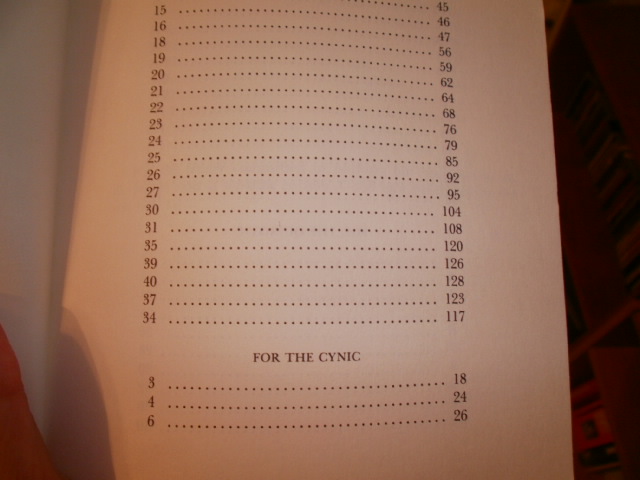

I am reading the novel as a “cynic.”
I have enjoyed Castillo’s work for half a decade, but the new-to-me work that I have been reading the past few days has shown me that she is someone I must write scholarship about. It is wonderful to discover an author who fits my interests in ethnic literature, LGBT literature, and postmodern literature.
Delany, Samuel R. Starboard Wine: More Notes on the Language of Science Fiction. Rev. Ed. Middletown: Wesleyan UP, 2012.
Samuel R. Delany is another rare author who fits my three primary scholarly interests. I have been looking for a copy of Starboard Wine‘s out-of print original 1984 edition for over two years without luck, and then found out a month ago that Wesleyan University Press, which has published or republished most of Delany’s literary criticism, was publishing a revised edition. It just came out, and I am very excited to finally have the chance to read it.
Both books bought on amazon.com.
Ana Castillo’s Loverboys
Ana Castillo’s short story collection Loverboys is one of the most beautiful books I have ever read. It’s so smooth, it feels like someone is talking to me and in doing so enchanting me instead of me actively reading. I feel like I’m in a dream while reading it to the point that I sometimes lose sense of the longer stories’ plots because I am so engrossed in the characters and how vivid they feel.
One of the things I love about Castillo’s writing is her descriptions of food, which always make me ravenous. Loverboys makes me hungrier than any of her other books aside from The Guardians. I also am enthralled by its lesbian love stories because they are so matter-of-fact, which is refreshing. The narrators in all of the stories grab love where they can find it, realizing how precious it is, and do not let its loss crush them, instead moving on to find it somewhere else. It is a hopeful book. It both makes me want to write about it professionally and send it to all of my good friends, a combination that I do not often experience.
An Odd Typewriter
Yesterday I was at one of my favorite non-bookstore stores in Salt Lake City, the vintage shop Unhinged, when I came across a nifty green typewriter.
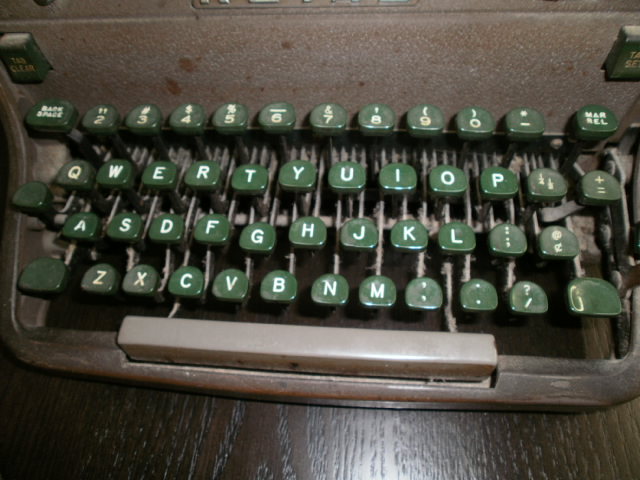
Upon taking a closer look, I discovered that, though it was completely intact, it didn’t have a 1. I have never seen a qwerty keyboard without all ten numerals on it before. (Incidentally, “qwerty” is one of 23 words with a q and no u that are legal in Scrabble, as is its plural, “qwertys.”)

I suppose that the makers of the typewriter thought they were being efficient by saving space in their exclusion of a 1, since the sans serif “I” seems to match the font of the other numbers.

However, this would really mess up one’s typing technique. Instead of hitting the 1 in its usual place, one must hit an uppercase “I” instead. I bet that this model resulted in an abnormally high rate of typing errors, frustrating secretaries and students everywhere. But because I could just appreciate the typewriter as an object instead of having to use it, discovering its oddity made my night.
Books Acquired Recently
Castillo, Ana. Loverboys. New York: Norton, 1996.
—. My Father Was a Toltec and Selected Poems 1973-1988. 1995. New York: Anchor, 2004.
Ana Castillo is an author that I really enjoy, especially her novel The Guardians, which I’ve taught several times. She is the writer-in-residence this semester at my college, so I thought I would get more familiar with her work as I also have the opportunity to get to know her as a colleague. I haven’t read her poetry before, and Loverboys, a short story collection, sounds really fascinating because it involves some same-sex love stories. I look forward to reading both.
Genet, Jean. Prisoner of Love. Trans. Barbara Bray. 1989. Hanover: Wesleyan UP, 1992.
I enjoy Genet’s novels and I am also fascinated by the history of the Black Panther Party, so I decided to buy this book, which is about Genet’s experiences with the Panthers and with Palestinian refugees, both of whose causes he advocated.
All three bought on amazon.com.
The U.S. Wins a Thriller Against Canada
If you weren’t watching the Olympic Women’s Soccer semifinal between the U.S. and Canada this afternoon, you suck. It was one of the most thrilling, well-played soccer matches I have seen in my twenty-plus years as a fan. Both teams played their guts out, with the U.S. scoring the winning goal in the 123rd minute to win 4-3. The U.S. came back from three one-goal deficits with two goals from Megan Rapinoe, a penalty kick from Abby Wambach, and the last-minute header by Alex Morgan. With the exception of Rapinoe’s first goal, a corner kick straight into the goal which Canada woefully misplayed, all of the goals were superbly taken (even Wambach’s penalty kick, which barely beat the Canadian ‘keeper to the left post). It was the kind of game that you hate to see either team lose, but at the same time it did not deserve to go to the farce of penalty kicks. I will be rooting for the Canadians to beat the French in the bronze medal match, and I hope the U.S. can gain revenge against Japan for their loss in the 2011 World Cup final in the gold medal match.
Chuck Palahniuk’s Invisible Monsters Remix
Chuck Palahniuk’s Invisible Monsters Remix is a fantastic printed object that deserves space in the canon of American postmodern fiction. It is the 1999 version of Invisible Monsters in its original intended form, which asks the reader to jump back and forth throughout the volume, kind of like a Choose-Your-Own-Adventure book from the 1980s. For instance, the end of the introduction instructs the reader to “jump to Chapter Forty-one,” where the novel begins. The end of that chapter directs the reader to another chapter, eventually culminating in the final chapter near the middle of the volume, which is marked “The End” in place of further direction.
However, this chapter sequence only covers the chapters from the original novel. There are around ten (I’m too lazy to go back and count!) new chapters interspersed throughout the book, some that extend the story of the novel and some that describe its original composition and how the idea for the Remix came about. If one has not been paying attention to which chapters have been read, it is easy to miss these new chapters. But the introduction suggests marking each read page with an X, which is what I did, and then I went through the book looking to check if there were any unread pages, thus discovering the new chapters. There are three sequences of new chapters that loop back on themselves, so the reader could begin with any of the chapters in the sequence and still encounter all of the chapters (e.g., I began the first sequence with chapter three because it was the first unread chapter that I discovered, and the last chapter I read in the sequence directed me back to chapter three, so even if I had begun with a different chapter in the sequence I still would have gotten to all of its chapters).
Two of the new sequences involve pages that are printed backwards so that the reader must use a mirror to read them.


Palahniuk acknowledges that readers “older, than, say, twenty-two” will hate this gimmick (104), but I love it! I appreciate books that try to stretch the limit of what a physical book can be, which is why I like the Remix so much. It combines elements of previous postmodern texts such as B.S. Johnson’s The Unfortunates and Mark Z. Danielewski’s House of Leaves. Even if one is not a fan of Palahniuk, the Remix is worth reading because of how it tries to break through the novel’s conventional generic form.

