Thoughts on the Weekly Reader

The news that Scholastic is shutting down its Weekly Reader elementary school newspaper (read more about it here: http://schoolsofthought.blogs.cnn.com/2012/07/25/the-last-weekly-reader/?hpt=hp_bn13) signifies the loss of another piece of my childhood. We would read through it each week in class for several years of my elementary school career (I want to say third grade and fourth grade, and perhaps also second grade, but I’m not sure), and it was always an enjoyable diversion from regular class activities even though I remember being bored by most of its articles. It felt like a big deal that there was a newspaper being published for kids because it symbolized adults recognizing that our intellects were important and acknowledging that we cared about what was going on in the world, too. The physical nature of it, the fact that you could hold the Weekly Reader in your hands as proof of this recognition, meant something (and similar experiences still mean something–I loved print culture then and I still love it much more than digital culture).

My clearest memory of the Weekly Reader is an article before the 1988 election which explained who the two big-party candidates were and included a ballot that you could cut out in order to have a mini-election in class. Being able to vote was so exciting! I voted for Dukakis, but as was the case in the actual election, Bush won in a landslide, something like 22-9. In hindsight, this landslide seems especially surprising because it was a class of third-graders in the Bronx! The fact that many of us had heard of Bush because he was vice president (I remember arguing that this was an unfair advantage for him), but had not heard of Dukakis swayed the vote. I voted for Dukakis because I knew my parents were voting for him.

It is sad that the Weekly Reader will be no more. What were cooler than the Weekly Reader, though, and are really only associated with it in my mind because they were printed on the same flimsy, full-color newsprint, were the Scholastic book order forms that would come four or five times a year. It was so much fun to look through the four-page catalogues for new titles and figure out whether I had enough money saved from my allowance to buy a book or two (the times when I had spent my money on other things [usually baseball cards] and couldn’t afford anything were sad, indeed). During my first few years of elementary school, the books (virtually all paperbacks) were usually $2.00 or less, then they became slightly more expensive in the upper grades when we had graduated to chapter books. I remember buying novelizations of films such as Superman 4: The Quest for Peace and Back to the Future 2, and a volume that included both Romeo and Juliet and West Side Story which I still have. You would cut out the order form, fill it out, and give it to the teacher in an envelope along with your money (often a smorgasbord of coins), and the books would arrive in about a month, which was long enough to have almost forgot about them, thus making the day when they arrived super-exciting, like a surprise Christmas. The teacher would always wait until the end of the day to hand them out, and the  anticipation would be excruciating. I don’t really know any elementary school children these days, but I hope that they still have this wonderful experience.

Some Thoughts on Edgar Allan Poe

Yesterday a friend of mine posted this hilarious cartoon on Facebook: http://i.imgur.com/rlEZr.png. Any time you can combine Edgar Allan Poe and “Bohemian Rhapsody,” you have to do it. I’ve been thinking about the cartoon and chuckling all day, which in turn got me thinking about Poe in general, and how he keeps inserting himself into my life at random intervals. I enjoy his work, though I would not consider him one of my “favorite” authors, but my history with him is longer than my history with any other non-children’s author aside from C.S. Lewis. Here is a brief recounting of some of that history.

My first encounter with Poe was via his famous poem “The Raven.” I don’t remember when I discovered this poem—presumably in school—but I knew it by 1989 when it featured in the first Simpsons Halloween special, with James Earl Jones narrating and the Bart-headed raven saying “eat my shorts” instead of “nevermore.”

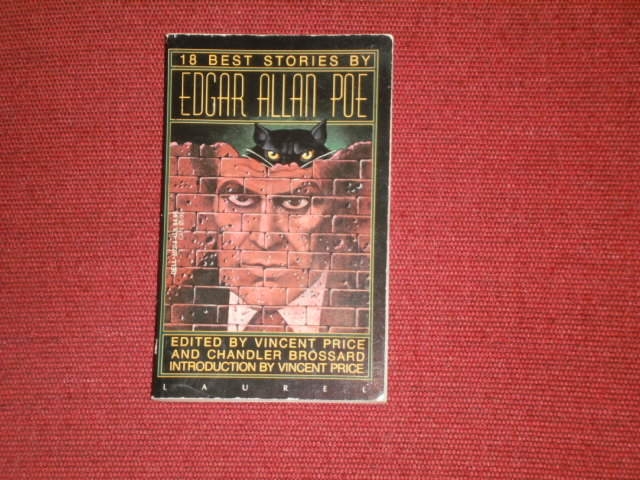
The second encounter with Poe which comes to mind is reading a book of his short stories for eighth-grade English. The stories were cool because of their creepiness, but I got a 72 (or maybe a 74? Anyway, pretty abysmal) percent on the exam that covered them, so didn’t revisit the book for years afterward because it was associated with bad memories. However, I still have it, and just now noticed that it is edited by Vincent Price! Classic. And only $4.95 new.

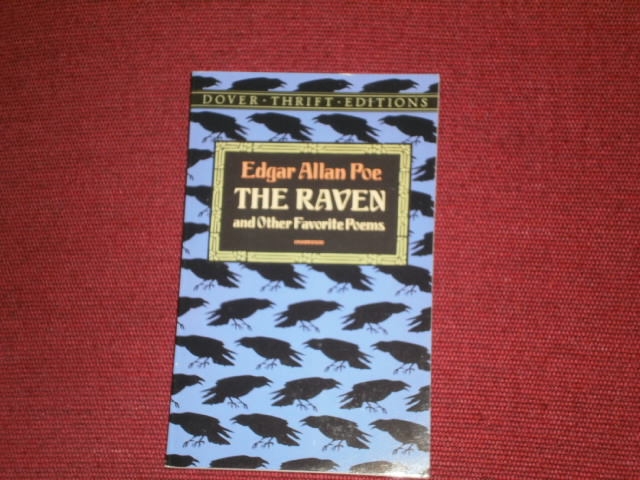
A third strong Poe memory comes from the tail end of my sophomore year of high school. I was in Stratford, Ontario on a school trip to the Stratford Shakespeare Festival (which was a surreal experience, but that is a story for another post). The plays were in the evening, thus we were spending the day browsing Stratford’s shops. I came across a small bookstore and decided to go inside and look for a collection of Poe’s poetry. (Why Poe? Why poetry? I don’t remember my reasons; it was like an unexplainable craving.) This is the earliest instance I can remember of that lovely phenomenon of going into a bookstore wanting a specific book and finding it when you were not sure that you would (Sinclair Lewis’s Main Street and Evelyn Waugh’s Brideshead Revisited are two other examples of this happy synchronicity that I have experienced). In this case, I didn’t even know whether the book I wanted even existed, but there it was, “The Raven” and Other Favorite Poems, for only $1.00.

My fourth major Poe memory, and really the last time I thought about him extensively until this weekend (I taught “Annabel Lee” this past semester, but made my students do the thinking about it), is from three or four years ago when I was playing chess with a friend and he observed that in successful attacks the threat of a crushing move is often stronger and more decisive than its actual execution. He compared this to the threat present in “The Purloined Letter,” where the threat of blackmail resulting from the stolen letter is so strong that those who look for it are out of their heads to the point where they miss that it is on the desk, out in the open. I suppose I must add Poe to that ever-increasing mental list of authors that I need to re-read.

Book Acquired Recently: Amy Abugo Ongiri’s Spectacular Blackness

Ongiri, Amy Abugo. Spectacular Blackness: The Cultural Politics of the Black Power Movement and the Search for a Black Aesthetic. Charlottesville: U of Virginia P, 2010.

One of my research interests within African American literature is the Black Arts Movement, which has been mostly ignored by critics until recent years. Most texts from the movement are electric, enjoyable to read because of their energy and their commitment to political change. I bought Ongiri’s book because of this interest.

Bought on amazon.com.

Nicholson Baker’s U and I

Nicholson Baker’s 1991 long essay U and I on his obsession with John Updike is rife with the smooth, profoundly observational prose which make him one of my favorite fiction writers, though it is also marred by two deficiencies which make it my second-least favorite book of his that I’ve read. (My least favorite is still Room Temperature [which he was completing while writing U and I] because, though the writing is beautiful like his three best works, The Mezzanine, Vox, and The Anthologist in some order, I just don’t care about the premise [a man holding his baby and thinking] because I am not going to have children.)

The first is that Baker claims that women and homosexual men are somehow better suited to writing novels than heterosexual men (and I keep hearing that phrase as “heterosexual white men,” which is hard not to do when thinking of Updike, but to Baker’s credit he doesn’t make that a part of his ridiculous equation). He does admit that he expects to be pilloried for this “sexual determinism,” but mentions it because it is one of the reasons he loves Updike—Updike shows him that heterosexual guys can write fiction, too (137). However, this idea is so, frankly, offensive (1991, everybody!), that it takes away from Baker’s argument that Updike is a genius rather than strengthening it because Baker immediately becomes a less likable persona. The last thing I want to hear as a queer Puerto Rican is how badly heterosexual males have it, especially when the vast majority of authors that have been taught in literature classes (especially when Baker would have been in college) are male.

The second is that it becomes apparent by the end of the book that a significant part of Baker’s motivation for writing it is his own insecurities as a writer. He is haunted by the question of whether he is or will be as good as Updike (for the record, twenty years on I think he’s better than Updike, and I sometimes teach his books while never teaching Updike’s), and while it is legitimate for him to ask this question, it is not one I am interested in reading about because all writers, myself included, have a version of this anxiety. Am I good at all? Is this just a waste of time? Et cetera. Perhaps this element of the book is less onerous to non-writer readers.

Nevertheless, with those two important exceptions, there are some delightful elements of U and I. Here are a few of my favorites:

There is a brief discussion of masturbating to Updike’s sex scenes (19). Baker says that he has not, though he knows people who have. I must admit that one of the elements of Updike’s work which first drew me to him was the eroticism included in his fiction because he happened to be one of the first writers I encountered who wrote openly about sex (the description of the bikinied teenager in his short story “A&P” [which I did, indeed, teach once myself]—so hot when I found it in high school). But fifteen years later his work is laughably vanilla to my jaded tastes.

There are several moments when Baker makes comments about book culture that are delicious. This is my favorite aspect of his writing: it is clear that he loves books as objects as much as I do, and thus pays attention to his interactions with them. For instance, he mentions that in college he would throw the dust jackets of his hardcovers away, wanting them to look like the unjacketed books in college libraries (29). I seriously considered doing this when I was in college, too! But I am now very glad that I never started this practice, and hope that Baker has stopped it. Dust jackets are fun to look at because they vary so widely, and they make finding books on the shelf much easier. Baker also mentions accumulating different editions of books he already has when he encounters them in used bookstores, as I do. Here is his sublime description of the Franklin Library edition of Updike’s Rabbit, Run: “The padded, bright red binding was somewhat more reminiscent of a comfortable corner booth at an all-night, all-vinyl coffee shop” (36). There is also a passage where Baker describes removing the price sticker from books and then putting “it back on because it is a piece of information I will always want to have” (73). Aside from old price stickers on the occasional used book that I acquire, I hate price stickers and always remove them, but I appreciate Baker’s desire to know as much about the object as possible, to remember the individual volume’s history (how much was a copy of Madame Bovary going for in year X?).

Baker observes that “[b]ooks and life interpenetrate” (125), which is exactly correct, and is why reading books is so necessary and enjoyable. They teach us about life and how to live it better. This is why I love Baker’s fiction so much; his ability to observe the minutia of life (including our physical interactions with books) and show its importance is unparalleled.
Book Acquired Recently: Nicholson Baker’s U and I

Baker, Nicholson. U and I: A True Story. 1991. New York: Vintage, 1992.

I am very excited to read this book. Nicholson Baker is one of my favorite writers because his prose flows like hot chocolate syrup, which makes his books virtually impossible to put down. I love his attention to detail and his obsession with book culture, which I share, and which leads to the best, most observant writing about literature in both its physical and intellectual manifestations that I have ever read. This book is about his love affair (well, intellectual love affair, but wouldn’t it be quintessentially Updikean if they had actually had a clandestine physical affair?) with John Updike, a writer who I also like when I’m not feeling guilty for liking him.

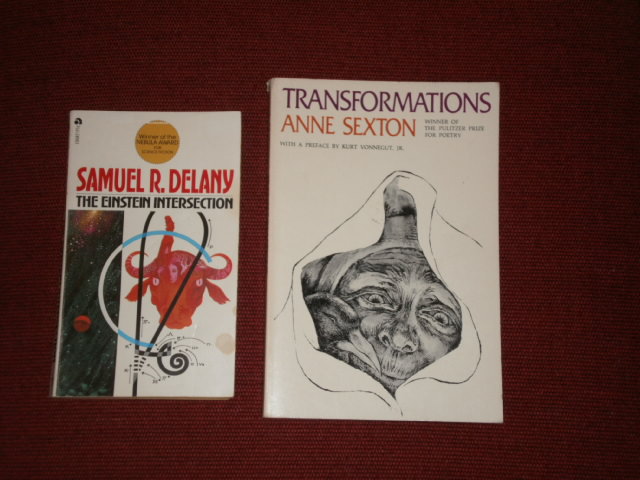
I went through a voracious period of reading Baker’s fiction last fall and winter, and have been getting to his nonfiction here and there. I bought this book to help me reach amazon.com’s $25.00 plateau for free shipping on a recent order (the other book in the order was Samuel R.Delany’s Starboard Wine, which is coming out later this summer). In other words, my book-buying addiction feeds my study of Baker’s book addiction. We addicts have to stick together!


Rooting for the Knicks

With the latest news (it keeps changing! by the time I finish writing this post everything I say might be completely outdated) that the New York Knicks are going to let Jeremy Lin join the Houston Rockets, some people, most notably Bill Simmons, have asked whether it is justifiable for Knicks fans to switch their allegiance to the Nets since they are moving to Brooklyn. Simmons argues that it is justifiable because James Dolan is such an incompetent owner. In response, there is a discussion on grantland.com about the issue:

http://www.grantland.com/blog/the-triangle/post/_/id/32174/dumb-office-arguments-are-knicks-fans-allowed-to-become-nets-fans

As a Knicks fan, I must say that it is RIDICULOUS to even consider becoming a Nets fan at this juncture. Sal Iacono writes in his part of the article that if you live in Brooklyn (i.e., if the Nets are now your “local” team rather than the Knicks), it is justified to switch to the Nets, and I agree,  but this is the only circumstance in which it would be justifiable to switch. Being a fan of a team is about loyalty and history–the team’s, your own, and how they intersect–it’s not about throwing a temper tantrum about a decision you don’t agree with. Lin is an exciting player, but he hasn’t even performed at a consistent level for a year. He is far from a known quantity; it’s not the end of the world that he’ll be with another team.

Katie Baker puts it best in the piece (though her pessimism is a bit hyperbolic), and her words should be heeded by all Knicks fans: “Maybe I’m stubborn, or stupid, or both. But I’m sticking around. I’m going down with the ship, playing “Go New York, Go New York, Go” on a waterlogged and out-of-tune violin. I may be a bitter old biddy by the time the Knicks finally win a post-‘70s title; more likely, I’ll be dead. But I just truly don’t think I could ever imagine it any other way.”

Books Acquired Recently

The Works of Flaubert and Samuel R. Delany’s The Motion of Light in Water

Delany, Samuel R. The Motion of Light in Water: Sex and Science Fiction Writing in the East Village, 1957-1965. New York: Arbor, 1988.

I have the revised edition of this book (published by University of Minnesota Press, 2004), but needed a copy of the first edition for an essay I’m writing on the history of public images of Delany’s body (groovy cover, eh?). Also, I’m a Delany addict, and as I’ve written before, I compulsively collect copies of his books. Bought on amazon.com.

Flaubert, Gustave. The Works of Gustave Flaubert: One Volume Edition. Roslyn: Black’s, 1904.

I was walking around downtown Salt Lake City today and noticed that a new bookstore, Eborn Books, had moved into the old Sam Weller’s location (N.B. The new Weller’s location at Trolley Square is quite inferior, alas). Eborn’s is still very disorganized as a lot of their inventory is either not on the shelves yet or is not in alphabetical order, but I am very glad that the location will remain a bookstore, and the more independent bookstores, the better. I found a collection of Flaubert’s works in their caddywhompus classics section for only five dollars (in very good condition, too). I have two other volumes from the series, Robert Louis Stevenson’s and Jonathan Swift’s, which were given to me by my elementary school music teacher because he knew that I liked to read (as it happens, Treasure Island was my favorite book as a boy, and I need to find time to re-read it).  I’ve been looking for a copy of Madame Bovary since I read John Irving’s  In One Person several weeks ago, in which the main character is advised to read Flaubert’s classic “when your romantic hopes and desires have crashed, and you believe that your future relationships will have disappointing–even devastating–consequences” (277). This is exactly how I have been feeling lately, thus I am interested to see what wisdom I might glean from the novel.


Left Field Cards and Some Thoughts on Obsession

I just read an article by Paul Lukas (http://espn.go.com/blog/playbook/fandom/post/_/id/6053/the-coolest-baseball-cards-of-the-year) about Left Field Cards (http://www.leftfieldcards.com/index.html), an art project by Amelie Mancini that consists of quirky sets of baseball card-esque postcards. I love paper culture, and I love baseball, and I love the nostalgia evoked by baseball cards (I collected them avidly as a boy), so I absolutely love these cards! Their retro style is aesthetically pleasing, and I appreciate their hand-made quality. I also like that Mancini has depicted four Mets (Keith Hernandez, Dwight Gooden, Nolan Ryan, and Kevin Mitchell) in only thirty cards.

But what I especially love about Left Field Cards is the inspiration for the project. Mancini’s biographical statement reads in part that

“She moved to New York in 2006 and didn’t know what a curveball was until a couple of friends took her to Shea Stadium one evening of [sic–Mancini’s slight misuses of English make her story even more lovable] 2007. The Mets lost that night to the Phillies, but Amelie fell hard for America’s national pastime, becoming increasingly obsessed with the game and eventually making it one of the center themes of her work. Fascinated by baseball cards, she decided to print her own and started Left Field Cards in 2011.”

I am always drawn to stories of people’s obsessions, and I think that the tale of Mancini’s discovery of baseball is beautiful (Lukas’s article gives further details). For many years as a teenager and younger adult I was jealous of stories like hers, of people who just had a passion grip them completely and let it become Their Thing. I wanted the same kind of experience; I was obsessed with finding an obsession (Sorry! I couldn’t help myself.). It took me way too long to realize that I already had an obsession–books, both reading and collecting them. So now I worry about cultivating my obsession instead of acquiring one, but I still find stories of other people’s obsessions powerful. It feels like we are part of a club, that even if I know nothing about the subject of someone else’s obsession, I know a little something about them and how they feel. There is a sense of community that forms via these stories, and making connections to one another is one of the essential aspects of living a satisfying life.

Giannina Braschi’s Yo-Yo Boing!

The Puerto Rican-American writer Giannina Braschi’s 1998 novel (this is the best term I can think of for it, though it is only a novel insofar as that term is now so all encompassing, like a giant, shaggy literary beast somewhere between Cookie Monster and Grendel that devours everything in its path) Yo-Yo Boing! (translated into English by Tess O’Dwyer) is a gripping pastiche of a book that is all about voice rather than plot. The bulk of it is a dialogue between unnamed voices, sometimes between two fairly recognizable personas (a woman and man), sometimes between two indestinct personas that are apparently different than the first two (gender unclear), sometimes between at least three personas that are different than all of those which have come before (at least two of them are women). But the rapid-action dialogue is interesting no matter who is speaking. The dialogue meanders from discussions of poetry to discussions of Puerto Rican politics to discussions of academic politics to discussions of bodily excretions, circling back through these topics several times. The last line is “God, who is dead!”, so the book falls firmly into the postmodernist anti-universal narrative camp. The style is like a Puerto Rican Kathy Acker mixed with some James Joyce mixed with some Ernest Hemingway mixed with just a dash of Samuel R. Delany. This hodgepodge might alienate many readers, but I really enjoy it, and look forward to reading more of Braschi’s work.

Books Acquired Recently

Dahl, Roald. The Wonderful Story of Henry Sugar and Six More. 1977. New York: Puffin, 2010.

I just received a desk copy of this in my school mail today. I’m teaching it this fall in my Introduction to Literature course as an example of one of the reasons we read literature–for fun. Dahl’s short stories for adults are decent, but “The Wonderful Story of Henry Sugar” is magnificent, it keeps me enraptured every time I read it.

Weinstein, Lawrence. Writing Doesn’t Have to Be Lonely: 14 Ways to Get the Help of Other People When You Write. Cambridge: OneOfaKind, 2012.

I received this as an exam copy from the publisher. It is the kind of handbook that I tend not to assign students because I’d rather have them spending their limited textbook funds on literature instead, but I am interested in reading this book for myself because one of my flaws as a writer is that I have a very difficult time asking for and listening to feedback from others. Learning new strategies for being proactive about this issue will be a big help.