I’ve written here before about Paul Lukas’s Uni Watch site, which is a daily stop in my internet wanderings. One of the reasons I love Uni Watch is that Lukas’s material aesthetic is very close to mine: he’s obsessed with fine craftsmanship, enjoys older objects, and has an eye for fine detail (and, like me, is a Mets fan and likes Nicholson Baker’s The Mezzanine!). Today’s column is one in a series where he answers questions from readers about himself, and it’s worth checking out because it epitomizes what a thoughtful, intriguing person he is.
Books Acquired Recently
Kane, Daniel. All Poets Welcome: The Lower East Side Poetry Scene in the 1960s. Berkeley: U of California P, 2003.
I am a major fan of the New York School of Poets (John Ashbery, Kenneth Koch, Frank O’Hara, James Schuyler, et al.) and its descendants. Kane’s book covers both groups, so I bought it to read for fun.
McNeill, Elizabeth. Nine and a Half Weeks: A Memoir of a Love Affair. 1978. New York: Harper, 2005.
I recently learned about this book when a friend posted an article about it on Facebook which mentions that the author went to my alma mater/my friend’s former employer, Goshen College. This fact was not enough for me to buy the book, but its subject matter–bondage, a scholarly interest of mine–was.
Millay, Edna St. Vincent. A Few Figs From Thistles. 1922. Fayetteville: Juniper Grove, 2008.
I enjoy poetry, but have read very little of Millay’s work. I read about this collection in an essay on Greenwich Village in the 1920s that made the book sound delightfully scandalous, and since I hadn’t bought any poetry in a while I decided to buy it.
Both this and McNeill’s book bear a note on the final page that they were printed on 2 December 2012 in San Bernardino, California. This has also been the case with other lesser-known books that I’ve ordered from amazon.com (Walter Abish’s Alphabetical Africa immediately comes to mind). On the one hand, it is wonderful that publishing technology has advanced to the point where books are able to stay “in print” even when they have not actually been printed yet because more books are able to remain available to readers, which is a good, important thing. But it also helps large retailers such as amazon, who have the facilities to print the books on-site, save on warehousing costs, which gives them a competitive advantage over brick-and-mortar bookstores. This is a bad thing.
All books bought via amazon.com.
Writing About Black Sexuality
A friend passed along this article by Stacey Patton from The Chronicle on Higher Education. It provides a helpful summary of the ever-growing history of the intersection between Black Studies and queer theory. This dialogue is a crucial one for my work on Samuel R. Delany, thus it is pleasing that others outside of the (very small) field are beginning to notice it.
Reality Imitating Art
I went to the dentist this morning. As I was lying prone in the chair in pain, I thought of Frank Norris’s novel McTeague, in which the title character is a dentist whose grip is so strong that he is able to extract teeth with his bare hands. Later in the visit, I received a lecture that I’ve been given before about how I should really be using an electronic toothbrush rather than a manual one, and I thought about how the hygienist probably thinks of me as a “difficult” patient for not heeding her advice. This thought reminded me of the Seinfeld episode where Elaine gets labelled “difficult” by her doctor. When she complains, she gets blacklisted by all of the doctors in the area. As I grumpily made my way home after the appointment, the first line of Shel Silverstein’s poem “Hurk” surfaced out of my childhood memories: “I’d rather play tennis than go to the dentist.”
This experience struck me because I realized that I wasn’t using any original thoughts to analyze it, but simply relied on art to do the analysis for me, to tell me how to feel. It is important to see how art relates to real life (whatever that means; as David Shields writes in Reality Hunger: A Manifesto, “reality… is the one word that is meaningless without quotation marks” [4]), but it becomes dangerous when we let art (or, more broadly, the simulated reality of pop culture) mediate all of our experiences for us.
Harvard Kink
An article on CNN.com reports that Harvard has just approved a student club for students who are interested in “kinky sex.” Kudos to both the students behind the club for organizing publicly and to the school for recognizing that non-vanilla sex (which does not just encompass BDSM, but also includes various fetishes such as watersports, podophilia [an attraction to feet], and so on) is not somehow “sick” or dangerous, and that it has no effect on those who choose not to participate. This kind of openness toward forms of uncommon sexual practices by consenting adults is necessary in order to eradicate systemic violences such as sexism and homophobia because any type of Othering of those who are not white male vanilla heterosexuals plays a part in these (and other) interrelated oppressions. American culture has a long way to go to become sexually healthy, but events such as this one show that there is hope for the future.
Visiting Robert Smithson’s Spiral Jetty
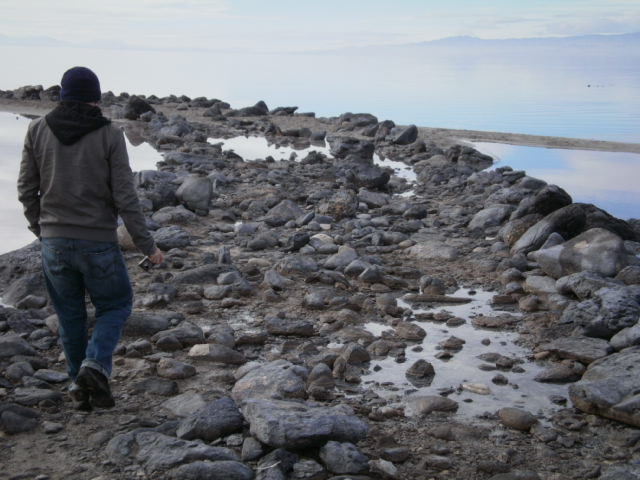
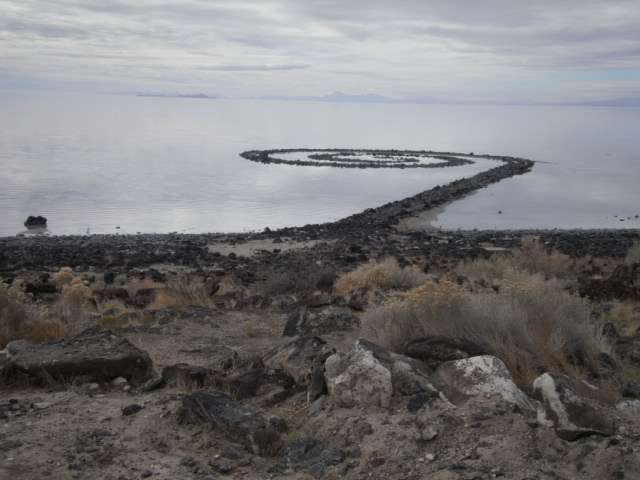
Today with three friends I visited Robert Smithson’s Spiral Jetty, a piece of land art near Corinne, Utah, that was built on the shore of the Great Salt Lake in 1970. It was an amazing experience! I had seen numerous pictures of the Jetty in art history textbooks, but it was wonderful to get to experience it for myself. The scenery surrounding the piece is beautiful (the sky is amazing in many of the photographs below), though it is made even more sublime by the presence of Smithson’s work, which is made out of natural materials while simultaneously epitomizing the artificial. The Jetty would still be a fascinating landscape if it had somehow appeared organically out of the lake, but I appreciate it more because it is, in fact, an intentional something, because it is art, because it is artificial. It makes the lake–which is impressive-sounding until you actually see it and realize that it is this weird, uncategorizable entity of liquid death, neither lake nor sea–more interesting. It is in the lake, but not of it. Anyone who has the chance to see it should. It is a worthwhile trip, one of the most exciting things I’ve done in years.
What follows are some selected photographs of the Jetty that I took while exploring it. They move in chronological order from arriving in the small parking lot just above the piece through walking onto the Jetty and around it to the extent possible (the innermost swirl was enough underwater to be unwalkable, though it was still visible) to walking back toward the parking lot. At the beginning of the day it was overcast, but several hours later when we returned to the car it was wonderfully sunny, as can be seen in the final photograph.


Books Acquired Recently
Baker, Houston A., Jr. Blues, Ideology, and Afro-American Literature: A Vernacular Theory. Chicago: U of Chicago P, 1984.
This is a classic in the field of African American literary studies which keeps popping up in my reading, so I figured it was time to finally break down and read it.
Bought from Better World Books via amazon.com.
Duvall, John N., ed. The Cambridge Companion to American Fiction After 1945. Cambridge: Cambridge UP, 2012.
This is another book that I ordered at Rocky Mountain MLA last month. I have enjoyed other volumes in the Cambridge Companion series, and American literature after 1945 is my academic specialty, thus I did not need any extra persuasion when I had the opportunity to buy the book at a discount. I am especially excited to read the “Fiction and 9/11” chapter, though the entire collection looks enjoyable.
The New Site Photograph
I just updated the main photograph for the site (what Facebook would call the “cover photo”). It is a picture of one of my favorite shelves in the poetry section of my library. The photograph includes some of my favorite poets and one of my favorite books of poetry, William Blake’s Songs of Innocence and of Experience, which is a beautifully reproduced combined volume of Blake’s engravings for Songs of Innocence and Songs of Experience published by Oxford University Press.
Blake is followed on the shelf by Di Brandt, my second favorite poet after Frank O’Hara. I have all of her books (her first collection, questions i asked my mother, is still my favorite), as well as a selection of her poems edited by Tanis MacDonald. Gwendolyn Brooks is next. Her Selected Poems only goes through 1963, so I have several of her later collections as well, which I enjoy not only for their content but also aesthetically, as I am a collector of old Broadside Press volumes.
Sterling A. Brown’s Collected Poems, which I read for my Ph.D. exams and thus feel sentimental towards, follows. Ana Castillo’s My Father Was a Toltec and Selected Poems contains some enjoyable work, although I prefer her fiction.
Other highlights on the shelf are C.P. Cavafy’s Complete Poems, which I enjoy because of their unabashed homoeroticism, and Sandra Cisneros’s Loose Woman, which is one of the best single collections of poems that I’ve ever read. I read a lot of Lucille Clifton when I first began investigating poetry, and think of her fondly even though I haven’t returned to her work for some time.
Brief Thoughts on Fiction in America
I mentioned in a post on 15 November that I’m currently serving on the search committee for a job opening in my department. The position is for a fiction writer, so I’ve been reading lots of short stories which serve as the candidates’ writing samples. Much of the fiction is quite good, which is comforting because it shows that American literature is in a good place and that there is an up-and-coming generation of writers who will help it continue to thrive.
However, virtually all of the stories that I’ve read thus far–both realist and speculative, and by both whites and persons of color and across genders–have been about alienation, about failing relationships, about characters who have enough material goods to be happy, but are not. While it is true that it is usually more interesting to read about imperfect characters and scenarios than their opposite (e.g., the American literature from the 1950s that has lasted is also mostly about these themes), this trend gives me pause because of what it says about the current state of American life. What does it mean when the people who should be happiest because of their level of education and wealth remain dissatisfied?
Obviously this is not an original question, and the political side of me immediately wants to answer “Of course people aren’t happy! Capitalism has rotted their souls!” or something like that, but nevertheless it is always troubling when I am again reminded of it. It is difficult not to think that America is heading for a painful reckoning sometime soon. This status quo can’t last.
Books Acquired Recently
Kroll, Eric, ed. The Art of Eric Stanton: For the Man Who Knows His Place. Cologne: Taschen, 2012.
This book collects many of Stanton’s erotic drawings from the 1950s and 1960s, many of which appeared in Irving Klaw’s publications (Klaw is the man who made Bettie Page famous). It fits perfectly with my scholarly interests in the history of print culture and the depiction of sexuality in literature. In flipping through the book, it is clear that it reaches Taschen’s usual high production standards. I look forward to perusing it further.
Bought on amazon.com.
Léger, Tom, and Riley MacLeod, eds. The Collection: Short Fiction From the Transgender Vanguard. New York: Topside, 2012.
I attended a reading featuring six of this book’s contributors last night, and it was probably the most enjoyable reading I’ve been to in the past decade. The stories were both funny and powerful, and the collection is apparently the first collection of transgender fiction to be published in the United States (which is surprising, but that’s what the editors claim), so I was happy to buy it. The best part of the evening was discovering that one of the contributors, Casey Plett, was raised Mennonite in Manitoba! It is always exciting to discover new Mennonite authors, but it is especially exciting to discover new queer Mennonite authors because I am currently working on an essay about the intersection between queer theory and Mennonite literature.