Books Acquired Recently: MLA Edition

Today I made my long-anticipated visit to the MLA Convention book fair. I acquired five books and ordered several more that will be shipped to me, which I will write about once I receive them. All of the books interest me, but the fact that I got several of them at a discount made them irresistable. I noticed that the majority of the publisher representatives at the fair were women, and especially younger women who looked to be in their twenties. This trend was especially pronounced in representatives from commercial publishers. My perhaps cynical thought upon making this observation was “this is where excess English majors end up.” But that’s not quite fair. I suppose that the job would be a fascinating and even enjoyable one. On the one hand it’s just being a cashier, but on the other, it involves travel and the opportunity to meet lots of people.

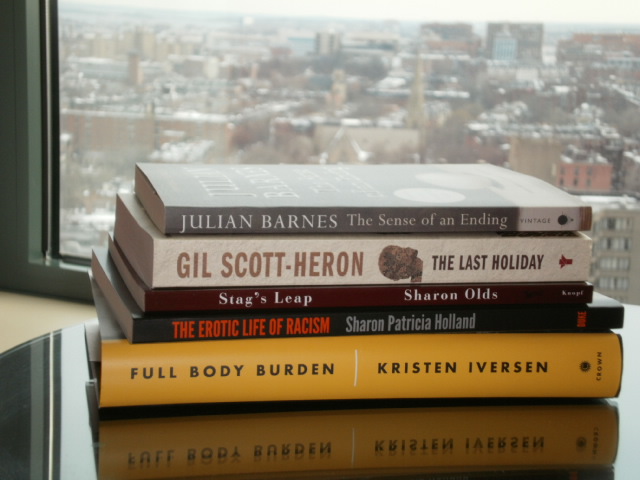
The books that I acquired at MLA with the view of downtown Boston from my hotel room window in the background.

Barnes, Julian. The Sense of an Ending. 2011. New York: Vintage, 2012.

I’ve heard good things about Barnes’s work and read a laudatory review of this novel when it was published in hardcover, thus I was happy to buy the paperback for only $3.00.

Holland, Sharon Patricia. The Erotic Life of Racism. Durham: Duke UP, 2012.

This book’s blurb begins “A major intervention in the fields of critical race theory, black feminism, and queer theory….” Boom. I was sold right there. (Yes, I realize that I am a total nerd.) Duke University Press publishes so many yummy books about queerness and about race that it was very difficult to restrain myself from buying many more of their books. There was a history of the concept of the orgasm that was especially tempting to me, but I was able to resist.

Iversen, Kristen. Full Body Burden: Growing Up in the Nuclear Shadow of Rocky Flats. New York: Crown, 2012.

The publisher was giving hardcover copies away for free, and Iversen was there to sign them, so I picked one up. It looks somewhat interesting–it is about her childhood growing up in one of the classified towns the U.S. government set up in the 1940s and 1950s for nuclear weapons research and development. I’m not sure how I as an author would feel about my publisher giving my books away for free while making me sit there and watch. Does the publisher think no one will buy them, and so this is a PR-friendly way of getting rid of them? Do they think the book is so good that they can give it away to professors because we’ll all want to assign it in our classes? I admit to being confused by this promotion.

Olds, Sharon. Stag’s Leap. New York: Knopf, 2012.

I love Olds’s poetry and was able to buy her latest collection for only $3.00. This price makes me happy, but it is also a shame to pay so little for something so valuable as poetry.

Scott-Heron, Gil. The Last Holiday: A Memoir. New York: Grove, 2012.

I’ve been fascinated by Scott-Heron since I heard his two most famous songs/poems, “The Revolution Will Not Be Televised” and “Whitey on the Moon” back in high school. His art is so wise, and yet he struggled with an addiction to heroin up until the time of his death. Getting the opportunity to learn more about this paradox alone makes the book worth the $5.00 I paid for it.

MLA

I am currently at the MLA Convention in Boston. MLA is always a fun time; it’s a total geek-fest. While the various sessions are interesting, people watching is my favorite convention activity (aside from browsing at the book fair, of course). I love that eighty percent of the attendees–including myself–are dressed in black, I love the multitude of nerdy glasses, I love the vibe of slight social awkwardness that people exude, I love the covert badge-checking that goes on, I love the diverse range of ages represented, I love playing a guessing game with myself about why each person is at the conference–presenter? interviewee? observer?

One trend I’ve noticed this year which was not nearly as pronounced when I attended two years ago (or, indeed, even when I went to Rocky Mountain MLA three months ago) is that many people read their papers directly from their laptops rather than from a paper copy. This possibility would never occur to me. I am just that old school.

I’ll write more in the next day or so once I get a chance to visit the book fair, which does not open until tomorrow.

Books Acquired Recently: Holiday Edition

My family exchanged gifts today rather than on the 25th. Here is a list of all of the books I was fortunate enough to receive:

Bechdel, Alison. The Essential Dykes to Watch Out For. Boston: Houghton, 2008.

I read an article in the New Yorker about Bechdel earlier this year and decided that I wanted to check out her work. I look forward to reading through the comic strip that put her on the public radar.

Eagleton, Terry. The Event of Literature. New Haven: Yale UP, 2012.

I don’t always agree with Eagleton, but I enjoy his work because it is at the very least thought-provoking. His latest book sounds interesting.

Glimcher, Mildred L. Happenings: New York, 1958-1963. New York: Monacelli, 2012.

I am very interested in the New York art and literary scene of the 1950s-1960s, and this book documents how artists of the time were stretching the boundaries of what “art” could be and how it related to performance.

Jones, Hettie. How I Became Hettie Jones. 1990. New York: Grove, 1997.

I’ve done writing about Jones’s ex-husband, Amiri Baraka (formerly LeRoi Jones), and, as I mention above, I am interested in their artistic millieu, so I’ve been wanting to read this memoir for a while.

Jones, L.H. The Jones Second Reader. Boston: Ginn, 1903.

This book is one of my grandfather’s old school books that he kept until his recent death. I am honored to have it in my possession.

Marshall, Ian. Class of 92: The Official Story of the Team That Transformed United. London: Simon, 2012.

I became a Manchester United fan in 1991 as an eleven-year-old, just before their greatest generation of players began taking the pitch. I am very excited to read more about their time before they broke into the first team.

Shaw, Lytle. Frank O’Hara: The Poetics of Coterie. Iowa City: U of Iowa P, 2006.

As I’ve written here before, O’Hara is one of my favorite poets, so I acquire books about him rather compulsively.

Swartz, Ted. Laughter is Sacred Space: The Not-So-Typical Journey of a Mennonite Actor. Harrisonburg: Herald, 2012.

Swartz is an actor whom I have met and seen perform several times. As a side note, Herald Press’s headquarters was in Scottdale, Pennsylvania for its entire history until just recently. I was shocked when I looked at the copyright page and saw that they have moved.
My Grandfather’s Diary

My maternal grandfather died peacefully two weeks ago, and going through his things the family discovered that he had kept a diary for much of his life. It is surprising that he lived to be 96 and no one knew that he engaged in this practice. He wasn’t being secretive about it; he was just a humble man who didn’t realize that other people would be interested.

Last night I read through the volume which describes his time living in Boston while he completed his Master’s degree in Public Relations at Boston University in the late 1950s. Reading this document was fascinating not only because I learned more about his life, but also because it was interesting to hear about what life as a graduate student was like fifty years ago.

His wife and children were living in Virginia while he studied up north during his sabbaticals from Eastern Mennonite College (now University), so to make money for his living expenses in Boston he worked various odd jobs. These included typing up other students’ dissertations (he was an excellent typist and typed everything, including the check he gave me for my high school graduation), packing boxes of Christmas ornaments, and selling his blood. He got paid between $15.00-$30.00 for this last activity—an excellent rate when one takes inflation into account. For a while he lived at the YMCA, and later rented a room in a boarding house. He also rented a typewriter instead of bringing his own from home, which I found puzzling considering that it was such an important machine for him. He admits to skipping a class every once in a while in order to get a paper or project done for another class. I guess that bad student habits are timeless!

My favorite detail from his time in Boston is that he planned to go to a Celtics game against Philadelphia during the 1959-60 season just for something to do even though he was not a sports fan. I love that he tried to take full advantage of all of the experiences that living in a big city offered him when he had the chance (up to that point he had only lived in small rural communities: Greencastle, Pennsylvania, a brief time in rural Kentucky, and Harrisonburg, Virginia). If he had attended the game, he would have seen two of the greatest players of all time, Bill Russell and Wilt Chamberlain, engaging in one of the best one-on-one rivalries of all time during the season in which Wilt (one of the first NBA stars to achieve “first name only” status: Wilt, Oscar, Kareem, Magic, Shaq, Kobe, LeBron…) averaged over 37 points per game as a rookie. My grandfather almost certainly did not realize the importance of the matchup, but it is neat to think about him going to the game, anyway.

However, in looking up the game in question, it appears from evidence in the diary that he did not actually attend the game. The entry for “Thursday, December 3 [1959]” states that he “Got ticket for Boston Celtics-Philadelphia basketball game next week.” The only time the two teams played the following week was on December 9 (here is the boxscore). The entry for that day reads in part that he “Got telegram saying Papa was seriously ill. Called Gladys [his sister who was still living on the family farm] in evening. Worked part of evening. Sent card to Papa and took a walk.” So apparently the news that his father was ill (he died on January 17, 1960) concerned my grandfather enough that he did not use his ticket. This decision is, of course, understandable, and it was special to read his entries from the time of his father’s illness and death while I spend time with my mother as she continues to grieve his death.

Thoughts on the R.A. Dickey Trade

Barring a failed physical this afternoon, the Mets will trade R.A. Dickey to the Blue Jays for several blue chip prospects. Rany Jazayerli explains in an article on grantland.com why this is a bad move for the Mets, but I think it is a reasonable move for the Mets (and for the Blue Jays, though as a Mets fan I’m not concerned about their end of the deal) because of the two teams’ 2013 context, which Jazayerli does not consider. The Mets will probably not be contenders this coming season. Therefore, while Dickey will probably be a better player in 2013 than Travis d’Arnaud, the main prospect who the Mets will receive (though there’s a good chance d’Arnaud will immediately be an improvement for the Mets at catcher), over the long haul d’Arnaud is likely to be more valuable. The trade makes sense for the Blue Jays because they are built to win now and Dickey helps in that regard, and it makes sense for the Mets because they are focused on the long-term. I am sad to see Dickey go and will root for him except for the rare occasions when the Mets and Blue Jays play an interleague series, but I feel good about the trade.

Zadie Smith on Music and Obsession

Zadie Smith has an article in the 17 December 2012 issue of the New Yorker about her journey to appreciating Joni Mitchell’s work in which she also offers some thoughts on being a connoisseur of various art forms. Smith writes that she distrusts those who claim to be true connoisseurs of more than one form, noting that the novel is her obsession and that she can’t imagine having an equal affinity for another genre even though she enjoys music. She offers her ignorance of Mitchell’s oeuvre as an example of how devotion to one form results in what may seem to be embarrassing blind spots in one’s knowledge of another.

This article resonated with me because I have had a similar relationship with literature and music. Books are my obsession, but another smaller obsession is my fascination with people who have obsessions about something, especially music. I have always been a little jealous of them. Smith describes coming across a Talking Heads album in a record store and being “gripped by melancholy, similar perhaps to the feeling a certain kind of man gets while sitting with his wife on a train platform as a beautiful girl–different in all aspects from his wife–walks by. There goes my other life” (33, Smith’s italics). This passage expresses my feelings about music perfectly. One of my favorite fictional/movie characters is Rob from High Fidelity because of how obsessed he is with both music itself and its physical manifestation in records (though unlike Rob, who owns a record store, I could never run a bookstore because getting rid of the books would be too painful even though they would only nominally be “mine”).  I enjoy music, but I rarely listen to it because I have little time to do so. I am unable to listen to it while multitasking except for when I wash dishes or, sometimes, cook, and the vast majority of my free time is spent reading.

My version of Smith’s ignorance of Mitchell (whom I, too, have little experience with, though I like the work of hers that I’ve heard, and have had “River” [the title of which, I admit, I had to look up online] in my head for the past few days) is my lack of interest in Prince. I know everyone thinks he is great, and I have tried to listen to his music, but it just doesn’t click for me. I suppose this would be an argument against the idea that there is a universal standard of aesthetic quality.

Books Acquired Recently: Queerness and Race

Reid-Pharr, Robert. Once You Go Black: Choice, Desire, and the Black American Intellectual. New York: New York UP, 2007.

Somerville, Siobhan B. Queering the Color Line: Race and the Invention of Homosexuality in American Culture. Durham: Duke UP, 2000.

Stockton, Kathryn Bond. Beautiful Bottom, Beautiful Shame: Where “Black” Meets “Queer. Durham: Duke UP, 2006.

I bought these three books for my research on Samuel R. Delany, who is both one of my favorite authors and one of my favorite research subjects because of the way sexuality and ethnicity converge in his work. I am interested in the books because they will help me to understand this intersection better. I am especially excited about Reid-Pharr’s book because he has also written about Delany, but all three look enjoyable and thought-provoking.

They were all bought on amazon.com.

Paul Lukas’s Fascination With Interesting Things

I’ve written here before about Paul Lukas’s Uni Watch site, which is a daily stop in my internet wanderings. One of the reasons I love Uni Watch is that Lukas’s material aesthetic is very close to mine: he’s obsessed with fine craftsmanship, enjoys older objects, and has an eye for fine detail (and, like me, is a Mets fan and likes Nicholson Baker’s The Mezzanine!). Today’s column is one in a series where he answers questions from readers about himself, and it’s worth checking out because it epitomizes what a thoughtful, intriguing person he is.

Books Acquired Recently

Kane, Daniel. All Poets Welcome: The Lower East Side Poetry Scene in the 1960s. Berkeley: U of California P, 2003.

I am a major fan of the New York School of Poets (John Ashbery, Kenneth Koch, Frank O’Hara, James Schuyler, et al.) and its descendants. Kane’s book covers both groups, so I bought it to read for fun.

McNeill, Elizabeth. Nine and a Half Weeks: A Memoir of a Love Affair. 1978. New York: Harper, 2005.

I recently learned about this book when a friend posted an article about it on Facebook which mentions that the author went to my alma mater/my friend’s former employer, Goshen College. This fact was not enough for me to buy the book, but its subject matter–bondage, a scholarly interest of mine–was.

Millay, Edna St. Vincent. A Few Figs From Thistles. 1922. Fayetteville: Juniper Grove, 2008.

I enjoy poetry, but have read very little of Millay’s work. I read about this collection in an essay on Greenwich Village in the 1920s that made the book sound delightfully scandalous, and since I hadn’t bought any poetry in a while I decided to buy it.

Both this and McNeill’s book bear a note on the final page that they were printed on 2 December 2012 in San Bernardino, California. This has also been the case with other lesser-known books that I’ve ordered from amazon.com (Walter Abish’s Alphabetical Africa immediately comes to mind). On the one hand, it is wonderful that publishing technology has advanced to the point where books are able to stay “in print” even when they have not actually been printed yet because more books are able to remain available to readers, which is a good, important thing. But it also helps large retailers such as amazon, who have the facilities to print the books on-site, save on warehousing costs, which gives them a competitive advantage over brick-and-mortar bookstores. This is a bad thing.

All books bought via amazon.com.

Writing About Black Sexuality

A friend passed along this article by Stacey Patton from The Chronicle on Higher Education. It provides a helpful summary of the ever-growing history of the intersection between Black Studies and queer theory. This dialogue is a crucial one for my work on Samuel R. Delany, thus it is pleasing that others outside of the (very small) field are beginning to notice it.