Euro 2012: The First Round of Matches

All 16 teams have now played one match at Euro 2012, and it has been a rather entertaining tournament thus far. Here are some thoughts on each of the groups:

Group A

Poland were lucky to escape with a draw against Greece in a crazy match that saw both sides reduced to ten men and Greece miss a penalty. Russia evicerated the Czech Republic 4-1, a scoreline that might have even flattered the Czechs. Poland are sentimental favorites as co-hosts, but they have a very difficult test in their second game against Russia, who can all but clinch a second-round birth with a win. I expect Greece to beat the Czechs, as the Greeks will not want to let their survival rest on getting three points in their final match with the Russians.

Group B

The “Group of Death” provided the most surprising result in the first set of matches with Denmark beating Holland 1-0. This result, coupled with Germany’s 1-0 win over Portugal, means that the group could be decided after its second set of games on Wednesday if Germany beat Holland and Denmark beat Portugal. I would be very surprised if either of those two outcomes occur, though, as Holland and Portugal have enough in them to at least take some points and keep themselves alive.

Group C

The clash between Spain and Italy was the best match of the tournament thus far, with the 1-1 result fair even though both sides could have scored more. I was impressed by how well Italy played; I picked them to get eliminated in the group stage, but they look like they will prove me wrong. Croatia’s 3-1 win over Ireland was the most boring match thus far. The Irish never really looked in it and Croatia looked uninspiring even though they did a good job of taking their chances. Italy should be able to defeat them in the next match, and I doubt that Ireland will threaten Spain.

Group D

This is the Group of Death-lite because of the presence of the other co-host, Ukraine, who scored an exciting 2-1 victory over Sweden today. The Ukrainians certainly look like they can take points off the French in their next game. The 1-1 draw between France and England was a fair result, and bodes well for the English. Their match with Sweden will be one that both sides will be trying to win, Sweden because they are desperate for points and the English because they will not want the task of needing a win against Ukraine in their final group match, which should lead to some fun end-to-end action.

Theodora Keogh’s Meg

I just finished reading Theodora Keogh’s 1950 novel Meg, which is about the eponymous protagonist’s struggles with her entrance into womanhood in the year before she turns thirteen. I am generally not a fan of books that are primarily about children (two major exceptions are Jonathan Safran Foer’s Extremely Loud & Incredibly Close and Miriam Toews’s The Flying Troutmans), but Meg is a thought-provoking, well-written book. It is a cross between Judy Blume and Lolita, with the salacious bits just titillating enough to keep the reader’s attention without causing them too much worry about Meg’s fate, and the more innocent parts genuine enough as to not verge into sappiness.

What impresses me most about the novel is how prescient it is about the enforced conformity of the decade that followed its publication. Nothing much scandalous happens (There are constant hints that something will–Will Meg be seduced by her best friend’s father? Will she be kidnapped by a child molester? and so on–but the only time the book lives up to its luridly suggestive cover is when Meg loses her virginity to a slightly older boy, an experience that is neither pleasurable nor traumatic for her. Her description of the experience is beautifully profound: “‘What did it feel like?’ She thought a moment as she buttoned on her blouse. ‘Well, it was as if there was no place and you were making one, only you never quite got to make it.'” [95]), but the book feels subversive simply because it portrays characters who are unsatisfied by the roles society assigns them and want something more. Unfortunately, as is par for the course in most 1950s pulp fiction, most of the characters are punished for their differences. The prostitute Miss Tracy is murdered by her pimp, and Meg blackmails her history teacher when she finds out that she is a lesbian in order to get a passing grade. Aside from this one act, though, the reader roots for Meg, and she happily gets through the book relatively unscathed, albeit wiser, and the reader knows that she won’t grow up to be the kind of adult drone which the novel writes against.

“The Wake-Up Bomb” at the 1995 MTV Music Awards

Here’s a link to R.E.M.’s performance of “The Wake-up Bomb” at the 1995 MTV Music Awards (oh those halcyon days when MTV mattered/was relevant to music)*:

http://www.youtube.com/watch?v=GLhZN6dwnEY

I remember watching it on television at the time and being a) disappointed, because I had never heard the song before since it hadn’t been released yet–I was expecting them to play something from their latest album, Monster (remember that in the early days of the internet, and really before youtube, it was A HUGE DEAL to get to see your favorite band perform on television); and b) a little confused by the fact that Michael Stipe was wearing eyeliner, but assuming that he was doing it just because it was his job as a rock star to do weird things. In hindsight, I think it was the first time I had ever seen a man wearing make-up, and I remember my father commenting to me that it bothered him that the lead singer of my favorite band wore make-up and was thus hinting at cross-dressing, just like a few years earlier he had expressed his displeasure when I was listening to U2’s Achtung Baby because there was a picture of Bono wearing a dress in the liner notes. (Actually, now that I just typed that sentence, that picture of Bono is the first time I saw a man wearing make-up because he also has lipstick on. But the dress was more noticeable!). As such, watching this performance was a seminal experience for me because it was an early instance of me slowly learning that not everyone fits into the heterosexual mold (the earliest example of this was when I was nine and read Martina Navratilova’s autobiography, which is where I learned what lesbians are). These instances were very difficult to come by growing up in a conservative Christian household. Soon thereafter I learned that Stipe was bisexual, which at the time only signified to me why he wore make-up, but later on in my life when I realized that I was bisexual it was neat to know that there were public role models for me to look toward.

I like “The Wake-up Bomb” now, though it is a guilty pleasure because it is so pop-y, not as sophisticated as most of the rest of R.E.M.’s early stuff (“early R.E.M.”=when Bill Berry was still with the band, i.e., all of their albums through New Adventures in Hi-Fi. With the exception of their greatest hits album In Time, I pretend that later R.E.M. never existed.), and it is one of the weaker tracks on New Adventures in Hi-Fi, which is an underrated album. But every time I hear it I think about that first performance.

* This post is going to overuse parentheses.

Some Thoughts on the Role of Pop Culture in Teaching Us How to Live

One of my favorite film scenes is when Rob (John Cusack) asks in High Fidelity

“What came first, the music or the misery? People worry about kids playing with guns, or watching violent videos, that some sort of culture of violence will take them over. Nobody worries about kids listening to thousands, literally thousands of songs about heartbreak, rejection, pain, misery and loss. Did I listen to pop music because I was miserable? Or was I miserable because I listened to pop music?”

This is an excellent question, because it’s true that we learn a lot about how to act in relationships from the narratives we encounter, whether in songs, books, or films. The more of our own experience we have, the more we are able to view these narratives with a critical eye, judging which of them contain the most truth about love. But they can really mess you up if you are impressionable, as Rob says. I grew up listening to a lot of country music because it was basically all my parents listened to, and I remember vowing to myself when I was ten years old that I would never fall in love because these country songs clearly showed that falling in love was more trouble than it was worth. Of course I repented of this vow, because it is impossible to decide whether one is going to fall in love or not. But the above quote resonates with me because I experienced the influence that Rob talks about.

Anyway, in honor of Rob’s constant Top Five lists, and in honor of the poster for the film, which is a take-off of the cover for the Beatles’ A Hard Day’s Night, here’s a list of the Beatles’ top five songs with women’s names in them:

1. “Julia”

2. “Lovely Rita”

3. “Polythene Pam”

4. “The Ballad of John and Yoko”

5. “Eleanor Rigby”

The Django Unchained Trailer

Here’s the trailer for Quentin Tarantino’s forthcoming film, Django Unchained:

http://movies.yahoo.com/movie/django-unchained/

I am fantastically excited about this movie! I love most of Tarantino’s work. Deathproof was only so-so, but Pulp Fiction and the Kill Bills are two of my favorite films (remember that Kill Bill was meant to be a single release). I am also very intrigued to see what Tarantino does with the uncomfortable topic which was the subject of my dissertation: what is the appropriate African American response to racism? As the trailer says, the obvious answer would seem to be “vengeance,” but Tarantino is a master of misdirection, so we’ll have to wait and see about the film’s final verdict. It comes out on December 25 just like The Great Gatsby, so I might have to spend all day in the theater.

“Hold Me, Thrill Me, Kiss Me, Kill Me”

Here’s the video for U2’s “Hold Me, Thrill Me, Kiss Me, Kill Me”: http://www.youtube.com/watch?v=-_WDG8iLT1o

There’s not much to say about it other than that it’s a fantastic video: It’s animated! Bono reads The Screwtape Letters! Batman plays the cello! It was always a treat when it came on television, back when MTV still played videos.

Samuel R. Delany’s Through the Valley of the Nest of Spiders

I just finished reading Samuel R. Delany’s new novel Through the Valley of the Nest of Spiders. It is his longest fictional work (beating the classic Dhalgren by three pages and a much larger word count), and includes many themes which will be familiar to Delany fans (characters with nailbiting fetishes and/or massive penises, graphic descriptions of literally dirty sex, descriptions of the elusiveness of history, keen observations about geographical space, and so on).

Delany is my favorite writer, thus I deeply wanted to love this book. While I enjoyed it overall, it has its flaws. The first 100 pages will be virtually impossible to get through for most readers who are not either devoted Delany fans or who have a very high gross-out threshold because they include numerous vivid descriptions of coprophilia, urophilia, and intercourse between characters who bathe once a week at most (also, new to Delany’s work, snot-eating and mutual-consent father-son incest. Whew.). Delany travels these waters much more skillfully in The Mad Man, which is one of the best novels I’ve ever read. The Mad Man describes these acts more poetically, and does a better job of explaining why their description is important, whereas Through the Valley‘s sex scenes are simply pornographic. At least four of Delany’s previous novels (Equinox [The Tides of Lust], Hogg, The Mad Man, and Phallos) are usually described by critics as pornographic, a designation which I strongly disagree with because they are actually about pornography rather than being pornography themselves, but Through the Valley fits this label. This is not a problem in and of itself, but the novel’s message of openness toward all forms of sexual expression and its insistence that sex be treated in literature as a normal, unremarkable part of everyday life like any other activity instead of having a false facade of taboo placed around it is blunted by the placement of the pornographic scenes right at the beginning of the novel when the reader has no context for them. The sex scenes later in the book are more comprehensible and powerful once we know the characters and have a  better sense for the ethic which the novel espouses.

The novel gets much more engaging and less sexually intense throughout its last two-thirds. It is vintage Delany–thought-provoking and difficult to put down. One neat thing about the book is that it includes a few elements that can be considered science fiction, which makes Through the Valley Delany’s first foray into SF since Stars in My Pocket Like Grains of Sand in 1984. Delany does a nice job of integrating the early events of the novel, which take place in the  present and recent past (e.g., there is discussion of the 2008 election and what it will mean if Obama gets elected. No prediction on whether or not he wins a second term, though.) with developments such as holographic houses, nanotechnology house-building materials, and flying cars by the 2070s.

If this is Delany’s last novel–I hope it isn’t, but he is 70, so it is a possibility–it is a good note to go out on. It’s not his strongest work, but it is respectable and important. It is not the first Delany book you should read, but it is worth reading once you have some familiarity with him.

Mario (Barwuah) Balotelli Does Something Right

According to this article, Italian/Manchester City bad boy Mario Balotelli will be wearing both his Ghanaian and Italian last names on his shirt for Euro 2012. http://www.sport24.co.za/Soccer/Euro2012/Balotelli-to-sport-two-names-20120605

Balotelli’s reason for doing this is to combat the racism which it is feared black players will face in Poland and the Ukraine during the tournament. He says he will leave the pitch in protest if he is racially abused. Balotelli has a (rather deserved) reputation as a petulant hothead, but this decision of his is spot-on. The fans are there to be entertained, and if they don’t appreciate the players’ efforts and choose to be bigots instead, they deserve to have the players refuse to play for them.

On a closely related issue, I understand the political reasons why organizations such as UEFA and FIFA want to stage their tournaments in (to be nice, for lack of a better phrase) football backwaters such as Poland, the Ukraine, and, in the case of the 2022 World Cup, Qatar. But giving these showcase tournaments to countries that can’t even guarantee the safety of all the players (not to mention the fans), and in Qatar’s case to a country that treats women as sub-human, is, frankly, bullshit. Trying to be “fair” to minnows like Poland by letting them stage a tournament every once in a while only makes sense if they deserve to host a tournament, which it is becoming clearer and clearer that they don’t. The fact that Balotelli has to make his jersey gesture against racism in the first place shows that there is something wrong. UEFA should have taken care of this problem in the first place by giving the tournament to a safer country.

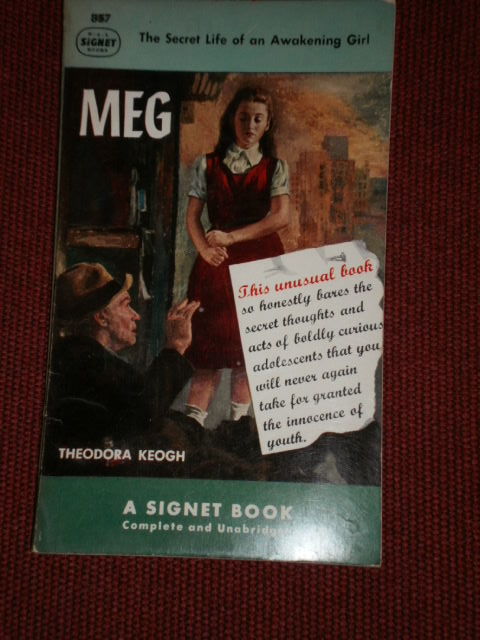
Book Acquired Recently: Theodora Keogh’s Meg


Keogh, Theodora. Meg. 1950. New York: Signet, 1951.

I bought this book after reading Keogh’s novel Gemini, which I enjoyed. I love old pulp fiction paperbacks, and thus am especially excited to add this edition to my library. The cover painting isn’t as lurid as pulp fiction illustrations often are, but the descriptions of the novel are clearly meant to titillate. The text at the top promises to reveal “The Secret Life of an Awakening Girl,” and we are told further down that the “book so honestly bares the secret thoughts and acts of boldly curious adolescents that you will never again take for granted the innocence of youth.” If the reader isn’t already hooked by these descriptions, the back cover blurb describes some salacious characters: “Miss Otis–the respectable history teacher with a guilty secret… Eddy Smollet–a man with an evil taste for little girls… Godwyn–in the basement he brooded about the prostitute upstairs.” Count me in!

Bought on amazon.com.

A Blog Post About a Blog Post About Lax Bros

Here’s a fantastic blog post from Grantland.com (one of the best sports websites out there) about a rather ridiculous Boston Globe article about “lax bros,” who are apparently just jocks who play lacrosse, i.e., lacrosse players (and people wonder why newspapers are dying!).

http://www.grantland.com/blog/the-triangle/post/_/id/28743/trend-alert-lax-bros

I giggled the entire time I was reading it. It’s surreal even if you know what they’re talking about; I think it must be even funnier to readers who know nothing about lacrosse (so everyone should read it).

Also, I must say that I totally have a crush on Katie Baker. She’s my favorite writer on the site aside from Bill Simmons (and it’s a closer contest than I’d like to admit. Sorry for my near-disloyalty, Sports Guy!). That ranking speaks both to how excellent of a writer Baker is and how much Chuck Klosterman has stunk up the joint of late, mostly by refusing to publish more than one column a month (that’s how it feels, anyway). I’m sad that hockey season is coming to an end because it means that Baker’s “Coldhearted” column will come to an end, too.