Thoughts on Shopping and Lost History

This afternoon I was reading Elizabeth McNeill’s Nine and a Half Weeks, and of course I found the depiction of her relationship fascinating, but something else that struck me was her description of the various shops she and her lover visit on the weekends. The book takes place in the mid-1970s, and they go to all sorts of (generally high-end) businesses, most of which no longer exist.

I’ve thought about this before in thinking about how cities and towns change (when I lived in DeKalb, Illinois, the only business in photographs from thirty years ago that was still around was the town’s adult bookstore), and every time I think about it, it makes me a little sad, and it fills me with questions. What happened to these businesses and the people who ran them? Did they retire and simply close the business, feeling satisfied that it had run its course? Did the shifting economy claim the store as a victim, leaving its proprietors bereft? My guess is that this was primarily the case with the various department stores which McNeill names.

Change is inevitable, but the amount of history that gets lost as the memory of all of these mostly small shops fades is terrifying. The human element of our purchases often gets forgotten in light of the excitement surrounding the objects that we’ve bought. Thinking about this is a good reminder for me of the importance of shopping at local businesses rather than at faceless chain stores.
A Controversial List of Independent Bookstores

Hilary Davidson has an article on CNN.com today listing the “Best indie bookstores” in North America. I’ve never been to McNally Jackson in New York City before, so I’ll have to check it out the next time I am there. But while Davidson makes clear that her list consists of stores she has visited on her book tours, I find any list that claims to include the “best” bookstores without including the Strand rather ridiculous.

Book Acquired Recently: Stephen Beachy’s Some Phantom/No Time Flat

Beachy, Stephen. Some Phantom/No Time Flat. 2006. Portland: Verse Chorus, 2013.

I received this diptych of novellas in the mail from amazon.com yesterday, and read Some Phantom immediately and No Time Flat this evening. Both are excellent; I read the first one (which I greatly enjoyed in part because it takes place in Salt Lake City) and thought “Wow, the second one can’t be as good,” but I was wrong.

Some Phantom is about a woman running from an abusive relationship who ends up in Salt Lake City, gets a job as a teacher’s aide, and becomes obsessed with one of her students. The city’s geography is an essential element of the story–sparse, dry, malevolent. It reminds me a lot of the austerity of Janet Kauffman’s writing, even though she virtually never writes about urban environments. Beachy does a fantastic job depicting the exciting seediness of the stretch of State Street between approximately 700 and 1900 South.

No Time Flat involves some of the searing themes from Beachy’s best novel, Boneyard: illicit gay sex, much of it involving bondage, and the thin line between pain as pleasure and pain as violence. It reads as serious fiction, but it arouses like the best pornography, too. The experience of reading it is still too fresh for me to be articulate about it other than to say that I highly recommend it.

Books Acquired Recently: English Soccer Novels Edition

King, John. The Football Factory Trilogy: The Football Factory, Headhunters, England Away. London: Vintage, 2000.

Sampson, Kevin. Awaydays. London: Cape, 1998.

I recently ordered these two books used from English bookshops via amazon.com. Sampson’s book is autographed, which is a nifty bonus, especially considering that I only paid $0.02 for it (both books originally retailed for £9.99).

Virtually no fiction about soccer is published in the United States (I remember reading one or two children’s novels on the subject as a kid), but I recently read Graham Parker’s interview of Sampson on grantland.com and decided that his work sounded exciting. When looking online for his book, I came across King’s as well. The only novel I’ve ever read that is even nominally about soccer is B.S. Johnson’s The Unfortunates, so I am looking forward to reading further in the field. I love English soccer, and these two books will be an enjoyable way of feeding my craving for it during the summer offseason.

The Environmental Issue With Digital Media

Steven Hyden has a fascinating article on grantland.com today about how digital downloads of music are quickly becoming a thing of the past as they are replaced by services such as Spotify. He notes that, while record aficionados will continue to buy physical objects (and one could also make this argument for those of us who prefer real books to their bastardized e-book cousins), no one will be nostalgic about downloading songs because no physical object changes hands. As Hyden writes, “[p]eople continue to buy vinyl records because they enjoy the process of buying and playing vinyl records;” there is no equivalent of this experience with digital files. Or, to put it in Marxist terms, buying a record (or a book!) is one of the most prominent examples of a commodity fetish.

Hyden’s explanation of the changing way we consume recorded music makes sense, but what his article (and similarly, all of the articles extolling the virtues of e-readers) fails to discuss are the consequences of having all of one’s music in digital form when we run out of fossil fuels in twenty or thirty years. All of that data becomes meaningless if there is no electricity (or so little that it is needed for more basic tasks such as cooking or heating the home) to run the computer or charge the iPod. I suppose this might also be a problem when trying to run a CD player (though it won’t when trying to read a real book as long as there is a window nearby!). But my point is that, while the Digital Age is an exciting one, we do not talk nearly enough about its environmental impact and how we will adjust when the energy that powers it is no longer as available as it is now. This is why physical libraries/archives are so important.

Books Acquired Recently: Poetry Edition

ellipsis 49 (2013).

Strasko, Barbara Buckman. Graffiti in Braille. Cincinnati: Word, 2012.

Friday night was the debut reading for this year’s issue of ellipsis, Westminster College’s literary journal. ellipsis is unique in that it is run by students, but accepts submissions for review from anyone, so it ends up publishing a good mix of established poets, emerging poets from around the country (lots of newly-minted MFAs in the contributor list, ha ha), and a few students. Aside from some student poems, every year a featured poet who has previously published in the journal reads their work. This year’s poet was Barbara Buckman Strasko.

After this tragic week, and with the announcement about fifteen minutes before the reading began that the second Boston bombing suspect had been captured, I was really feeling the need for some poetry. The poems read from the journal were all quite good, with many of them being thought-provoking as well as finely crafted. Strasko’s work was also enjoyable. She lives in Lancaster, Pennsylvania, which is where my mother’s family has lived since the early 1700s, so I was happy to be able to talk with her after the reading. She was very approachable, and happy to talk with students, which not all visiting writers are. I look forward to reading her book!

Books Acquired Recently

Ai. No Surrender. New York: Norton, 2010.

Last Thursday I was grading some student essays about Martín Espada’s poetry reading on campus last month, and, as is often the case when reading student work, I was seized with an incredible desire to read literature (in this case poetry specifically) rather than reading writing about it. So after I was done at the office I walked up the hill to The King’s English Bookshop to look for some poetry because they have an excellent poetry section. I decided to buy Ai’s last collection even though I am not that familiar with her work–I’ve only read a few of her poems in anthologies. I read the book immediately and loved it! The collection consists primarily of long narrative poems, all very smooth, probably the best long poems I’ve read aside from Kenneth Koch’s. I highly recommend it.

Bergen, David. The Retreat. 2008. Toronto: Emblem, 2009.

As I’ve written here before, Bergen is one of my favorite novelists. However, I did not realize this book existed until I recently read his latest novel, The Age of Hope, which included The Retreat in the list of his previous books. Apparently it hasn’t been published in the U.S., which is why I didn’t receive the usual notification from amazon.com about “a new book from an author whose books you’ve purchased before.” However, I was able to find a copy of the Canadian edition from one of their used booksellers.

Saying Goodbye To Old Friends

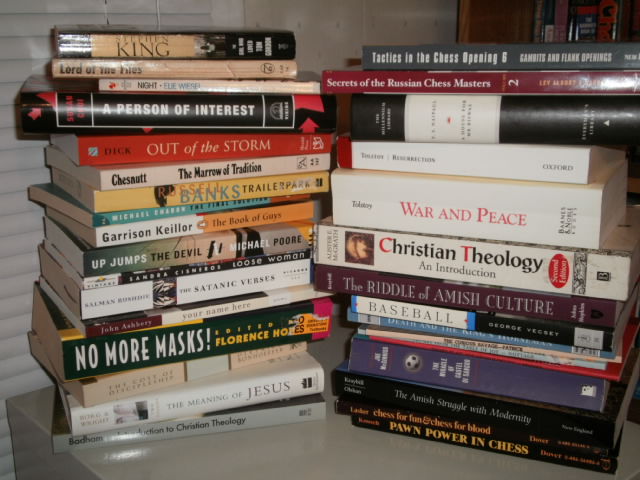
The books that I am removing from my library.

I have decided to de-accession some of my books in preparation for my upcoming move. This is a difficult decision because I love my books, not just for their content, but also for the history that they embody. My obsessive book collecting is one way to document my life. There are many books that I have which I know I will almost certainly not read again and which probably will never come in handy as reference for my research, but I keep them because of the memories that I associate with them. Thus giving some of them away is like giving away part of myself, which sounds cliche, but is true in my case. I am not just a person with lots of books, I am a cyborg in the Harawayan sense who consists of my physical person and my books (and perhaps a few other objects as well).

But this group of books that I’ll take to my local bookstore (the Central Book Exchange) for some cash no longer have enough nostalgia attached to them to justify moving across the country. Most of the nonfiction is well-written, I’ll just never read it again. Most of the fiction (clearly not all–War and Peace is pretty decent, ha ha) is not. A few of the books are excellent, but I have two copies and only need one. It is an interesting cross-section of texts: some old religion textbooks from my undergraduate days, some superfluous chess books (I’ve had Pawn Power in Chess since high school, but I still haven’t read it, and haven’t played in about three years, so I wouldn’t get to it any time soon), some fiction.

Books Acquired Recently

Burton, Betsy. The King’s English: Adventures of an Independent Bookseller. Salt Lake City: Gibbs, 2005.

The King’s English is a bookstore in my neighborhood that I have patronized frequently during my time living in Salt Lake City. It is probably the best bookstore which sells exclusively new books that I’ve ever been to–I always find something fascinating that I wasn’t looking for. Burton’s book is a history of the store’s first quarter century. I’ll be moving this summer to take a new job, and have been acquiring various mementos of my favorite places in the city. This purchase is a part of that saying goodbye.

Penner, Jessica. Shaken in the Water. Tipp City: Foxhead, 2013.

I received a review copy of my good friend Jessica Penner’s new novel, and I am hoping to get a review of it published in an academic journal. I’ve read a few excerpts of it previously which were quite good, so I am looking forward to reading the whole thing. You can buy it here.