Good Writing on Reading Digitally and its Consequences

I’m a bit behind on my PMLA reading, and I was reading the January 2013 (128.1) issue this morning, which includes an excellent suite of essays on “Reading in the Digital Age.” I’ve written here about these issues before, especially about my concern that we retain less and our brains get less exercise when we read digitally rather than in print, and the frightening long-term effects this will have on society. Thus it was nice to discover that such a prestigious journal is paying close attention to the subject. Here are some of the highlights:

My favorite article in the group is Naomi S. Baron’s “Redefining Reading: The Impact of Digital Communication Media,” which reports the results of several surveys she conducted measuring both students’ and the general population’s attitudes about reading digitally versus reading in print. I like the article because the survey shows that even students who have grown up with computers all of their lives realize that they prefer reading in print once they are asked to think about it. Respondents appreciate the physicality of reading books, even textbooks that they are planning on selling back to the bookstore at the end of the semester (which is another problem to discuss another time). They also say that they retain information much better when they are interacting with print texts, in part because they get distracted in electronic environments. The article also shows that more and more people conceive of reading as a search for specific bits of information rather than as an exploration fueled by intellectual curiousity. I admit that sometimes I am guilty of this in my research, going straight to a book’s index to find the passages that are relevant to my topic, but I also enjoy reading for pleasure rather than purpose, and I have grown intellectually just as much if not more via the former kind of reading as the latter. Baron’s essay is necessary reading for anyone interested in the life of the mind and how it’s evolving, and I am going to assign it to my students this autumn.

Michael Cobb’s intriguing article “A Little Like Reading: Preference, Facebook, and Overwhelmed Interpretations” examines what sort of reading act occurs when we “Like” something on Facebook. I am addicted to Facebook, and am glad to see that it continues to draw serious academic analysis. One of the most profound conference presentations I’ve ever heard was a presentation on Facebook as a form of autobiography at the 2010 MLA Convention. Seriously engaging with Facebook rather than simply dismissing it as a waste of time is essential because of its ubiquitousness, and Cobb’s essay is a superb example of this engagement.

Jim Collins’s essay “Reading, in a Digital Archive of One’s Own,” which is pro-digital reading, is a thought-provoking piece in part about how both sides of the debate are represented by unhelpful caricatures and how the debate problematically takes place as “an exercise in nostalgia, grounded in a discourse of inevitable loss” (212), and in part about how one’s digital playlist is a form of autobiography just like one’s library. Collins makes a good point about how those of us who are defenders of print media need to integrate the realities of digital reading into our viewpoint, though I don’t think he pays enough attention to the foreboding realities of digital reading described in Baron’s essay.

N. Katherine Hayles’s essay “Combining Close and Distant Reading: Jonathan Safran Foer’s Tree of Codes and the Aesthetic of Bookishness” argues that many recent authors (she also mentions B.S. Johnson’s classic The Unfortunates) have expressed concern about the future of the book by creating books that play with books’ traditional physical form. She offers a helpful, data-ridden analysis of Jonathan Safran Foer’s Tree of Codes as an example of this trend.

Lisa Nakamura’s essay “‘Words with Friends'” Socially Networked Reading on Goodreads” is also quite good for many of the same reasons as Cobb’s. She examines Goodreads as an important source of data on contemporary reading habits, but also notes that is important to keep in mind that such seemingly-innocent social networking sites function because users consume their advertising. They are cogs of capitalism in disguise.

Books Acquired Recently: More Canadian Mennonites Edition

D’anna, Lynnette. fool’s bells. Toronto: Insomniac, 1999.

D’anna is the pen name of Lynnette Dueck, a Canadian writer of Mennonite origin. A friend who knows that I am interested in the intersection between sexuality and literature recommended D’anna/Dueck’s work to me; apparently it is quite explicit, which is a rarity in Mennonite literature. I may end up writing about it as a result. I’ve ordered a bunch of her books from amazon.com’s network of booksellers, and this is the first one to arrive (i.e., get ready for several more Books Acquired Recently entries on her work in the near future!).

Jacobsen, Annie, with Jane Finlay-Young and Di Brandt. Watermelon Syrup. Waterloo: Wilfred Laurier UP, 2007.

I acquired this novel because Brandt, one of my favorite poets, is listed as one of the authors, and I would love to read some fiction by her. As it turns out, she did not actually write any of the book. Jacobsen wrote it, but died before she could revise and publish it, so per her directions Finlay-Young revised it and had Brandt act as a consultant on the Mennonite issues in the book because Jacobsen had Mennonite ancestry and the novel includes several Mennonite characters. It looks interesting, but for different reasons than I first anticipated. I ordered it via amazon.com from Better World Books‘s United Kingdom branch; it was originally owned by a library in Chelsea.

Two Portrayals of Soccer Fandom

I am currently reading John King’s 1996 novel The Football Factory about soccer fan culture and its causes in 1980s/early-1990s England. I also just read Sarah Lyall’s recent New York Times article about attending English soccer matches, which I found via one of my favorite soccer websites, When Saturday Comes.

The contrast between the two pieces is striking. It is clear to any serious follower of the English game that Lyall’s piece is written by a rank outsider (which is, admittedly, in part the point, as she assumes that most of her readers will also be outsiders), and thus contains some major flaws. Aside from a smattering of factual errors (e.g., that the famous meat pies served at matches are traditionally filled with chicken rather than red meat, usually beef), there is no attempt to actually understand the culture. Instead, the article highlights its idiosyncrasies in order to demean them and the culture as a whole. It is an example of disgustingly U.S.-centric reporting.

The article is flawed in its depiction of sports fandom in general, not just soccer fandom. The usual elitist attitude toward sports that is shared by way too many otherwise rational intellectuals (i.e., the sentiment “Why waste time caring about sports? It’s just a game.” In contrast, the reason I love When Saturday Comes is that it shows that a love of sports and a life of the mind can coexist.) is present throughout the piece. For example, Lyall is puzzled by the fact that English fans often seem miserable when watching their team, but this is the case with the majority of serious fans of any sport, including Americans. It is difficult to watch a team that you desperately care about for a multitude of reasons (not just whether they win or lose) play even if they are often successful (like my beloved Manchester United) and you expect them to win. Once you understand the nuances of a sport, it is difficult not to focus on the flaws inherent in the way it is played. That doesn’t mean that the glorious moments of beauty and triumph aren’t enjoyable, but that the knowledge that they are rare leads to a sort of resigned pessimism.

Unlike the article, The Football Factory endeavors to show how soccer fandom fits within its broader societal context. The book is especially trenchant in its portrayal of how the Thatcher government’s policies destroyed the working and middle classes, and how responses to this calamity manifested themselves in soccer fandom. The novel does not celebrate troubling elements of fandom such as hooliganism, but it does offer a genuine attempt to understand them. Lyall’s article fails in this regard. It views fandom in a vacuum instead of considering how issues of class, race, and gender intersect with it.

Books Acquired Recently: Mostly Mennonite/Mostly Canadian Edition

I’ve been thinking and writing about Mennonite literature a lot lately, and this latest round of book-buying includes some of the earliest novels published in the field. It also includes one of the more recent works of Mennonite fiction and a book by someone with a Mennonite-sounding name (Kroetsch), though to my knowledge he has no Mennonite ties. Aside from Flamethrowers, all of the books take place in Canada.

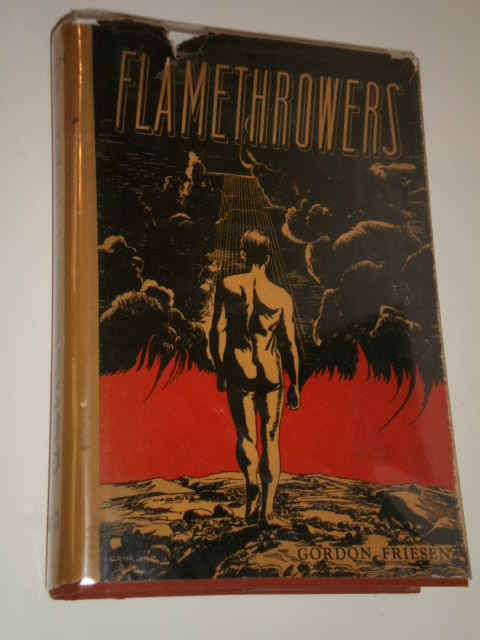
Friesen, Gordon. Flamethrowers. Caldwell: Caxton, 1936.

OLYMPUS DIGITAL CAMERA

Flamethrowers is to my knowledge the earliest literary novel by a Mennonite published in the United States. It, like Kliewer’s book (and arguably like Wiebe’s), is rather critical of the community. I bought it from one of amazon.com’s booksellers. Hossack’s, Kliewer’s, and Wiebe’s books were also purchased via this method.

Hossack, Darcy Friesen. Mennonites Don’t Dance. Saskatoon: Thistledown, 2010.

I try to keep up on writing by as many contemporary Mennonite writers as possible, and just heard about Hossack’s short story collection from a friend. This person passed along the rumor that the publisher insisted on the title rather than on Hossack’s choice because books with “Mennonite/s” in the title sell better, especially in Canada where Mennonites are seen more as an ethnic group than as a religious one.

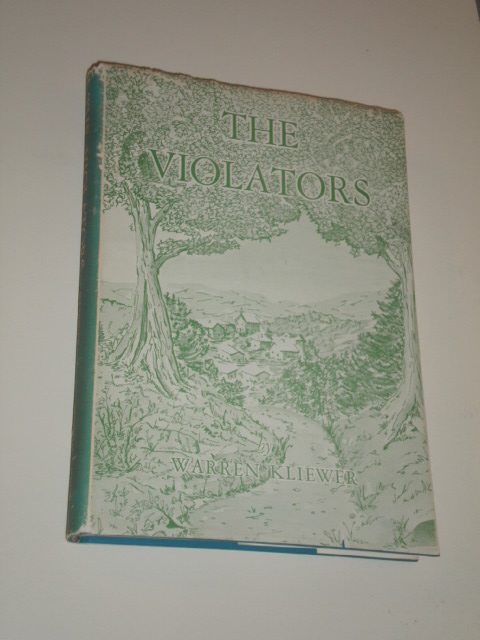
Kliewer, Warren. The Violators. Francestown: Jones, 1964.

OLYMPUS DIGITAL CAMERA

This is another early example of U.S. Mennonite fiction. I am tickled by the juxtaposition between the cover’s bucolic illustration and the book’s violent title.

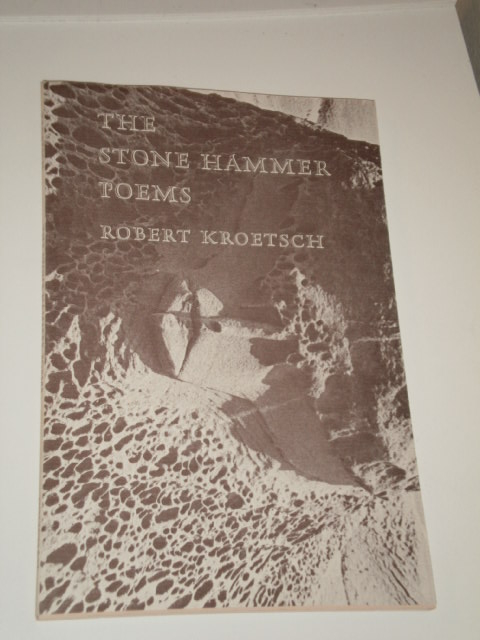
Kroetsch, Robert. The Stone Hammer Poems: 1960-1975. 1975. Lantzville: Oolichan, 1983.

OLYMPUS DIGITAL CAMERA

I bought this at Back of Beyond Books in Moab, Utah, which is an excellent new-and-used independent bookstore. I’ve been wanting to investigate non-Mennonite Canadian literature more, and Kroetsch is an author in this category whom I’ve heard of, so I decided to buy his book. It is a lovely aesthetic object.

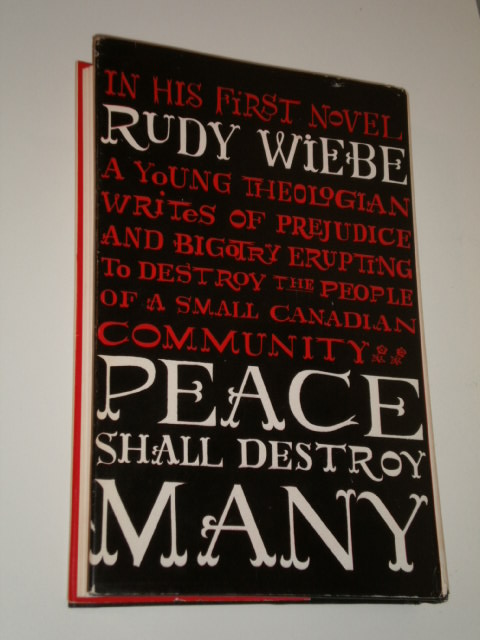
Wiebe, Rudy. Peace Shall Destroy Many. Toronto: McClelland, 1962.

OLYMPUS DIGITAL CAMERA

I already have the 1964 Eerdmans paperback edition of Peace Shall Destroy Many, which is the most important early piece of Mennonite literature, but I wanted a copy of the McClelland and Stewart hardcover edition because of its unique back cover, pictured here. The front cover of both the hardcover and first paperback printing has a white background with red lettering for the title and author’s name, and black lettering for the controversial plot description (Wiebe was the editor of a church newspaper at the time, not a “theologian.” He strongly objected to this description, but the publisher insisted on it). The back cover’s reversal of these colors is striking and foreboding. I acquired this copy for only $7.00 even though it is signed by Wiebe.

Random Friday Thoughts

I taught my final class of the school year on Wednesday, and for the past two days have just been relaxing and letting my mind wander. It hasn’t hit me on a visceral level yet that I don’t have to teach another class until late August, but my brain is already going on all sorts of tangents. Here are a few that are rattling around this afternoon:

Sometimes I have dreams that people have statistics for their lives just like athletes have sports statistics. Usually these dreams center around me having a low “life average” (akin to a baseball batting average), somewhere below .250. I’m always very worried about this in the dream until I realize that there’s no such thing as life averages. But it would be kind of interesting if there were. It would be fascinating to compare oneself to other people numerically like it is possible to compare one athlete to another. For instance, basketball-reference.com has something called “Similarity Scores” on each player’s page (scroll down to the bottom to see Patrick Ewing’s) that compares the player to other players (past and present) with similar statistics. If it were possible to do this in real life, it would be helpful because then one could see if one’s life was headed in a good direction or not based on those with similar life arcs.

I bought a regular-sized candy bar at the college bookstore this afternoon that cost $1.25. I realize that the bookstore is not the cheapest place to buy such an item, but even so, it points to how candy bar prices have exploded over the past decade or so. For all of my teens and into my twenties it was common to be able to find candy bars on sale for $0.50, and sometimes even less. Nowadays it is hard to find one for less than $0.75 even at stores that claim to have “low prices” (at least in Salt Lake City, and this was the case when I lived in Illinois, too).

Conversely, I also bought a pack of two Bic red pens for $0.99. What a deal! A pleasing quality product for under a dollar. Good office supplies are always exciting. The way things are going, though, they are an endangered species.

Reflections on One Year of Blogging and My Book Addiction

This week was the one-year anniversary of this blog, and it feels appropriate to mark the occasion with a post about it.

First, here is a post from one of my favorite blogs, A Little Blog of Books and Other Stuff, about lessons learned from blogging. I particularly agree with numbers 3-5.

Second, this is my third and most successful attempt over the past decade at blogging (here is a link to the previous one). I am happy that I have finally had the willpower to keep posting regularly: at least once a week with only a handful of exceptions, and many weeks two or three times, especially during the summer when I’m not teaching.

Third, around half of my posts have been in the Books Acquired Recently category. I began this category because I thought it would be interesting to document how many books I actually acquire rather than making random estimates. I just went through all of these posts for the past year, and I must say that I was a little surprised at the results. I knew that I was both a book and a book-buying addict, but I did not realize just how addicted I am. Over the past twelve months I have acquired (mostly bought, but some were also gifts or exam/desk copies) 155 books! That is an average of nearly three per week! Perhaps just as impressively, I have read all but twenty-six of them (I’ll catch up this summer!).

Here is the breakdown of my 155 new friends:

76 books of fiction, including two Norton anthologies that encompass multiple genres. Fiction is both my favorite genre to read and to write about, so I am not surprised that nearly half of the books fit here. I am actually a bit surprised that it wasn’t more than half.

30 books of literary criticism/theory. I am such a nerd.

26 books of miscellaneous nonfiction–mostly memoirs, some art history, some cultural studies, some sports.

20 books of poetry. My guess would have been that this would have been the category following fiction. I am kind of sad that I acquired fifty percent more criticism/theory than poetry.

2 collections of comic books/comic strips.

1 play (Amiri Baraka’s Dutchman).

The Office Series Finale

The Office series finale last night did a good job of ending the show. I’ve always felt that Steve Carell’s final episode should have also been the show’s final episode, but since it was not, last night’s episode did about as good of a job of ending the show as was possible. Yes, it was schmaltzy, and yes, all of the main characters’ stories (especially Pam and Jim’s) got tied up much too neatly to be plausible, but The Office was good enough and important enough for long enough (i.e., barring the past two seasons) that it could get away with an ending that was much more uplifting than the show’s overall subject matter. Unlike many previous last episode disasters (e.g., Seinfeld‘s, which was laughably horrible, and Will and Grace‘s, which was traumatic and had me screaming at the television), The Office‘s finale didn’t insist on being over-the-top, which allowed it to end things smoothly and successfully.

There were also some fantastic one-liners and inside references for long-time viewers, such as the stripper at Dwight’s bachelor party who had also worked Bob Vance’s bachelor party and had accepted the rabies research check from Michael dressed as a “nurse” in one of the series’ best episodes. I thought Carell’s cameo was handled quite well: he got in one last “that’s what she said,” and his final line about having his kids (i.e., his former workers) grow up and marry each other being “what every parent wants” was classic Michael. I was a huge fan of The Office until two seasons ago, and I feel like last night’s episode allowed me to end my relationship to the show with a sense of peace.

David Beckham’s Retirement

David Beckham has announced that he will retire from soccer at the end of the season. He has had an excellent career, which most people forget because now he is more well-known for his off-the-pitch celebrity activities than for his footballing. In his honor, here is a link to the highlights of the 1999 Champions League final, one of the most thrilling matches ever. Both Manchester United goals come in the aftermath of Beckham corner kicks, and the first corner is set up by a lovely pass from Beckham to Gary Neville.

Books Acquired Recently

Binnie, Imogen. Nevada. New York: Topside, 2013.

As I mentioned in a recent post, I ordered this book from the publisher (Topside Press is a fantastic new venture dedicated to publishing transgender literature) after reading a glowing review of it by Casey Plett. I am excited to read it soon, perhaps this weekend.

Gregg, Melissa, and Gregory J. Seigworth, eds. The Affect Theory Reader. Durham: Duke UP, 2010.

I bought this book because I only have a vague idea of what affect theory is about. It sounds fascinating.

This and Grafton’s book were bought on amazon.com.

Grafton, Anthony. The Footnote: A Curious History. 1997. Cambridge: Harvard UP, 1999.

I am totally addicted to footnotes, and have been since I was an undergraduate. I decided to break down and buy Grafton’s history of the form after recently reading some criticism on David Foster Wallace’s use of them. I prefer footnotes to endnotes, but MLA style calls for endnotes, so that’s what I normally use. But footnotes are much more user friendly.

Lehman, Joanne. Driving in the Fog. Georgetown: Finishing Line, 2013.

I heard about this chapbook of poems from a friend who knows Lehman and pre-ordered it from the publisher several months ago (Lehman is a Mennonite, which is why the book sounded interesting to me). Then I promptly forgot about it. It was thus a nice surprise to receive it in my mailbox yesterday!

Schott, Penelope Scambly. Lillie was a goddess, Lillie was a whore. Woodstock: Mayapple, 2013.

I received a review copy of this collection of poetry from Your Impossible Voice, a new online literary journal that I’ll be writing some reviews for. It is exciting to be a part of the early days of a new publishing venture! Schott’s book is about Lilith, Adam’s first wife, and one of my favorite mythological figures (her story didn’t make it into the Bible because she insisted that she be on top during sex). I am looking forward to reading it.

Thoughts on Bill Hader Leaving Saturday Night Live and Endings in General

Bill Hader announced this week that he is leaving Saturday Night Live at the end of this season. While I got into SNL at the tail end of the Will Ferrell/Chris Parnell/Tracy Morgan-into-the-Tina Fey/Amy Poehler/Maya Rudolph days, Hader’s generation (Andy Samberg, Kristen Wiig, Kenan Thompson, with Jason Sudeikis and Fred Armisen having been there a bit longer) was the one that I connected with the most as a fan, and now that most of it is gone, I feel a keen sense of loss that isn’t just tied to the show, but is also tied to the forthcoming transition in my own life into a tenure-track (and thus explicitly long-term) position. It is like the fun times are over and it’s time to go into a settled, middle-aged life of bourgeois despair. I haven’t watched the show regularly this season after the first few weeks because the new cast members just didn’t have enough verve to fill the gap left by Wiig’s and Samberg’s departures at the end of last season, and now that Hader is leaving my guess is that I’ll watch it even less. There’s still a lot of talent on the show, and the new cast members have certainly been getting better, but somehow it no longer feels like it’s mine. Endings are always also beginnings (and it feels like there have been a lot of these that I care about lately, most notably the retirements of Sir Alex Ferguson and Paul Scholes), and I feel like I should be excited for mine as one would think Hader is excited for his (he’ll have more time to work on his thus far promising film career), but it just makes me feel old.