Pro Wrestling as Narrative

There’s an excellent interview with WWE executive Triple H on grantland.com that explains how WWE storylines get generated, and how they play out during live events. I loved to watch wrestling as a kid, and while I no longer watch it, I still enjoy reading about it. This may sound odd, but reading about it gives me the same kind of light pleasure one would get from reading a cheap bit of genre fiction. Triple H says that “everything we do is storytelling,” and as someone who is vitally concerned with how narrative works, of course I respond to this element. I have a friend who still watches wrestling, and when people find out and say to him “Why do you watch wrestling? It’s fake” (which is inaccurate: it’s staged, not fake. There are often real injuries.), he says “Yeah, but so is Shakespeare.” It’s a snarky-yet-profound statement.

Mike Piazza’s Long Shot

Mike Piazza’s autobiography Long Shot is a fascinating, candid, at times disturbing book. It is a true autobiography, covering his entire life up through the publication of the book in detail. Here are a few thoughts on what stood out to me.

I found the first part of the book boring because I was reading it for the details about Piazza’s baseball career, not his childhood, but I was intrigued to find that as a result of his upbringing Piazza is a staunch Catholic, which helps to explain his conservative political views.

The center of the book about Piazza’s time as a major leaguer is its strength. He writes knowledgeably about the game and gives the inside story of such famous events as his beaning by Roger Clemens and his feud with Guillermo Mota. He admits that he should have charged Clemens when Clemens threw a bat fragment at him in game 2 of the 2000 World Series, but he was worried about getting suspended (238).

Piazza also discusses the steroids issue, remaining adamant that he never took them and offering a number of reasons aside from PEDs that there was a home run boom in the 1990s. I view Piazza as a sort of canary down the mineshaft in terms of how Hall of Fame voters will treat power hitters from the steroid era. He is suspect because everyone from that era is suspect, but if he gets elected it will show that voters are willing to consider each player on an individual basis rather than painting the entire era with a wide brush.

Piazza reiterates his desire to wear a Mets cap on his Hall of Fame plaque should he be elected, saying that he would rather wear no logo than the Dodgers logo because of the acrimonious ending to his time with the team (344). One could make a case for either team, but the combination of the facts that he played more games for the Mets than Dodgers, went to his only World Series as a Met, had more home runs and RBI as a Met, and prefers to be enshrined as a Met is a compelling argument that he should go in with an NY on his cap. I was surprised at how genuinely reflective Piazza is about his place in baseball history. He makes a compelling case for himself as the best offensive catcher in history and as an underrated defender. He is at his best when talking about baseball.

But there are two places in the book where Piazza’s conservative views cause him to come off as an idiot. The first is in his treatment of questions that were raised about his sexual orientation. While he never actually says that this kerfuffle bothered him because he viewed being gay as an insult, it is clear in the way he spends so much time protesting about it that this is how he feels. He says that he was bothered by the idea that people viewed him as dishonest because he claims he would never hide a part of himself (which, judging from the honest tone throughout the book, is fair), but doesn’t ever make the necessary statement that it is okay for people to be gay, or that he wouldn’t mind having a gay teammate (262). Also, when he mentions Belle and Sebastian’s song “Piazza, New York Catcher,” which asks at one point “Piazza, New York catcher, are you straight or are you gay?,” he does not seem to realize that the song is actually a paean to him (263). For instance, the line “the catcher bats .318 and catches every day,” an incredible statistic, and one that is made even more incredible by the fact that Piazza hit higher than .318 in seven different seasons (he hit .318 in his first full season when he won the Rookie of the Year), shows that the song is interested in examining all of Piazza, not just the controversies that surrounded him.

Piazza’s second objectionable stance is his dislike of Latino players. Aside from the culturally insensitive argument that Spanish-speaking players should all learn English (which he argues Asian players are exempt from, and in this inconsistency shows his specific bias toward Latinos), he goes so far as to claim that Latino players actively conspired against him throughout his career (307-8)! This is racist paranoia, plain and simple. Piazza makes the mistake of projecting his dislike of a few individual Latino players (e.g., Mota) onto the entire group as a whole. He complains about negative Italian stereotypes earlier in the book (94), but doesn’t see that he is guilty of perpetuating the same offense toward Latinos.

Overall, the book is worth reading for all serious baseball fans because it attempts to be thoughtful about a number of important baseball-related issues and, aside from the two major, major failures at this which I have just mentioned, generally succeeds. There is a generous section of photos in the middle of the book, and also a thorough index, which is rare for sports autobiographies. As a Mets fan, I have always been a Piazza fan. Reading this book made me even more convinced of his greatness as a player, while at the same time making me like him a lot less as a person. Before I thought that I would definitely attend his Hall of Fame induction ceremony, but now I am not so sure.

Books Acquired Recently: Strand Edition

I spent a few days this week in New York City, which of course involved my usual trip to the Strand. I have been shopping at the Strand since 2002, and it always brings me joy even though their renovations over the past decade have taken away some of the store’s character. But I was able to recognize a few of the workers who have been there since I first began going, and I love that feeling of continuity.

There are only a few weeks left before the beginning of the new semester, so I probably won’t read many of these books for a while (I hope some of them aren’t still sitting on my to-read shelf when next summer rolls around!), but they were all irresistible.
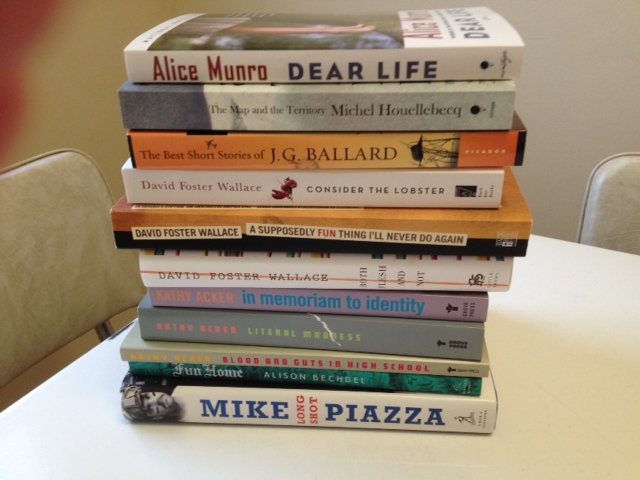
Acker, Kathy. Blood and Guts in High School. New York: Grove, 1978.

—. In Memoriam to Identity. New York: Grove, 1990.

—. Literal Madness: Three Novels: Kathy Goes to Haiti, My Death My Life by Pier Paolo Pasolini, Florida. New York: Grove, 1987.

I love Acker’s work, and her books are hard to find in stores so it was a no-brainer to buy these three, which were all in almost perfect condition.

Ballard, J.G. The Best Short Stories of J.G. Ballard. 1978. New York: Picador, 1995.

Ballard is a writer who, like Acker, always makes me see so-called taboo subjects in a new light. I’ve been wanting to read more of his work for a while.

Bechdel, Alison. Fun Home: A Family Tragicomic. 2006. Boston: Mariner, 2007.

I really enjoy Bechdel’s Dykes to Watch Out For comic strip, and have read excellent reviews of Fun Home.

Houellebecq, Michel. The Map and the Territory. Trans. Gavin Bowd. 2011. New York: Vintage, 2012.

I first bought one of Houellebecq’s books the last time I was at the Strand and really enjoyed it. I almost bought The Map and the Territory when it first came out in hardcover, and found the paperback for a good price.

Munro, Alice. Dear Life. 2012. New York: Vintage, 2013.

This is another recent book that I nearly bought in hardcover when it first was released. I’ve read several of its stories in the New Yorker and really enjoyed them.

Piazza, Mike, with Lonnie Wheeler. Long Shot. New York: Simon, 2013.

As a serious Met fan it was only a matter of time before I bought this book. I got a used copy in excellent condition for half the cover price.

Wallace, David Foster. Both Flesh and Not: Essays. New York: Little, 2012.

—. Consider the Lobster and Other Essays. 2005. New York: Back Bay, 2007.

—. A Supposedly Fun Thing I’ll Never Do Again: Essays and Arguments. 1997. New York: Back Bay, 1998.

I adore Wallace’s fiction and have been wanting to read more of his nonfiction. I’ve read a lot about Consider the Lobster and A Supposedly Fun Thing I’ll Never Do Again. Both Flesh and Not is a recent collection of Wallace’s nonfiction that did not make it into either of his collections while he was still alive.
In Defense of Tiger Woods

Yesterday, Tiger Woods shot a 61 to give him a seven-stroke lead in the WGC-Bridgestone Invitational. He will now almost certainly win the tournament, which would give him four PGA Tour victories this year ahead of next week’s PGA Championship. Even though it isn’t finished, Tiger’s year is already one worthy of yet another Player of the Year award.

But despite his high level of play this year, most of the discourse surrounding him has focused on his failure to win a major tournament since 2008. Some columnists (e.g., Rick Reilly earlier this summer on ESPN.com) wonder what Tiger’s legacy will be if he never wins another major and thus fails to break Jack Nicklaus’s record of 18 major victories.

While I understand that this is a compelling storyline, it is also a ridiculous one. Whether Woods wins another major or not (and I think he will, and if he does win another major and gets that load off of his back, he will definitely break Nicklaus’s record), the way he has been playing this year makes it clear that he still has a number of prime years left and will obliterate the all-time record for PGA Tour wins, and maybe even become the first player to reach 100 wins. He is the greatest golfer of all time, and it is time the media started treating him as such the way they crowned Michael Jordan the best basketball player ever while he was still playing.

But, of course, there are extenuating circumstances. Aside from Woods’s highly-publicized womanizing and subsequent messy divorce, he is, apparently (just like Jordan!), not the most pleasant guy to be around. So of course many in the media focus on his failures instead of his continuing success. I think especially here of Curtis Strange’s commentary on Woods during the final round of this year’s British Open, which made me want to turn off the television. Strange acted like no one before Woods had ever had a bad final round to fall out of contention at a major at the same time Lee Westwood was doing the exact same thing! (The narrative there was simply “Poor Lee Westwood, will he ever win a major?”)

While I do not condone Woods’s personal behavior during his marriage (I have no problem with him sleeping with multiple women [let’s be honest, ninety percent of heterosexual American men would have done the same thing if they were in his position], but he should have been honest and asked for a divorce before doing so instead of trying to hide it from his wife), I do think it is unfair that the media keeps harping on it. Just compare the way the media treats Woods to how they treat Michael Vick’s story, which is presented as a narrative of redemption. Woods made mistakes, he paid for them both financially and in terms of trying to “get better” by going to rehab, and it is time to move on, which many in the media refuse to do.

It is thus difficult not to read a racist element in the media’s treatment of Woods. He is a black man succeeding in a white sport, and not only did he cheat on his wife, but he was guilty of that most punishable of sins throughout American history, having sex with a white woman. I suppose that, this being America, I shouldn’t be surprised about how Woods gets treated, that he gets judged for things other than his performance on the golf course, but it angers me nonetheless. This is why I continue to root for Woods. He is the one more sinned against than sinning.

Thoughts on Narrative in Everyday Life

I was especially excited to watch the Mets game last night because Zack Wheeler was pitching, and I was thinking about the high hopes that I have for both he and Matt Harvey. Specifically, I was thinking, “Well, Harvey is clearly Tom Seaver, and maybe Wheeler can be Jerry Koosman.”

I know that I am not the only Mets fan making these comparisons, but the act of doing so struck me. I think it is an example of how we as humans naturally turn to past narratives to help us make sense of the present. While I am by no means the first person to note this function of narrative (my favorite articulation of it is in the work of Stanley Hauerwas), it is worth repeating. The world is inherently chaotic, and stories help us see how bits and pieces of it make sense.

In this particular instance, I am choosing a narrative that I want to see repeated, a sort of messianic second coming, because Seaver was the best Met ever, and Koosman was either the second or third best Mets pitcher ever depending on how you feel about Dwight Gooden. Of course it is not fair to Harvey or Wheeler to make these comparisons because it is important that they be given the space to write their own narratives. However, connecting them to the past as a fan is one way to fit them into the larger New York Mets narrative. The Mets have been the most successful when they have had stellar home-grown pitchers, and it is enticing to think that with Harvey and Wheeler they are returning to this formula.

The Comfort of Baseball

Last night I watched the Mets-Atlanta game, and the Mets lost in excruciating fashion, with Bobby Parnell giving up two runs in the top of the ninth to blow a 1-0 lead and Jason Heyward making a fantastic diving catch on Justin Turner’s drive into the left-centerfield gap in the bottom of the ninth for the final out, which would have tied the game if it had bounced out of Heyward’s glove or won the game if it had missed the glove altogether. Afterward, as I have many times before, I thought to myself “Screw this! I don’t need this kind of anguish! I’m not watching the game tomorrow night; I’ll read instead.”

But as this afternoon has worn on and I am thinking about how to unwind after a stressful day, the thought of watching the game becomes more and more appealing, and of course I’ll be in front of the television promptly at seven.

This turnaround, which has also occurred many times before, made me think of Philip Dacey’s poem “America without Baseball” from Brooke Horvath and Tim Wiles’s anthology of baseball poems, Line Drives. It depicts a late twenty-first century America where baseball has somehow died, but subliminally lives on. While “box scores began to look / like Greek or Sanskrit,”

3 and 9 became magical numbers–
all automobile license plates
carried either or both,
as did the logos of some commercial ventures,
though often buried in the design
to work subliminally on customers,
though no one could remember why.

This is the idea from the poem that has stuck with me since I first read it nearly a decade ago. I love the thought of baseball being completely ingrained in the national sub/consciousness, the thought that we could not get away from it even if we tried. This is not really the case anymore for the nation, but I was reminded that it is the case for me, and that knowledge is comforting. No matter what kind of day I am having, I can turn to baseball for solace, even in cases like last night: even though it was a hideous loss, the game itself was an intriguing, exciting one that I would have deeply enjoyed had my favorite team not been playing. The game made me exclaim out loud several times, and very few activities have that power over me. In seeking this comfort I am connected to millions of others, and that connection is significant.

Books Acquired Recently: Desk Copies Edition

Today I received all of my desk copies for the upcoming semester. I’ll be teaching semester one of the first-year composition course, American Literature to 1865, and American Literature Post-1945. It should be a fun semester toggling back and forth between the two American literature extremes! It will make a fascinating contrast.

I already have copies of most of these books, just not the editions that are currently in print, hence the necessity of acquiring the ones listed below.

Bottini, Joseph P., and James L. Davis. Utica: Then & Now. Charleston: Arcadia, 2007.

Cooper, James Fenimore. The Last of the Mohicans. 1826. New York: Penguin, 1986.

DeLillo, Don. Falling Man. 2007. New York: Scribner, 2008.

Hawthorne, Nathaniel. Young Goodman Brown and Other Short Stories. New York: Dover, 1992.

Irving, Washington. The Legend of Sleepy Hollow and Other Stories. New York: Penguin, 1999.

McClatchy, J.D., ed. The Vintage Book of Contemporary American Poetry. 2nd ed. New York: Vintage, 2003.

Nelson, G. Lynn. Writing and Being: Embracing Your Life Through Creative Journaling. Novato: New World, 2004.

Poe, Edgar Allen. The Complete Short Stories of Edgar Allan Poe (Volume I of II). N.P.: Digireads.com, 2012.

Roth, Philip. Goodbye, Columbus: And Five Short Stories. 1959. New York: Vintage, 1993.

Walker, Alice. The Color Purple. 1982. Orlando: Harvest, 2003.

Whitman, Walt. Leaves of Grass. 1855. New York: Penguin, 1986.

Books Acquired Recently

The Mennonite Encyclopedia, Volume II: D-H. Scottdale: Herald, 1956.

The Mennonite Encyclopedia, Volume III: I-N. Scottdale: Herald, 1957.

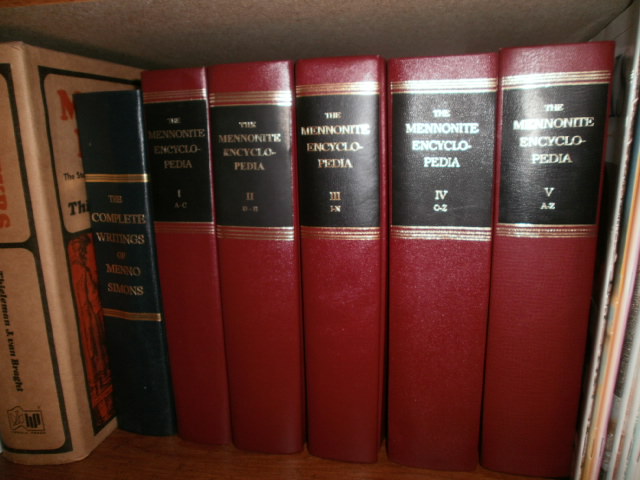
I bought Volumes I, IV, and V of The Mennonite Encyclopedia over a decade ago at a conference at a steep discount ($15.00 apiece when they are normally $85.00) because they each had a few damaged pages. I’ve been meaning to complete my set since then, but there were numerous other book purchases that took priority since admittedly I rarely consult the volumes I had. But they look so pretty on the shelf!

My Mennonite Encyclopedia set, right next to Martyrs Mirror and The Complete Writings of Menno Simons.

I finally decided to complete my set when I received some money from my grandfather’s estate. He was very interested in Mennonite history, thus I think he would appreciate the purchase.

Bought on amazon.com.

Silverman, Matthew. Swinging ’73: Baseball’s Wildest Season. Guilford: Lyons, 2013.

I bought this book from the National Baseball Hall of Fame bookstore during my visit to Cooperstown on Monday. It’s a signed copy. I am intrigued by 1970s pop culture in general and am especially intrigued by the 1973 baseball season because the Mets won the pennant that year, so Silverman’s book caught my eye immediately.

Visiting the Baseball Hall of Fame

Today I visited the National Baseball Hall of Fame in Cooperstown, New York for the first time since my eighth birthday. I don’t remember much about the museum itself from that visit, only that I had a milkshake for the first time ever. I loved them immediately and actually had three that day–two chocolate and one chocolate chocolate-chip. I also remember being surprised and disappointed that there were no fast food chains in town because I was wanting to have lunch at McDonald’s and supper at Wendy’s (how said that I had already been trained to assume that these chains were ubiquitous!). There are still no chain restaurants along Cooperstown’s main strip, which now makes me happy.

The "Jumbo Burger" and  chocolate milkshake from the Cooperstown Diner. I got a chocolate shake for old times' sake even though now I prefer vanilla when drinking one with a meal.
The “Jumbo Burger” and chocolate milkshake from the Cooperstown Diner. I got a chocolate shake for old times’ sake even though now I prefer vanilla when drinking one with a meal.

Anyway, it was good to get back to see the artifacts. Both Cooperstown and the Hall itself were packed because it is prime tourist season, and I saw many families with children who looked about the age I was on my first visit. It pleases me that the ritual of visiting is one that continues through the generations. Many people were wearing gear from their favorite teams, which was also neat. It gave the town a central meeting-place kind of vibe; we all had our individual allegiances, but ultimately we have our love of the game to unify us. I was planning to buy a new Mets cap, and was happy to find one for only $9.95 at one of the numerous shops selling sports memorabilia.

There are a number of players that I think deserve to be in the Hall of Fame that are not (Mike Piazza, Pete Rose [even if he did bet on baseball], Craig Biggio, Keith Hernandez…), and visiting did not make me change my mind about any of the players that I just mentioned, but reading through the amazing statistical achievements on the plaques of those who are members did make me feel that the Hall should be more exclusive than I’ve wanted it to be in the past.

Me in front of the Hall. I'm wearing my Keith Hernandez shirt because he should be a member.
Me in front of the Hall. I’m wearing my Keith Hernandez shirt because he should be a member.

Here are some of the photographs I took during my visit, most of them Mets-related:

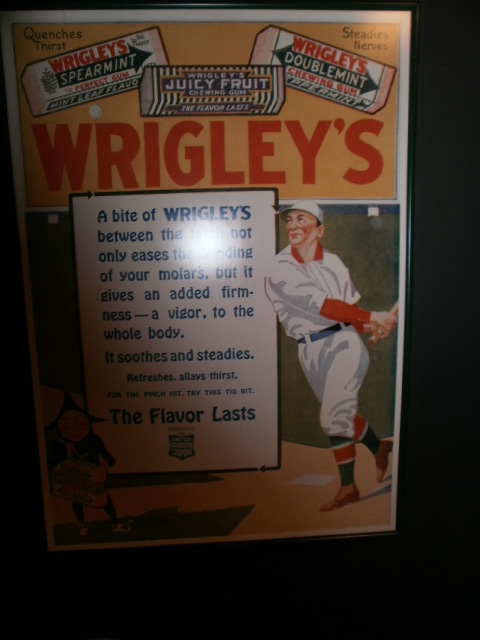
An old Wrigley's gum ad. Who knew that chewing Wrigley's "gives an added firmness--a vigor, to the whole body"?
An old Wrigley’s gum ad. Who knew that chewing Wrigley’s “gives an added firmness–a vigor, to the whole body”?
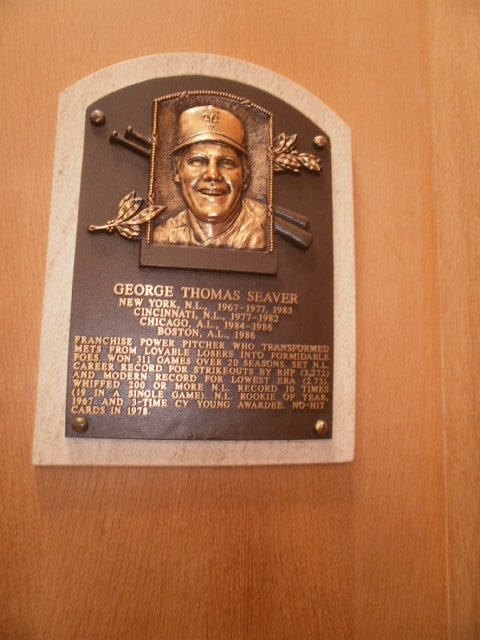
Tom Seaver's plaque.
Tom Seaver’s plaque.
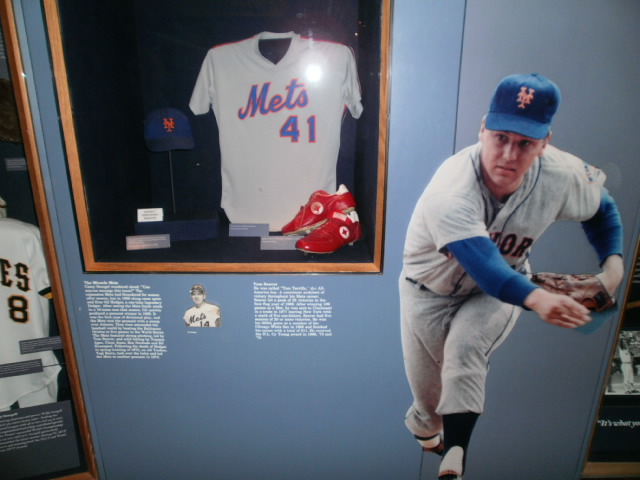
The Tom Seaver display.
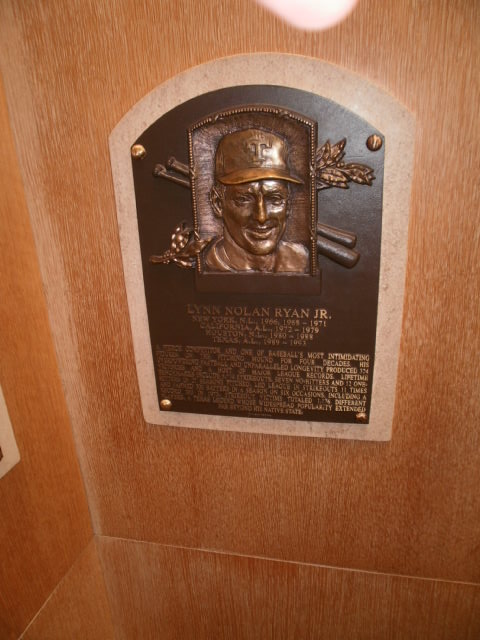
Nolan Ryan's plaque. Seven no-hitters! Unbelievable.
Nolan Ryan’s plaque. Seven no-hitters! Unbelievable.
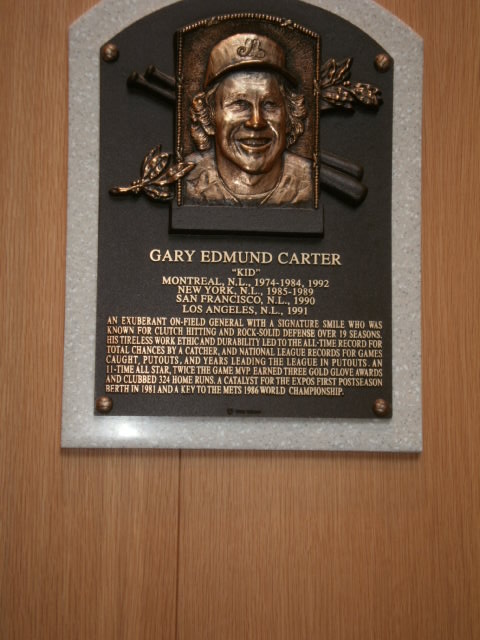
Gary Carter's plaque. R.I.P.
Gary Carter’s plaque. R.I.P.
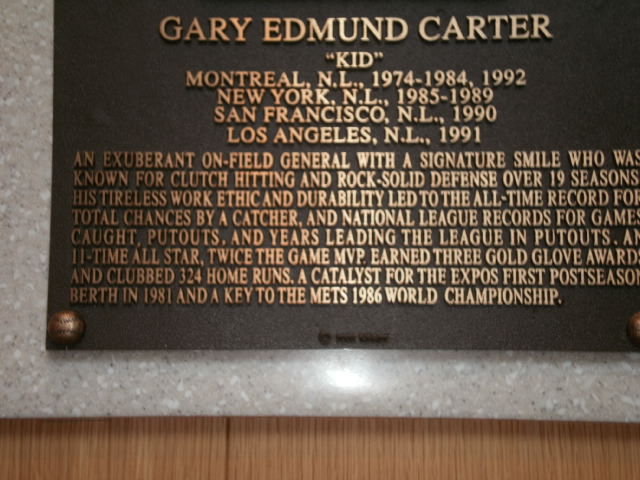
A close-up of Gary Carter's plaque detailing his importance to the 1986 Mets.
A close-up of Gary Carter’s plaque detailing his importance to the 1986 Mets.
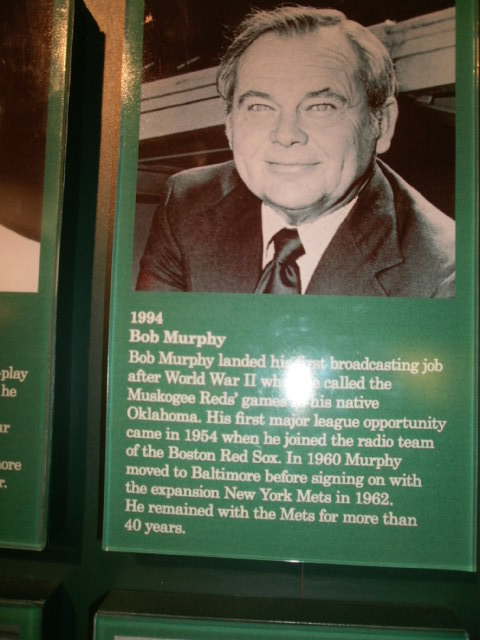
Long-time Met broadcaster Bob Murphy's plaque in the broadcaster's wing.
Long-time Met broadcaster Bob Murphy’s plaque in the broadcaster’s wing.
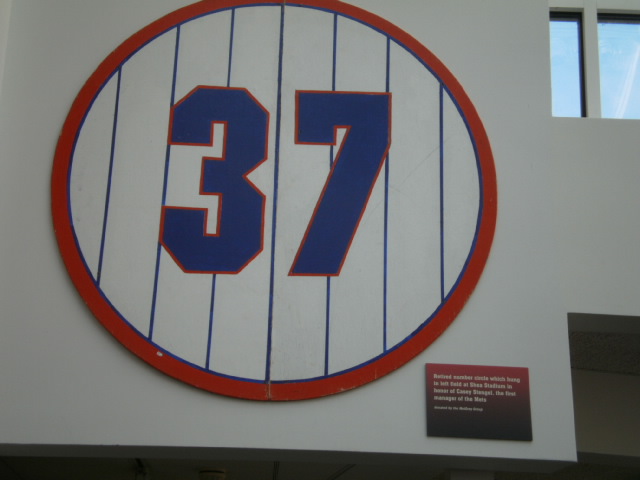
Casey Stengel's retired number from Shea Stadium.
Casey Stengel’s retired number from Shea Stadium.
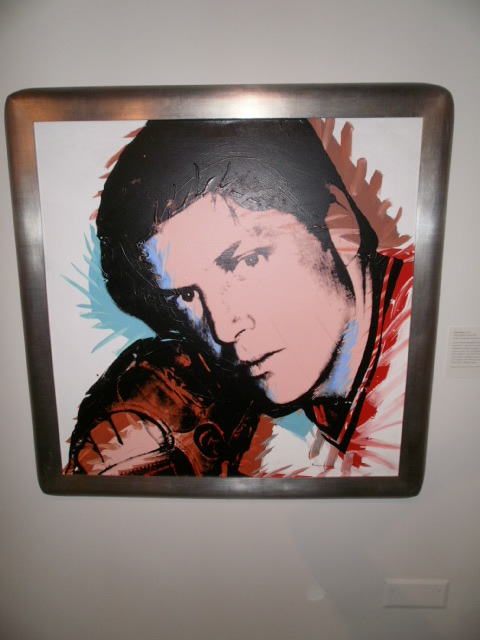
A portrait of Tom Seaver (as a Red, alas) by Andy Warhol.
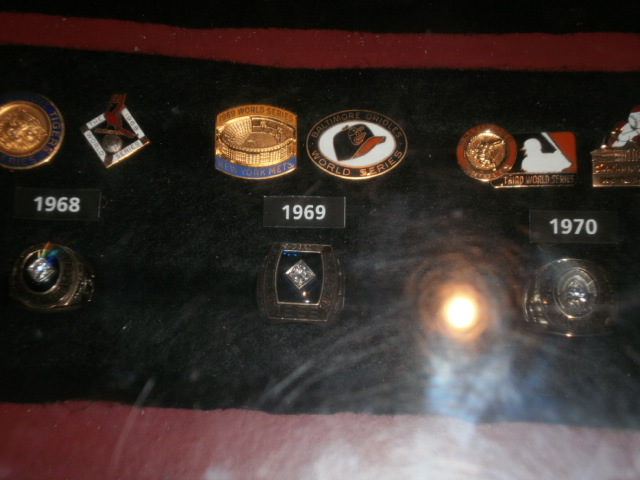
The Mets 1969 World Series ring.
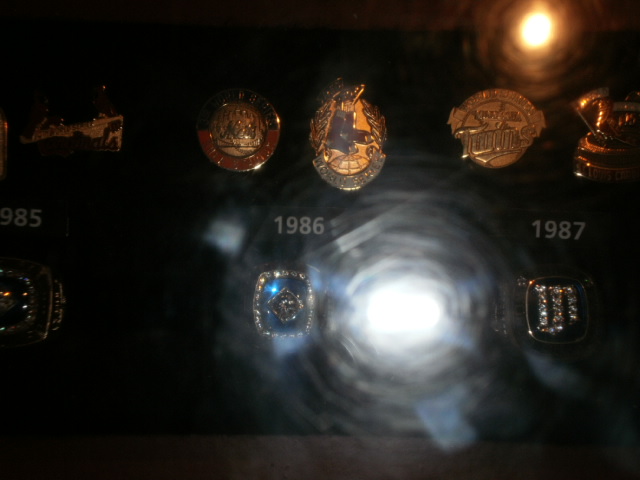
The Mets 1986 World Series ring.
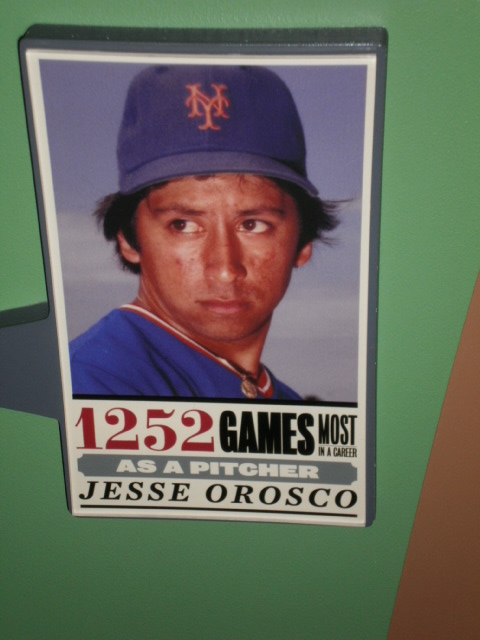
A sign celebrating Jesse Orosco's record for games pitched.
A sign celebrating Jesse Orosco’s record for games pitched.
Two members of the Mets current broadcasting team in the baseball card section.
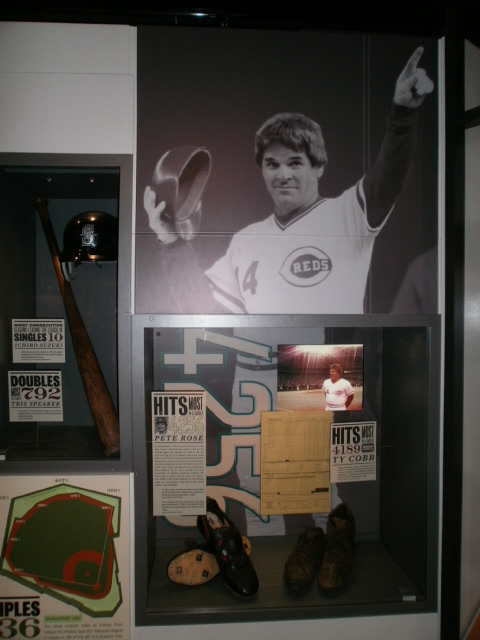
A display celebrating Pete Rose's all-time hits record. At least the Hall acknowledges his existence.
A display celebrating Pete Rose’s all-time hits record. At least the Hall acknowledges his existence.

Taking Myself Out to the Ball Game

Last night I went to my first Utica Brewers game. The Brewers, who are not, to the best of my knowledge, affiliated with the Milwaukee Brewers even though their primary logo uses one of Milwaukee’s script logos, play in the Perfect Game Collegiate Baseball League, a wood bat collegiate summer league.

A scene from the game. Note the scout holding the radar gun in the first row.
Another shot of the game. The Utica catcher is wearing his school catching gear rather than gear matching the Brewers' uniforms.
Another shot of the game. The Utica catcher is wearing his school catching gear rather than gear matching the Brewers’ uniforms.

I always enjoy going to games (usually minor league games) in small, intimate stadiums, but I often feel that I can’t really root for any of the teams because they are not affiliated with the Mets, and thus to root for one of them would be an act of disloyalty. Thus it was nice to feel that I could truly “root for the home team” last night.

Aside from the endearing cheapness of the ticket–only $5.00 for a grandstand seat!–one bonus of going to the game was that it was Cap Night. Now I can feel like a true Utican as I wear my Brewers cap around town.

Cap Night!
Cap Night!

The game itself was a wild one. I bought a program and kept score (see Paul Dickson’s excellent book The Joy of Keeping Score for an explanation of how doing so enhances the baseball-watching experience) even though the program itself inexplicably did not contain a scorecard, only team sheets (this is why I only kept batting statistics). I love how the scorecard (badly drawn on the fly as it may be) graphically illustrates the game’s zaniness.

The away team scorecard.

The away team, Amsterdam, scored eight runs in the second inning, with eight of their first nine batters scoring. They batted around in the fourth inning as well, putting four more runs across the plate. They also had four batters get hit by a pitch, the last one right in the helmet, though thankfully he was uninjured. All of these were clearly as a result of wildness on the pitcher’s part, but nevertheless it showed great restraint that no Utica batters got plunked in retaliation.

The Utica scorecard.

Amsterdam’s early offensive explosions put the game out of reach, but the Utica nine were no slouches at the plate, either. They sent nine men to the plate in the fourth inning, and scored seven runs on seven hits, which most nights would be enough for victory. Alas, when the starting pitcher only goes 1.1 innings and allows eight runs it is difficult to win. It is also unusual to see a team score seven runs while also accumulating fifteen strikeouts. Amsterdam pitchers struck out the side in the eighth and ninth innings.