Books Acquired Recently

Oyer, John S., and Robert S. Kreider. Mirror of the Martyrs. Intercourse: Good, 1990.

I bought this book to use in my continuing research on the Martyrs Mirror. My research of late has been especially focused on the illustrations by Jan Luyken, which are one of the main subjects of Oyer and Kreider’s book.

Santos-Febres, Mayra. Sirena Selena. Trans. Stephen Lytle. New York: Picador, 2000.

I’ve been reading some Puerto Rican history lately, and this novel has been mentioned as an important recent piece of Puerto Rican literature, which is a field that I am woefully unversed in. I was able to find a new copy of the first edition for less than $4.00.

Both books were acquired from amazon.com’s network of independents sellers.

It’s World Cup Time!

I am incredibly excited for the men’s World Cup that begins today. It is my favorite sporting event because it is long enough that one can get completely ensconced in it and because of its global aspect: I love knowing that I am sharing the experience with hundreds of millions of people around the world. This happens to a certain extent each summer, as there is the men’s World Cup-women’s World Cup-men’s European Championships-Confederations Cup (along with men’s World Cup qualifiers) tournament cycle, but the men’s World Cup is the most satisfying because it is the longest and because it gets the most people talking. I also have a nostalgic attachment to the men’s World Cup because the first soccer match I ever watched on television was the semifinal between West Germany and England (Alas, Paul Gascoigne! Alas, West Germany’s classic green change shirts! Alas, England’s newly begun tradition of losing on penalties!) at Italia ‘90. This is when I found out that the next World Cup would be in the United States, and I became a soccer fan following the buildup to the tournament both on television (mostly via matches on Univision and Telemundo, though sometimes ABC would show a U.S. match) and in print via a subscription to the now-defunct Soccer Digest.

Although the marquee matchups usually come in the knockout stages, the group stage is my favorite because of its unpredictability and inclusiveness. There is something exciting about watching a team like Honduras or Greece play because it is their one chance on the big stage that is missing when you are watching a perennial powerhouse like Germany or Brazil who are all but guaranteed to move on in the tournament. Games from previous group stages are some of my most vivid World Cup watching memories. The U.S. versus Switzerland in 1994 when Eric Wynalda scored an excellent goal off of a free kick just before halftime, Belgium against Holland in 1998 when Patrick Kluivert was red carded, the U.S.’s stunning upset of Portugal in 2002 when the Yanks went up 3-0 before halftime, the U.S.’s bizarre draw against Italy in 2006 in which three players were sent off, and, of course, the U.S.’s thrilling last-minute victory in 2010 against Algeria.

I love the drama of the matches themselves, but my favorite thing about watching the group games is the pageantry: the fans dressed in their jerseys, scarves, and crazy hats, the teams parading out onto the pitch, the national anthems. International soccer tournaments are always a reminder that the U.S. has one of the worst national anthems. It sounds so ugly and uninspiring compared to the others. Generally, it seems like the less amount of geopolitical clout a country has, the better their anthem sounds. It is always interesting to see which players sing their anthem, and which are so ensconced in mentally preparing themselves for the match that they stay silent. One of the reasons that I love watching the anthems (which is also true about the matches in general) is that there is a single television feed that is broadcasted everywhere around the world. Each country simply has its own announcers (and sometimes its own graphics) for the pictures. The knowledge that I am seeing the same exact video as someone in Europe or Africa makes me feel connected to the rest of humanity in a way that I do not normally experience.

Along with being excited about the tournament itself, I also feel good about the U.S.’s chances. I expect them to get out of their group even though it is the “group of death,” and if they do so their potential opponents from Group H (Algeria, Belgium, Russia, and South Korea) in the second round are all beatable, thus it is conceivable that the U.S. could match their best-ever modern World Cup showing from 2002 (they reached the semifinals in 1930, technically finishing joint third-fourth [the third place playoff was not instituted until 1934], but at the time the semifinals were the first knockout stage, so one could argue that the fact that the U.S. won a knockout round game in 2002 makes it their best showing ever).

The answer to one major question will go a long way toward determining the U.S.’s fate: just how group-of-deathy will the group of death be? The most group-of-deathy group of death ever was 1994’s Group E, in which all four teams, Mexico, Ireland, Italy, and Norway, finished with a win, a draw, and a loss, and a goal difference of zero. In 2014’s Group G, will there be lots of draws, or will there be lots of decisive results? The former will benefit the U.S., and the latter will not unless it is them getting the wins. One middle of the road scenario that would be favorable to the U.S. is if Germany wins its first two matches and the other three teams spend time drawing each other. The Germans would have little to play for in their final match against the U.S., which might make it easier to get a result. It is really up to the U.S. and Ghana to make the group a true group of death. If they can get some results, the group will be very interesting. Germany and Portugal will probably be content to draw one another in their first match, thinking they can get the necessary points in their final two matches, but this could be a risky strategy. If Germany and Portugal draw and the U.S. beat Ghana, then Portugal will feel some pressure for a result against the U.S. in the second game. Of course the key for the U.S. is to get a win against Ghana. If the U.S. does this then they only need a result against either Portugal or Germany, but if they lose to Ghana, getting results against both Portugal and Germany is a tough ask. Because it is the group of death, it is quite plausible that a win and a draw will be enough to advance to the second round.

I will not predict a champion yet (I think Germany, Argentina, and Spain are top contenders), but I will predict a loser: Brazil will not win the World Cup. I do not think they have enough talent in their squad from top to bottom to do it, and the pressure from their home fans will be a negative influence on them. But for me the best thing about the World Cup is the experience of going through it during one glorious month rather than the end result of who becomes champion (unless the U.S. makes a miracle run to win it!).

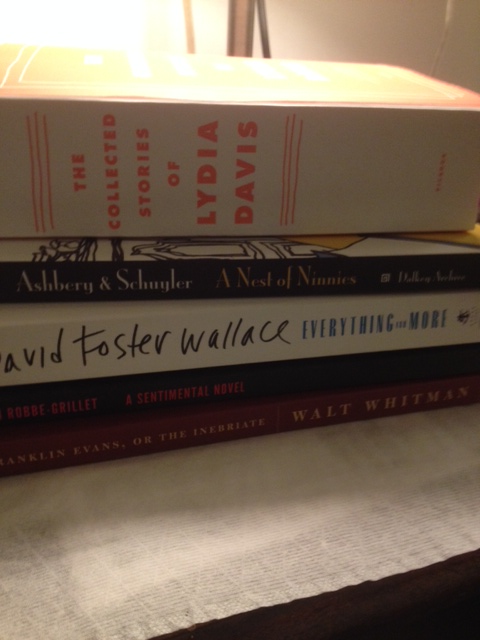
Books Acquired Recently: Strand Edition

Yesterday I once again visited my favorite place in the world, the Strand Bookstore at 12th and Broadway in Manhattan. I was recently remarking to a friend how when I lived within walking distance of the Strand about a decade ago it always seemed like I would go there and there would be a book specifically waiting for me, whether it was the book that I had gone there to look for in an exquisite edition, or a book that I didn’t know that I was looking for (as I would often go just to browse and see what caught my eye) that grabbed me and was somehow a perfect fit. The past few times I’ve gone to the store this hasn’t happened, and it has been depressing (though, of course, I’ve still enjoyed myself there) as a symbol of how both my relationship to the city and the store itself have changed (the Strand looks fantastic now, but I miss its old, badly lit grittiness before the renovations that were completed seven or eight years ago). But when I went yesterday, it happened again in three instances! It was tremendously exciting.

I eschewed a shopping cart when I entered the store, vowing that I would only buy as much as I could carry in one hand. I am proud that I had enough fortitude to stick to this vow, which is why I only bought five books.

Ashbery, John, and James Schuyler. A Nest of Ninnies. 1969. Champaign: Dalkey Archive, 2008.

I have been wanting to read this novel for quite a while because I am a big fan of the New York School poets and because I enjoyed Schuyler’s novel What’s for Dinner?, but it is a relatively minor work and thus I have never gotten around to it. But there was a stack of copies on one of the fiction tables at the back of the store on the first floor, and it was priced at only $5.95 new, so I had to have it.

Davis, Lydia. The Collected Stories of Lydia Davis. New York: Picador, 2009.

I have never read any of Davis’s work before, but recently read an article about her in the New Yorker that intrigued me, so I decided that I would begin looking for this collection the next time I was in a good (i.e., not Barnes & Noble) bookstore. Of course the Strand had a stack of this aesthetically pleasing volume right at the front of the store!

Robbe-Grillet, Alain. A Sentimental Novel. 2007. Trans. D.E. Brooke. Champaign: Dalkey Archive, 2014.

I have enjoyed the work of Robbe-Grillet’s that I’ve read, so I picked this book up while browsing and was immediately drawn to it by the beginning of its blurb: “In France, Alain Robbe-Grillet’s final novel was sold in shrink-wrap, labeled with a sticker warning that this adult fairy tale might offend certain sensibilities.” Sold! I read it on the train ride home and enjoyed it (on an academic level, you dirty-minded readers) for the most part. It is like a better version of Sade without all of the political diatribes.

Wallace, David Foster. Everything and More: A Compact History of Infinity. 2003. New York: Atlas-Norton, 2010.

I love David Foster Wallace, so I bought this book even though I am not a mathematics enthusiast. I appreciate learning about intellectual history, though, and am therefore hopeful and expectant that Wallace will make this subject fascinating to me. After I read his unfinished novel The Pale King, which is mostly about IRS agents, I was half-tempted to become an accountant, so I am confident that my investment in this volume will not have been in vain.

Whitman, Walt. Franklin Evans or The Inebriate: A Tale of the Times. 1842. Ed. Christopher Castiglia and Glenn Hendler. Durham: Duke UP, 2007.

I love Whitman’s poetry, but have never read this, his only novel, which is supposed to be awful. I’ve been wanting to read it since one of my students did a presentation on it this past year, and when I saw it I knew I had to buy it immediately because I am acquainted with Chris Castiglia! He is a lovely man who teaches at Penn State. It is always exciting to buy a book by someone whom you know. Thus I will enjoy reading it even if the novel itself is terrible.

The New York Rangers, the Stanley Cup, and Nostalgia

The Stanley Cup Final between the New York Rangers and the Los Angeles Kings begins tonight. I’ve been a Rangers fan since 1990, when I decided to root for them in their first-round playoff series against the Islanders. I began following the team closely during the 1991-1992 season, Mark Messier’s first with the team, as they won the President’s Trophy before being shocked by the Pittsburgh Penguins in the second round of the playoffs.

But, of course, my fondest Rangers memories are from the 1993-1994 season, which culminated with them winning the Stanley Cup for the first time since 1940. I was in eighth grade that year, and had several classmates who were also fans to talk about the team with. I listened to most of the games on the radio because my family did not have cable. The games were usually on 660 WFAN unless they were at the same time as a Knicks game, in which case they got bumped over to 1050. Howie Rose did play-by-play and Sal “Red Light” Messina was the color commentator. However, the one game I got to watch on television all season was game 7 of the Eastern Conference finals against New Jersey, so I missed Rose’s famous “Matteau! Matteau! Matteau!” call of Stéphane Matteau’s double-overtime series winning goal live, though WFAN replayed it numerous times over the next few days. (Here is a clip of the play with Rose’s call.)

Most hockey fans are familiar with Rose’s call now, as it gets replayed every time the Rangers have a big playoff game, and it is one of the greatest North American sports announcing moments ever. But what gets forgotten, and, in hindsight, what was terribly unfair to Rose, is that the Rangers decided to let their long-time play-by-play man Marv Albert announce periods one and three of games 5 and 7 as the team tried to win the cup on home ice, with Rose doing period two. Now, Marv Albert is my favorite announcer of all time; he is the best basketball announcer of all time and is quite a good hockey announcer (much better than his younger brother Kenny, who absolutely murdered this year’s Western Conference finals for NBC). But it seems cruel to have taken this moment away from Rose, though now he’s an announcer for the Islanders, so who cares, I suppose.

But at the time, I was excited to have Albert announcing game 7. I was listening to the game in the living room on our family’s stereo, lying on the carpet, wishing I could be watching on television. The local Fox station, channel 5, tried to broker a deal with the MSG Network to show the game on free television to no avail, though they were able to show all of the post-game festivities. My most vivid memories from the game involve my favorite player, Brian Leetch, whom I had liked since his time with Team USA during the 1988 Olympics in Calgary. I remember the excitement in Albert’s voice just before Leetch opened the scoring in game 7. I knew he was going to score before he scored, and then he did score, and from that point on I knew the Rangers were going to win. I also remember Leetch throwing a hip check later on that sent one of the Canucks flying, and how excited Albert got again: you could tell that the game and the team meant a lot to him personally, which is a side of himself that he very rarely shows on air. (The hip check is at 2:40 of this video, and Leetch’s goal is at 1:05.)

My family moved away from New York a few weeks later, and though I continued to root for the Rangers, it was never the same. I couldn’t listen to the games on the radio, and had to be content to catch a game whenever the Rangers were on nationally on ESPN or Fox with that ridiculous highlighted blue puck and stupid scoreboard robots (which Fox still uses in their NFL telecasts! Unbelievable.). I would always watch the Rangers in the playoffs, but without the bond that gets built up over a long season the games never felt nearly as life-and-death as they did in ’94.

As I grew older, baseball reasserted itself as my favorite sport and soccer became a close second, and now I follow the Mets and Manchester United with the same day-to-day devotion that I used to give to the Rangers. I’ve become closer to the Rangers now than I have been in years because I live in New York again, and I get MSG so I can watch them whenever I want, but I also know that I will never love them as much as I loved them then (a horrible admission, I feel dirty all over putting it in words, but it is the truth). In reality, all of my interactions with the Rangers since the mid-1990s have been a form of nostalgia for the 1994 team, an attempt to get back to those feelings of sheer joy and wonder.

Nevertheless, as the finals begin tonight, I’ll be rooting hard for the guys in blue, red, and white, and hoping that they will create some unforgettable triumphant moments of their own. Who will be this year’s Stéphane Matteau? Which save by Henrik Lundqvist will be remembered like Mike Richter’s save of Pavel Bure’s penalty shot in game 4 of the ’94 finals? (You can see video of it here. I love John Davidson’s reaction when the penalty shot is called: “Get your cardiologist!”) And most importantly, whose smile will be as big when they lift the cup as Mark Messier’s was when he held it high in front of all those screaming fans at the Garden?

Let's go, Rangers!
Let’s go, Rangers!

Book Acquired Recently: Roller Girls Love Bobby Knight

Hampton, Michael Wayne. Roller Girls Love Bobby Knight. Oregon: Artistically Declined, 2014.

A pre-order advertisement for this book showed up in my Facebook feed a few months ago, and I ordered it because I loved the title, and I also like to support small independent publishers (Artistically Declined Press’s website is here; I must say that it vexes me that they do not list a specific city of publication, only a state. But the book did come with a nifty “Books Are Better” bookmark). I love roller derby and thought it would be cool to read a novel about it. The self-proclaimed “novella” (it is only 108 pages) showed up in my mailbox today and I read it immediately.

Unfortunately, Hampton’s story is a dud at best and offensive at worst. The premise is promising: a down-on-her-luck single mother and her younger daughter arrive in a small Kentucky town where her older daughter has just bought an old skating rink in order to stage roller derby bouts; hilarity ensues. But the story is never interested in these women as people, only as tits-and-ass. If the book had been written by a woman, it would be a fun story of female empowerment, but written by a man the female characters are just exploitative cardboard cutouts. They love flaunting their fantastic curves, are super heterosexual (which is frankly not an especially accurate portrayal of the roller derby world), and are desperate to find men to complete them even though the men in their lives are all terrible. They all use language that reads like an Onion parody of the dialogue from Steel Magnolias.

It is clear that Hampton is trying to make some sort of aesthetic statement about fiction with these simultaneously overly stylized and utterly flimsy characters, but he fails miserably. The writing isn’t thought-provoking, it’s just, well, dickish. This is sad because the novella has the potential to be so much more. The resurgence of roller derby over the past twenty years is a significant social development that deserves to be chronicled in literature, and Hampton’s observation that “[c]hicken fighting, boxing matches, football games, if it’s got honest people hurting each other these folks will eat it up” is an astute one about the role of sports in American society (57). But he fails to consider these subjects in any kind of thoughtful manner, instead using them as props for his misogynist tale.

Book Acquired Recently: A Room With A View

Forster, E.M. A Room With A View. 1908. New York: Barnes & Noble, 2005.

I bought this book this morning at a friend’s recommendation and tore through it, finishing it in several hours. It is a lovely book because of Forster’s smooth prose. He is like a less pretentious Oscar Wilde. The novel’s easy, witty dismissal of the upper class’s prudish values is delightful. While I dislike the book’s insistence on marriage for Lucy and George (this conventional choice seems incongruous with the rest of their decisions), I appreciate its insistence that it will be possible for them to live happily, that their sexual license is celebrated rather than condemned. I’ve never read any of Forster’s work before, but I would certainly like to read more of it now.

Books Acquired Recently: Sports Edition

Lions, Bernard. 1000 Football Shirts: The Colours of the Beautiful Game. 2013. New York: Universe, 2014.

One thing I love about football (i.e., soccer) are the uniforms, and I have also been obsessing about the sport even more than usual lately because of the upcoming World Cup, so when I found out about this book I bought it immediately. It is difficult to find good books here in the U.S. about soccer, so I am especially attracted to books such as this that attempt to offer comprehensive histories of various elements of the game.

I will begin reading the book this afternoon, but I must note that I am immediately skeptical of it after looking at its cover. There are 130 shirts total pictured on the front cover, back cover, and spine, but none of these are from the biggest club in the world, Manchester United. There are two Liverpool shirts, a Chelsea shirt, a Manchester City shirt, an Everton shirt, and eight shirts from MLS (including the LA Galaxy home shirt twice, along with their change strip: blatant proof of David Beckham’s continuing commercial power). I love MLS, and I like Everton because I hate Liverpool, but there is no way that any of these nine shirts are more important than Manchester United’s. This is a ridiculous omission which makes me question the biases of Lions and his publisher’s designers. I hope that the text itself meets a higher standard.

Slocum, Frank, and Red Foley. Topps Baseball Cards: The Complete Picture Collection: A 40-Year History, 1951-1990. New York: Warner, 1990.

I collected baseball cards seriously as a boy between 1987-1990, and always preferred Topps over Donruss or Fleer. While I am no longer an avid collector, I will still buy a few packs (always Topps) every once in a while for nostalgia’s sake, and I buy a Mets team set each year. As a result of this fondness for the hobby, I have had my eyes on this book for several years, and finally found a copy for a reasonable price. It is much larger than I expected, which is exciting; I can understand why it was so difficult to find a copy for less than $50.00.

Both books were acquired from amazon.com’s network of independent sellers.

Thoughts on Landon Donovan’s Exclusion from the U.S. World Cup Roster

I am still stunned by the news that Landon Donovan has been left off of the U.S.’s final 23-man World Cup roster. Donovan is the best American soccer player ever, and while he is no longer in his prime, he certainly has some good years left in him. It is a bold move by national team manager Jurgen Klinsmann, one that many will point to critically if the U.S. does poorly in Brazil.

From a purely talent-based viewpoint, I can understand Donovan’s exclusion, kind of (I’m sorry, but there is just no way that someone such as DeAndre Yedlin will somehow be more valuable to the team than Donovan would have been [and yes, I realize they play different positions], but I suppose that Klinsmann’s choice shows that Donovan would have been on the periphery of the squad anyway, so it probably doesn’t matter in terms of who has an opportunity to be on the pitch). He has not been in good form this season, in part because of a nagging injury. Had he been selected to the squad, he would not have been starting. But I wonder about the psychological impact his absence will have on his (now former) teammates. Klinsmann may feel that the roster he has chosen is the strongest one, but do the players? Donovan is still the U.S.’s most visible player, both among casual American soccer fans and among European fans and players. He is a player that other national teams worry about facing, and that psychological advantage is now lost.

I also certainly question Klinsmann’s decision as a fan because I think Donovan has done enough for the U.S. Men’s National Team, and for soccer in America in general, that he deserves to play in one more World Cup. Donovan’s breakout performance came during the 2002 World Cup alongside the U.S.’s other hotshot young gun DaMarcus Beasley, and I never would have guessed that Beasley would be playing in this year’s World Cup (and he’ll probably be in the starting lineup!) and Donovan wouldn’t.

Terry Collins Needs To Go

The Mets had an excruciating 1-0 loss to the Yankees last night that epitomized their up-and-down season. They got a tremendous pitching performance from Jacob de Grom, who was making his major league debut. de Grom got through seven innings in less than 100 pitches, and only allowed one run, which, as I am about to explain, was not really his fault.

The loss was especially frustrating for two reasons: First, the offense was unable to give de Grom any kind of support. This has been a Mets trademark since at least 2005 in Pedro Martinez’s starts; the ace pitches well and the offense falls asleep. The Mets were shut out for the second game in a row, which is never acceptable.

Second, and most importantly, the one run that de Grom gave up should never have scored. In a tight ballgame, it is essential for every player on the field to play their part, and the Mets defense last night failed to do so. The player who scored the run, Brian McCann, should have been erased on an inning-ending double play in the seventh inning, but, as Keith Hernandez noted during SNY’s broadcast of the game, Daniel Murphy didn’t charge the ball before throwing it to second base, and David Wright made a lazy throw to first that McCann barely beat out. These two mistakes are not excusable, but they were compounded by one that was completely preventable. The next batter up hit a line drive to left-centerfield that went all the way to the wall, allowing the slow-footed McCann to score all the way from first. However, as Gary Cohen pointed out, if Juan Lagares had been playing centerfield instead of Chris Young, the ball would have been cut off before it reached the wall and the throw from the outfield would have arrived quicker (both because the distance would have been shorter and because Lagares has the best outfield arm on the team), making it impossible for McCann to score.

This leads to the question, why wasn’t Lagares playing? Mets manager Terry Collins has left him out of the lineup for the past two nights even though he is one of the best outfielders in the entire league and he has been the Mets’ second most consistent hitter after Murphy. There is no way that any of the other three outfielders should be starting ahead of Lagares, let alone for more than one game in a row. But Eric Young, Jr. has had a good week getting on base even though his advanced statistics are horrible, and Chris Young and Curtis Granderson both have big contracts, so Collins pencils them into the lineup automatically. This is terrible managing. In the case of Young, Jr., Collins shows that he is not a sabermetrically-minded manager, which is a problem because the Mets have been built by a sabermetrician general manager, Sandy Alderson, so Collins is failing to take advantage of the resources he has been given to win games. In the case of Chris Young and, especially, Granderson, they have underperformed consistently over a long enough stretch of time that they do not deserve to have guaranteed starting spots.

This mismanagement is the latest example of how Collins’s decisions have been hurting the Mets all year. He has consistently made questionable decisions regarding the use of the bullpen, and his management of the lineup has been guided by outmoded “baseball wisdom” instead of solid logic. Collins has done a good job as a caretaker manager over the past few seasons while the Mets have slowly been rebuilding themselves into a contender, but now that they have a decent team that could legitimately challenge for a playoff berth this year (yes, everyone is pointing towards next season as the time when the Mets will be serious contenders, but with the way the National League is shaping up this year they could have a shot, as they are currently only 3.5 games back of first place; certainly having a winning season is a very reasonable expectation), they have no room for errors such as Collins’s questionable decisions.

Therefore, just as the Mets have been bringing in new blood from AAA over the past few weeks, it is also time for them to make a managerial change. Terry Collins needs to go. I would personally bring up Wally Backman from Las Vegas (he has managed Vegas to a 29-11 record thus far this year) as interim manager for the rest of the season to see whether he is a worthy candidate for the full-time job, but at this point I would be happy with anyone other than Terry Collins.

Books Acquired Recently: More Mennonites Edition

Wiebe, Dallas. Our Asian Journey. Waterloo: mlr, 1997.

I have been wanting to read this novel for years, but it is out of print and rare. Every once in a while I check for it online to see if I can find a reasonably-priced used copy, and this time I was happy to find a copy in excellent condition for only $25.00 on abebooks.com. Wiebe was one of the few American Mennonite fiction writers, and I look forward to reading more of his work.

Wright, David. Lines from the Provinces. N.p.: greatunpublished, 2000.

As I mentioned in a recent post, I plan on doing some writing about Wright’s poetry this summer. I acquired this book from one of the independent booksellers on amazon.com for this purpose. It is blurbed by one of my favorite poets, Jeff Gundy, which makes me especially eager to read it.