Books Acquired Recently: Holiday Gift Edition

This post lists the various books I’ve received as gifts this holiday season. I actually didn’t ask for very many this year (I went a more purely aesthetic route, getting some snazzy clothing and several pieces of art), hence the small number, though I’ll probably buy a few more with some holiday cash. There are also more books coming from relatives who shipped them late, so expect a part two to this post sometime soon.

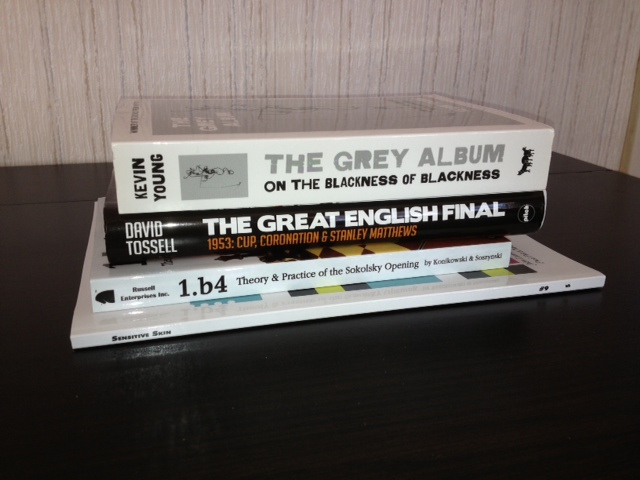
Konikowski, Jerzy, and Marek Soszynski. The Sokolsky Opening: 1. b4 in Theory & Practice. Milford: Russell, 2009.

1. b4 was my favorite opening as white when I played chess regularly, and soon after this book came out I put it on my amazon.com wishlist because I enjoy collecting books about such a deliciously esoteric opening. The book will be good to have on hand when I begin playing again.

Sensitive Skin 9 (2012).

This journal issue includes a story by my favorite author, Samuel R. Delany. I have heretofore been unfamiliar with Sensitive Skin, but in flipping through the issue it looks like a venue for some exciting writing and fascinating art work.

Tossell, David. The Great English Final: 1953: Cup, Coronation & Stanley Matthews. Durrington: Pitch, 2013.

I have been fascinated by the 1953 FA Cup final between Blackpool and Bolton Wanderers ever since I read Paul Gardner’s firsthand account of it in his book The Simplest Game. I am eager to read Tossell’s description of why the match has remained so ingrained in soccer fans’ memory, which contextualizes the match within early-1950s British society.

Young, Kevin. The Grey Album: On the Blackness of Blackness. Minneapolis: Graywolf, 2012.

This again is a book that I have had my eyes on since I first heard about it. It examines African American literature within the broader context of American pop culture.

Book Acquired Recently: Stand Our Ground: Poems for Trayvon Martin & Marissa Alexander

Osayande, Ewuare X., ed. Stand Our Ground: Poems for Trayvon Martin & Marissa Alexander. Philadelphia: FreedomSeed, 2013.

I received this anthology from my father, who works with Osayande at Mennonite Central Committee. I am incredibly excited to read it, as it looks to be an important addition to the long tradition of politically-activist poetry anthologies (Sam Hamill’s Poets Against the War is another relatively recent example) as well as to the rich tradition of African American anthologies in that it responds to America’s ongoing racism, although not all of the contributors are black.

Stand Our Ground includes poets from all over the world, though most are from the U.S. Impressively, the book’s list of contributors is quite democratic, including work by well-known authors such as Amiri Baraka, Sonia Sanchez, Haki Madhubuti, and Askia Touré alongside work by a few writers with hardly any publishing history, and all levels in between. Kudos to Baraka, et al. for contributing to this project, because I am sure FreedomSeed Press did not have money to pay any kind of substantial rights fees. Osayande and FreedomSeed also deserve praise for putting the book together so quickly. All of the proceeds from sales of the book go to either Martin’s family or Alexander’s continued fight for justice.

I was flipping through the book last night, and read Baraka’s poem “I liked us better,” which reads like a piece from his Black Arts Movement heyday (my favorite period of his work), asserting that “I liked us better when we were / shouting and marching and intent // On changing everything. I liked us better when we / didn’t dig white people so much” (35). I love that though he is almost 80, Baraka is still speaking uncomfortable truth to power unabashedly. I love that he refuses to back down, and that he takes pride in the fact that he was so controversial as the poet laureate of New Jersey that the state abolished the position rather than keep him around. His inclusion in Stand Our Ground, along with that of the other luminaries mentioned above, shows that poets can still be relevant as prophets, that literature still has a role to play in the fight for positive social change. Stand Our Ground is an important book that everyone should read.

The Ten Most Influential Books List

I recently participated in the Facebook meme that asks for a list of the ten most influential books on a person’s life. Here is my list with some brief comments:

1. boneyard by Stephen Beachy—This book showed myself to me in an exact way that I had never encountered before in literature. Queer and Anabaptist: two great tastes that taste great together.

2. Extremely Loud & Incredibly Close by Jonathan Safran Foer—My favorite book until I read boneyard. I’ve read it over half-a-dozen times and it always makes me cry. The last line is heartwrenching: “We would have been safe.”

3. questions i asked my mother by Di Brandt—Really all of Brandt’s poetry, but this collection is the one that I read first and that stays the most vivid in my mind. Brandt gave me a model for how to be transgressive when I really needed one.

4. Sleeping Preacher and 5. Eve’s Striptease by Julia Spicher Kasdorf—These two books feel inseparable for me. Kasdorf was the first poet whose work I read that made me realize that poetry could be relevant to my life.

6. Rhapsody With Dark Matter by Jeff Gundy—I had the same reaction to Gundy’s work as I did to Kasdorf’s. (Also, it drives me nuts that “with” in the title shouldn’t be capitalized here. What a dumb rule. I think it’s a significant enough word that it should be capitalized, which is why I have done so.)

7. The Tides of Lust by Samuel R. Delany—This isn’t my favorite Delany novel, but it’s the first one that I read (I also did a dissertation chapter on it), and it was good enough to get me interested in all of the others. Delany is the author whose work has been most influential on my current thinking.

8. Tearoom Trade: Impersonal Sex in Public Places by Laud Humphries—I read this while doing research for a paper during my senior year of college, and it completely changed my view of the world because it told me about a practice (i.e., anonymous gay sex) that I had no idea existed. It taught me to begin looking at the margins, because that’s where the really interesting, revolutionary stuff happens. It also helped me to see physical space in a new way.

9. The Blue Mountains of China by Rudy Wiebe—In hindsight, this was my first encounter with postmodern fiction, which is now my favorite kind of fiction. When I first read it, its ethical vision was extremely formative for me.

10. My Name is Asher Lev by Chaim Potok—This was the first text I read that explored the relationship between religion and art in a serious way. If I hadn’t read this book, the words of the poets mentioned above would have fallen on deaf ears.

Three observations on this list: 1. It is overwhelmingly Mennonite, showing that no matter how hard I try I just can’t get away, and 2. I encountered half of the texts while at Goshen College, which proves something about the importance of a good liberal arts education. 3. After a few days’ reflection, I still stand by the list’s accuracy. The only glaring omission is Nicholson Baker’s The Mezzanine (But what would it replace? My first thought is Potok’s novel, but reading My Name is Asher Lev made my appreciation of many of the rest of the books on this list possible), which I actually think about more than any other book because of its chapter on public restrooms. Every time I go into a public restroom that I haven’t been in before (i.e., the restroom at my job doesn’t count because of how frequently I use it), I check to see whether it has a paper towel dispenser (and if so, what kind) or a hand dryer. The science of hand dryers has advanced a lot since the novel was written, and so sometimes they are better than paper towels, but I still generally agree with the novel’s argument in favor of the paper towels. Both options need to be well-designed in order to fulfill their function of getting one’s hands dry in a sanitary manner, though. It almost is not fair to compare them as entire categories.

Thoughts on the 2014 World Cup Draw

Well, the United States will have their work cut out for them in the 2014 World Cup, as they have been drawn in the Group of Death with Germany, Portugal, and Ghana. A win in the first match against Ghana is a necessity, and then the U.S. will have to hope for a result against one of the European sides. The U.S. was so close to having an easier draw, as they could have been drawn in Group E (Switzerland, Ecuador, France) in place of Honduras, or if Russia had been drawn in Group G instead of Portugal. Group F is also rather tame, with Argentina, Bosnia, Iran, and Nigeria.

The U.S. has played all of its opponents in previous World Cups. The team will try to replicate the famous 3-2 victory over Portugal in 2002, and try to reverse the 2-0 defeat to Germany in 1998 and the tournament-ending losses to Ghana in the previous two tournaments. The U.S.-Germany match will have the Jurgen Klinsmann storyline, and the U.S. beat Germany in a friendly earlier this year, so there is some hope.

The U.S.’s arch rivals Mexico have a decent draw, with Brazil, Croatia, and Cameroon. Group B has Spain, Holland, Chile, and Australia, with the first match being a rematch of the 2010 final. The first round match-up between England and Italy in Group D (the Group of Death part two) should be interesting. Uruguay is the other contender in that group. All of the groups have at least three legitimate contenders to advance, so the tournament should be an exciting one.

Books Acquired Recently: R.J. Julia Edition, and Some Thoughts on the Form

First, let me say that obviously my blog has been taken over by Books Acquired Recently posts in recent weeks. This is partly a manifestation of my book-acquiring addiction and partly a manifestation of the busyness of my first semester teaching at Utica College: I just haven’t had time to write about other subjects. I hope the blog’s subject matter becomes more diverse again during the month-long Winter Break that is fast approaching.

Second, I’ve mentioned this before, but for any new readers out there, the Books Acquired Recently idea is a blatant rip-off of Nick Hornby’s column in The Believer, in which he discusses books that he’s recently read and acquired. I love being a voyeur of other people’s libraries because it is one of the best ways to learn about a person, and thus I enjoy allowing others to view the process of continuing to build my own library. What can I say? I’m a literary exhibitionist.

Third, the recently acquired books themselves: Over the Thanksgiving break I visited some relatives in Connecticut, and they took me to the delightful R.J. Julia Booksellers in Madison. The store’s three floors are architecturally pleasing, with inviting nooks for each section and plentiful cushioned chairs for customers who wish to investigate potential purchases without getting in the way of other patrons. The inventory is large, and the staff is friendly (not an easy task on Black Friday).

Baker, Nicholson. Traveling Sprinkler. New York: Blue Rider, 2013.

As regular readers of the blog know, Baker is one of my favorite writers. I didn’t realize he had a new novel out, but found Traveling Sprinkler in the store’s New Fiction section after I had already purchased the other two books and was waiting for everyone else in my party to be ready to leave. Of course I bought it as soon as I noticed it. I’m about a third of the way through the book, and while thus far it is not as good as its prequel, The Anthologist (which I love because it is The Nerdiest Book Ever), it has been smoothly enthralling like nearly all of Baker’s fiction.

Incidentally, Blue Rider also published the hardcover of Dickey’s memoir.

—. The Way the World Works: Essays. 2012. New York: Simon, 2013.

This book has been on my list of “books to buy eventually” since it came out. I enjoy Baker’s nonfiction, but reading it is always somewhat of a disappointment because it just isn’t as good as his fiction (which is not meant as a criticism: the two genres have different purposes, and nonfiction is much less concerned with creating a transcendent experience in the reader than fiction is). In this collection, Baker writes about essential topics such as how reading and writing are changing in the digital age. Everyone should be reading him.

Dickey, R.A., with Wayne Coffey. Wherever I Wind Up: My Quest for Truth, Authenticity, and the Perfect Knuckleball. New York: Plume, 2013.

I have been meaning to read Dickey’s memoir since it came out just before the 2012 baseball season, and then decided to wait to purchase it until after the paperback came out because I assumed it would have extra material on his phenomenal 2012 year when he won the National League Cy Young Award. The Plume edition does, indeed, have a new chapter. Although I probably will not get around to reading Wherever I Wind Up until the spring when I begin craving baseball again, I decided to purchase it now because R.J. Julia is an independent bookstore well worth supporting.

Books Acquired Recently: Retiring Colleague Edition

One of my colleagues is retiring after this semester, and she gave me some of her books dealing with African American literature because it is one of my research interests. I am happy to preserve some of her library by integrating it into my own. Several of the paperbacks are from the 1970s and have some seriously groovy covers.

I also just got three more desk copies for next semester in the mail, so it was a good day for books!

Chesnutt, Charles W. The Portable Charles W. Chesnutt. Ed. William L. Andrews. New York: Penguin, 2008.

I have another collection of Chesnutt’s short stories published by Mentor, but this volume also includes Chesnutt’s novel The Marrow of Tradition and some essays. And, of course, it is always good to acquire a Penguin paperback.

Fitzgerald, F. Scott. The Great Gatsby. 1925. New York: Scribner, 2004.

Sadly, the earlier Scribner paperback edition that I was assigned in high school and have myself assigned previously is now out of print. This one was necessary to acquire because it has different page numbers.

Flowers, Arthur. Another Good Loving Blues. 1993. New York: Ballantine, 1994.

This book is inscribed by the author.

Gilyard, Keith, ed. Spirit & Flame: An Anthology of Contemporary African American Poetry. Syracuse: Syracuse UP, 1997.

This one is also inscribed by the author.

Klosterman, Chuck. Downtown Owl. 2008. New York: Scribner, 2009.

I have taught some of Klosterman’s essays before, but next semester will be the first time I teach any of his fiction. I am excited to see what my students think of him. I think they will love this book, but their tastes often surprise me.

Lunsford, Andrea A., John J. Ruszkiewicz, and Keith Walters. Everything’s An Argument, with Readings. 6th ed. Boston: Bedford, 2013.

I’ll be using this book in my writing class for the first time in about a decade. I enjoyed it before, then tried other strategies and texts, and now have decided to go back to it and see how it has aged as a text and how I have aged as an instructor.

McKay, Claude. Banana Bottom. 1933. San Diego: Harvest, 1961.

This book has a price tag from the Strand on the front cover! It was on sale for $1.95–regularly $6.95.

Reed, Ishmael. The Last Days of Louisiana Red. 1974. New York: Bard, 1976.

I’ve enjoyed the bit of Reed’s fiction that I have read in the past, and look forward to reading this novel. The blurb on the front cover from the Village Voice calls it a “saucy underground classic.” Say no more!

Toomer, Jean. Cane. 1923. New York: Norton, 2003.

I have the Liveright edition of this novel, but it’s always nice to have a copy of one of Norton’s critical editions as well.

Washington, Mary Helen, ed. Black-Eyed Susans: Classic Stories by and About Black Women. New York: Anchor, 1975.

Morrison, Walker, Bambara, et al. A great period piece.

Yerby, Frank. The Vixens. New York: Dial, 1947.

This nearly seventy-year-old book is in excellent condition.

Youngblood, Shay. Soul Kiss. 1997. New York: Riverhead, 1998.

The least-exciting looking book of the bunch, but it was good enough to make it into paperback, so we’ll see.

Book Acquired Recently: Philip Fried’s Early/Late

Fried, Philip. Early/Late: New & Selected Poems. Cliffs of Moher: Salmon, 2011.

The New York City-based poet Philip Fried gave a delightful reading at Utica College this afternoon, and I bought his book afterwards. I had only read a few of Fried’s poems in anthologies before, and am very glad to have had this chance to experience more of his work. The poems he read are rife with sharp, vibrant story lines that often use a wry sense of humor to draw the reader in. Many of them are explicitly political, but not at the expense of artistry, a rarity. If you love poetry, you should be reading his work, and if you are not yet into poetry, his work is a good, accessible place to start.

I had the opportunity to have lunch with Fried after the reading. He is a lovely person: kind, well-read, unpretentious, with a clean-cut sartorial panache about him. He seemed genuinely interested in getting to know me and the others at the meal even though we were strangers, and projected an infectious love of literature throughout the conversation. Being around him was incredibly energizing because it reminded me why I love literature and believe in the importance of teaching it. There’s just something we get in literature that we can’t get anywhere else.

Books Acquired Recently

Arenas, Reinaldo. Before Night Falls. Trans. Dolores M. Koch. 1993. New York: Penguin, 1994.

I’ve been wanting to read this book for a while, as it combines two interests of mine, queerness and Cuba. I’ve actually hardly read any Cuban literature, which is a problem that I need to remedy. Arenas’s memoir is a start.

Coverley, Merlin. Psychogeography. Harpenden: Pocket Essentials, 2010.

I’m teaching a course next semester that involves doing spatially-themed projects about Utica, and will read this book as part of my theoretical preparation. Judging from my brief examination of it thus far, the book looks accessible enough that I may assign parts of it to my students.

Both books acquired on amazon.com.

Books Acquired Recently: Desk Copies Edition

DeLillo, Don. End Zone. 1972. New York: Penguin, 1986.

I’ll be teaching this novel in my Literature in Focus: Teens and Twenty-Somethings course next semester. The course only includes books with youngish protagonists. End Zone is the story of a college football team in Texas, and I am including it in the course with the hope that it will help some of the student-athletes who don’t read for fun realize that there is literature out there that speaks to their experiences. The novel is the best (and, frankly, one of the only) novel about American football by far. It is fascinating to me that there haven’t been more books written on this subject, considering that Americans are obsessed with it (and, of course, DeLillo does an excellent job exploring football as a metaphor for the American psyche). Perhaps this is because of football’s brutish nature. It appeals to a different mindset than a sport like baseball does, which has inspired a literary tradition almost as rich as the game itself.

Steinbeck, John. The Grapes of Wrath. 1939. New York: Penguin, 2006.

This has been one of my favorite novels since I first read it in high school, and I am finally going to teach it for the first time, in my American Literature After 1865 survey. Its length is right on the edge of what is possible to teach to undergraduates without them losing interest, but I think that the compelling storyline and the richness of Steinbeck’s prose will keep them engaged.

Books Acquired Recently: Gary Leising Edition

Leising, Gary. Fastened to a Dying Animal. Columbus: Pudding House, 2010.

—. Temple of Bones. Georgetown: Finishing Line, 2013.

I bought these two chapbooks at a poetry reading by my colleague Gary Leising last night. I had never read any of his poetry before, and was thus happy to discover that I really enjoy it. Leising’s poetry reminds me of work from the New York School in that it elevates everyday occurences to the level of the profound, and also smoothly incorporates elements of pop culture into its narratives. For example, my favorite poem from the reading, which is brand new and thus not included in Temple of Bones, is about Scarlett Johansson suing a French novelist for including a character named “Scarlett Johansson” in one of his books (which is obviously a ridiculously frivolous lawsuit. Good job being on the side of censorship, Scarlett.). The narrator of the poem then goes on to use Johansson’s name repeatedly, openly hoping that she will sue him and his work will get some free publicity. Many of Leising’s poems include this kind of well-crafted playfulness, which is refreshing rather than gimmicky. I look forward to reading more of them!