Ryan Giggs

Manchester United’s bizarre, disappointing season ended today with a 1-1 draw at Southampton. Ryan Giggs coached his last match as interim manager, and it is a good bet that his substitute appearance in the last home match earlier this week was his final one as a United player. Giggs has had a tremedous career since his debut in 1991, holding the club record for appearances and winning two European Cups and numerous league titles and domestic cups. He scored in every season of his career prior to this one.

It is difficult to write about his career simply because it was so successful; had you made up a fictional character with all of Giggs’s accomplishments before he came along no one would have found it credible. He is one of the sport’s all-time greats, and it frustrates me that he didn’t give himself the opportunity to play one last match today.

Here are two clips that epitomize Giggs’s sublime talent and his value to United:

First, his amazing solo effort to win the 1999 FA Cup semifinal against Arsenal, in which he dribbles the ball from United’s half into Arsenal’s penalty area before ending the run with a first-rate finish. This goal epitomizes the banner celebrating Giggs that hangs at Old Trafford: “Ryan Giggs: Tearing You Apart Since 1991.”

Second, highlights from the 1999 Champions League final, United’s greatest triumph, in which Giggs assisted on Teddy Sheringham’s match-tying goal.

Books Acquired Recently: Authors Whose Last Names Begin With W Edition

Wilson, Mookie, with Erik Sherman. Mookie: Life, Baseball, and the ’86 Mets. New York: Berkley, 2014.

I collect books about the 1986 Mets because I, like most Mets fans, am obsessed with that team, so when I heard that Wilson had a memoir coming out I pre-ordered it immediately. It just arrived yesterday. On a related note, here is my favorite YouTube video of all time: the final half inning of Game 6 of the 1986 World Series, which culminates in Wilson’s game-winning ground ball, re-created using the old Nintendo game RBI Baseball.

Wright, David. A Liturgy for Stones. Telford: DreamSeeker, 2003.

I am planning to do some writing about Wright (the poet, not the Mets’ third baseman, though I might do some writing about him, as well) this summer, and bought this book in anticipation of this project. However, I actually almost acquired it over a decade ago. Here is the story: at the 2002 Mennonite/s Writing conference in Goshen, Indiana, there were several raffles (what a weird word!), one of which I won. The prize was a set of books that had recently been published by writers at the conference, including texts by Patrick Friesen, Carla Funk, Julia Kasdorf, Maurice Mierau, and Douglas Reimer. A Liturgy for Stones was supposed to be included in this group, but its publication had been delayed (DreamSeeker had just been founded, and they were still working out the kinks), so it wasn’t there for me to collect with the other books. The conference organizers promised to send me a copy once the book came out, but they never did. I’ve only read a few of Wright’s poems, thus I am excited to finally have a long-delayed in-depth interaction with his work.

Both books were acquired from amazon.com.

Some Thoughts on Periodicals and Books

Today’s Uni Watch post is another edition of “Question Time,” in which site creator Paul Lukas answers questions from readers about himself. For the first time, I sent in a question, which asked about his favorite New York City bookstore (it’s the fourth question listed).

His answer that while he likes bookstores (and he names the Strand as his favorite, which made me happy), he prefers newsstands and magazine shops struck me because his approach to print culture is so different from my own. This difference is of course not a bad thing, because as long as you are on the print side of the print/electronic wars you are my friend, and Lukas is one of my favorite writers because his work always makes me think, and frequently helps me to see things (often literally things, i.e., objects) in new ways. But Lukas’s answer made me think about why I am not nearly as attracted to the periodical realm of print culture as I am to the book realm. Part of the reason is that my job is to analyze books, and this reason would also explain Lukas’s preference: he’s a journalist, so he’s attracted to other workers in the trade.

But I have to admit that one of the other reasons I am attracted more to books than periodicals is that books feel more permanent. They can sit there on my shelf and tell the story of my intellectual pursuits over the years, and when I buy one I feel a sense of accomplishment, and get that adrenaline rush that capitalism trains us to have when we acquire goods. While I have subscribed to the New Yorker for more than ten years along with a smattering of other periodicals here and there, there isn’t that feeling of excitement when it arrives in the mail that there is when a package containing books does. In fact, though I enjoy reading the New Yorker, it often feels like a task that I have to get through rather than a recreational endeavor like reading a book. So my preference says something about my reading habits: I am more willing to lose myself in a book because I know I will have to invest a lot of time in it, whereas with a magazine I feel like it will only be a quick, disposable interaction.

Books Acquired Recently

All of these books were bought with an eye toward my impending summer break, which begins in three weeks!

Ames, Greg. Buffalo Lockjaw. New York: Hyperion, 2009.

Greg Ames gave a reading from his novel-in-progress at Utica College this past week, and I enjoyed it to the point where I decided to buy a copy of his previous book. He has an engaging, DeLillo-esque writing voice that my students also found engaging.

Buell, Lawrence. The Dream of the Great American Novel. Cambridge: Belknap-Harvard, 2014.

This hefty tome received a good review in the New Yorker recently, and I decided to buy it because it looks like it could be helpful for my teaching of American literature. In looking through the table of contents, it is clear that Buell pays attention to ethnic minority writers; we shall see whether he does an equally good job of acknowledging queer writers as well.

Plett, Casey. Lizzy & Annie. Illus. Annie Mok. N.p.: Fireball, 2014.

This illustrated chapbook is a story from one of my favorite queer (and Mennonite!) writers, who also has a collection of short stories coming out from Topside Press this summer. Lizzy & Annie only cost $5.00, and you can buy it here (scroll down to the bottom right for purchasing information).

Wiebe, Rudy. First and Vital Candle. Grand Rapids: Eerdmans, 1966.

I’ve thought about reading this, Wiebe’s second novel, on and off for the past decade or so, and since I’ve been thinking a lot about Mennonite literature lately I decided to finally take the plunge. (However, rather famously among Mennonite literary circles, the book does not actually contain any Mennonite characters, which is partly why it has taken me so long to get around to reading it.) I was able to find a copy of the first Eerdmans edition in fine condition from one of amazon.com’s independent booksellers; there are a few rips in the dust jacket, but the volume itself is in excellent shape.

The way this first American edition was marketed (it was published at the same time in Canada by a more prestigious secular publisher, McClelland and Stewart) is fascinating. The dust jacket includes several blurbs extolling the novel’s Christian aspects. Clyde S. Kilby writes that “[t]his novel stands very close to the top among evangelical novels of this century,” and Charles A. Huttar adds that “Mr. Wiebe is remarkable among Christian novelists for his craftsmanship.” I know that later in his career (which is still ongoing, as rumor has it that Wiebe will soon publish a sequel to his first [highly controversial] novel, Peace Shall Destroy Many), Wiebe would strongly object to being pigeonholed as a “Christian novelist” instead of simply a “novelist,” so I wonder what his reaction to these meant-to-be-laudatory words was.
Books Acquired Recently

Gates, Henry Louis, Jr., and Valerie A. Smith, eds. The Norton Anthology of African American Literature. 3rd ed. 2 vols. New York: Norton, 2014.

I recieved an exam copy of these books from my local W.W. Norton representative. It took quite a while for Norton to update the first edition, so I am glad that they are now updating the book on a frequent basis. I am keeping my copy of the first edition, though, for sentimental reasons: I used it to study for my Ph.D. exams. This is one reason why I have so many books. I value them as pieces of my history, not just as sources of enjoyment or information.

Witkowski, Michal. Love Town. Trans. William Martin. 2010. London: Portobello, 2011.

I learned about this novel depicting the LGBT community in Communist Europe during the 1970s and 1980s from a colleague, and found a copy of it on sale from Better World Books for less than $4.00, so decided to buy it because my knowledge of queer literature outside of the U.S. and England is sorely lacking. The book has a pricetag from the Strand on it, which makes me happy.

Books Acquired Recently: NeMLA Edition

I have been at the Northeast Modern Language Association annual conference for the past few days. Normally this kind of convention offers excellent opportunities for book-buying. However, the conference has been a disappointment in this respect, as the selection at the bookfair was rather paltry. I only bought one book there.

Hosseini, Khaled. The Kite Runner Graphic Novel. Illus. Fabio Celoni and Mirka Andolfo. New York: Riverhead, 2011.

I’ve heard that Hosseini’s novel by the same name is excellent, and have also heard good things about the illustrated edition. It was a steal at $5.00.

I then went to the Midtown Scholar Bookstore, which is a short walk from the conference’s main hotel in downtown Harrisburg, Pennsylvania. I had heard that it was an excellent independent bookstore. While it is true that the store is large and has an inventory covering a wide variety of subjects, it is horribly organized. I was primarily interested in browsing the fiction section, and within this section the books were organized by the first letter of authors’ last names, but within each letter there was no organization whatsoever, not even to the point of putting all of an author’s books next to each other. For instance, in the D section, I saw books by Don DeLillo on at least three separate shelves. In the nonfiction sections, books were alphabetized by their titles rather than by their authors, which made browsing in any meaningful way close to impossible. The store, in short, was infuriating.

Nevertheless, I am such a book-buying addict that I acquired two volumes. I believe in supporting independent bookstores, even badly-organized ones.

Spark, Muriel. Open to the Public: New & Collected Stories. New York: New Directions, 1997.

I recently read some of Spark’s work for the first time and loved it, thus I was delighted to find a like-new hardcover copy of her collected stories for only $6.95.

Welsh, Lindsay. Necessary Evil. 1995. New York: Blue Moon, 2005.

I had not heard of this book or of Welsh before, but I noticed it on the shelf because it has Blue Moon’s distinctive cover design. The book was originally published by Masquerade Books, which published high-quality erotica in the 1980s-1990s. It was also only $6.95.

Books Acquired Recently

Call, Lewis. BDSM in American Science Fiction and Fantasy. New York: Palgrave, 2013.

I was so excited when I found out about this book because it examines two of my research interests. There is a chapter on one of my favorite authors/research subjects, Samuel R. Delany, and another one on Wonder Woman, my favorite super hero. I remember seeing an exhibit of panels from Wonder Woman comics depicting bondage at the Museum of Sex in New York City in late 2002, and I look forward to reading Call’s analysis of this recurring theme.

Self, Will. Psychogeography: Disentangling the Modern Conundrum of Psyche and Place. New York: Bloomsbury, 2007.

The psychogeography project I did with my students this semester has ended, and it went quite well, well enough that I am going to do it again next year. Therefore I continue to look for resources for it, and this book is a part of that search.

Both books were acquired from amazon.com’s network of independent sellers.

Books Acquired Recently: More Birthday Goodies

I recently received these two books as birthday gifts from my sister and brother-in-law. I’ve been wanting to read both since I read reviews of them in recent months.

Block, David. Baseball Before We Knew It: A Search for the Roots of the Game. Lincoln: U of Nebraska P, 2005.

I have been interested in the early roots of baseball since coming across a reference to “base-ball” in Margaret Fuller’s Woman in the Nineteenth Century, which was first published as an essay in 1843, several decades earlier than I had thought the term existed in widespread usage. I am looking forward to learning more about how the game began creeping into the public consciousness before its explosion onto the scene in the 1860s.

Eisner, Shiri. Bi: Notes for a Bisexual Revolution. Berkeley: Seal, 2013.

As someone who is attracted to men and women amongst other gender expressions, I am excited to encounter some new thinking about bisexuality and its potential for sparking social change. While I have used the term “bisexual” to describe myself in the past, and sometimes still use it because it is more broadly understood than my current preferred term, “queer,” I have grown uncomfortable with it because it implies that there are only two genders that one may be attracted to. I am thus intrigued to see what Eisner thinks about the continued usefulness of this term (which, let me make clear, is still a legitimate and important one for people to use if they feel so inclined) and what it can signify.

Books Acquired Recently

I just received two books from a friend as gifts for my upcoming birthday. Both look intriguing and enjoyable, and I hope to read them over my forthcoming Spring Break.

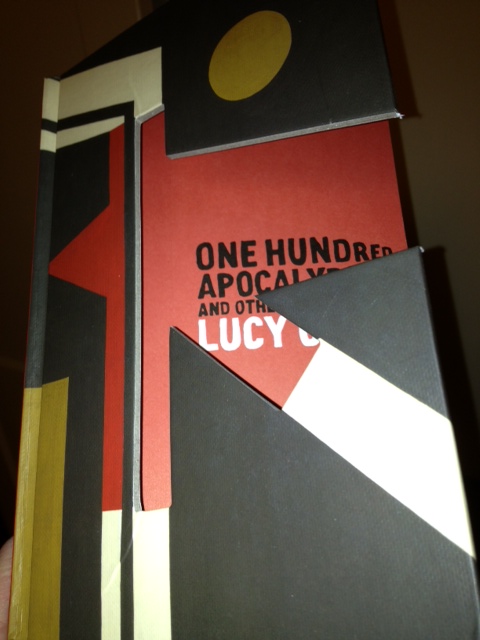
Corin, Lucy. One Hundred Apocalypses and Other Apocalypses. San Francisco: McSweeney’s, 2013.

I recently heard about this book via a “Best Feminist Books of 2013” list on Facebook, and was immediately smitten with the title. The book itself is a beautiful object (as is normally the case with McSweeney’s publications), with an arrow cut out of the cover to reveal the title and author, as can be seen in the photograph below.

Jack, Belinda. The Woman Reader. New Haven: Yale UP, 2012.

I have been interested in the history of readers since reading Ian Watt’s description of the eighteenth century English reading market in his classic The Rise of the Novel in graduate school. Jack’s book on the history of female readers will certainly feed this interest.

Book Acquired Recently: Wieland, Norton Critical Edition

Brown, Charles Brockden. Wieland and Memoirs of Carwin the Biloquist. Ed. Bryan Waterman. New York: Norton, 2011.

I just received this exam copy in the mail. I am going to teach Wieland in my American Literature to 1865 course in the fall, and am trying to decide between assigning the Penguin Classics edition or this Norton edition. My default mode is to assign Penguin paperbacks because they are inexpensive, authoritative, and aesthetically pleasing, but Wieland is a difficult enough text that I thought it might be helpful to have students read some of the supplementary material that Norton always includes in their critical editions. The volume is nearly 600 pages long, but less than 240 of it are the novels themselves (Memoirs of Carwin the Biloquist is Wieland‘s sequel). Make of this ratio what you will.