Books Acquired Recently: Mennonite Literature Edition

As I mentioned in a recent entry, I attended Mennonite/s Writing VII at Fresno Pacific University two weeks ago. Aside from the books that I bought at the conference, I also came away with a number of recommendations of books, and these texts have been arriving in the mail all week. I was able to order nearly all of them from amazon.com’s network of independent booksellers, but in two instances I ran into the issue of books published by Canadian companies not being readily available in the U.S. Thus I had to order Dueck’s book directly from Turnstone Press and Bergen’s book from a Canadian bookseller that I found on abebooks.com.
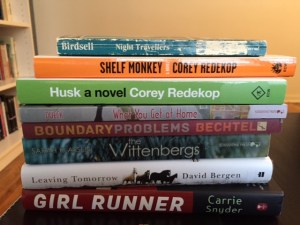
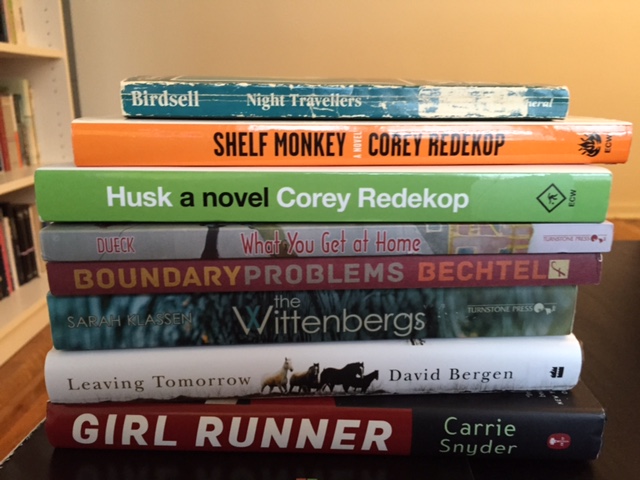
Bechtel, Greg. Boundary Problems. Calgary: Freehand, 2014.

Bechtel writes science fiction and is thus one of the very few Mennonite writers writing speculative fiction. This subfield is growing more and more, however, which is an exciting development.

Bergen, David. Leaving Tomorrow. Toronto: Harper, 2014.

Bergen is my favorite Mennonite novelist, and in recent years he’s been incredibly prolific, but sadly most of these books have not been published in the U.S.

Birdsell, Sandra. Night Travellers. 1982. Toronto: General, 1984.

I read this novel in stories straight through last night. What a powerful, early feminist Mennonite text!

Dueck, Dora. What You Get at Home. Winnipeg: Turnstone, 2012.

I read Dueck’s novel This Hidden Thing several years ago and thought it was only so-so, but I heard that this short story collection includes a story with a queer protagonist, and since LGBT Mennonite literature is a major interest of mine I decided to buy it.

Also, it is important to acknowledge the essential role Turnstone Press has played in support of Mennonite literature since they began publishing Mennonite writers in the 1980s. Aside from Dueck and Klassen, they have also published such heavyweights as Di Brandt, Patrick Friesen, and Miriam Toews.

Klassen, Sarah. The Wittenbergs. Winnipeg: Turnstone, 2013.

I met Klassen at the conference and she gave me a copy of one of her poetry collections for free (which I enjoyed), so I wanted to return the favor by making sure to buy one of her novels as well.

Redekop, Corey. Husk. Toronto: ECW, 2012.

This novel also apparently involves a queer protagonist.

—. Shelf Monkey. Toronto: ECW, 2007.

When I heard about Husk, I went to Redekop’s website to learn more about him and his work, and the description of Shelf Monkey (“Thomas Friesen has three goals in life. Get a job. Make friends. Find a good book to curl up with. After landing a job at READ, the newest hypermegabookstore, he feels he may have accomplished all three. … If you’ve ever thrown a book against a wall in disgust; if you’ve ever loved a novel that no one else can stand; if you obsess over the proper use of punctuation; this may be the novel for you”) was irresistible, so I bought it as well.

Snyder, Carrie. Girl Runner. New York: Harper, 2015.

I read this novel last weekend and it is excellent.
Books Acquired Recently

Hertz, Sue. Write Choices: Elements of Nonfiction Storytelling. Los Angeles: Sage, 2015.

I have been wanting to write more creative nonfiction, and while I’ve had a bit of success getting published in the genre in the past I still don’t feel like I have a good sense of how to write compelling pieces of it consistently. Therefore, when I was offered an exam copy of this book I was happy to take it with the hope that it will help improve my own writing as well as potentially my students’.

Howard, Tim, with Ali Benjamin. The Keeper: A Life of Saving Goals and Achieving Them. New York: Harper, 2014.

I received this book as a birthday present. Howard is the best American goalkeeper ever, and I am excited to read about his life in the sport that obsesses me.

Schulman, Sarah. Rat Bohemia. New York: Dutton, 1995.

A friend recently recommended this novel to me, and I am especially excited to read it now that I see that it has a blurb from Tony Kushner, whose work I love. I bought it from amazon.com’s network of independent booksellers.

Books Acquired Recently: Mennonite/s Writing Edition

This past weekend the Mennonite/s Writing VII conference was held at Fresno Pacific University. It was an excellent time, and as usual the conference had a wide variety of books by authors in attendance available. Despite the fact that I buy most pieces of Mennonite literature as soon as I find out about them, I still managed to come away with four books from the conference, and could have bought more. It’s important to note that three of the four books I acquired are poetry. I haven’t been reading much poetry and I think that subconsciously I was craving it.

Dueck, Nathan. he’ll. St. John’s: Pedlar, 2014.

Dueck and I got to know each other at the conference and we have a lot of both literary and non-literary interests in common. It’s always enjoyable to buy a book written by someone who you like as a person.

Everwine, Peter. From the Meadow: Selected and New Poems. Pittsburgh: U of Pittsburgh P, 2004.

Everwine was one of the featured local writers at the conference (he is not Mennonite, but there is a tradition of having non-Mennonite keynote speakers at these conferences), and gave a fantastic reading on Thursday night. I had never encountered his work before, but his work had the audience spellbound and there was no question about whether I should buy one of his books afterward.

Klassen, Sarah. Monstrance. Winnipeg: Turnstone, 2012.

I actually wanted to buy a book of Klassen’s fiction, but she was sold out. However, upon seeing my disappointment she gave me this collection of poetry as a gift! What a sweet, gracious gesture. I will make sure to order some of her fiction to repay the favor.

Swartley, André. Americanus Rex. Bluffton: Workplay, 2009.

Swartley and I were in college together (he was in the first writing workshop I ever took), and it was good to reconnect at the conference. He had several novels available, and I chose this one based on its blurb. I am about two-thirds of the way through it and am enjoying it thus far.

Books Acquired Recently: City Lights/Birthday Edition

Yesterday I had a ten hour layover in San Francisco on my way back from a conference (I must say that I was quite impressed with the San Francisco airport), so I decided to make a pilgrimage to the famous City Lights Bookstore. I’m glad I went because so much germinal literary history has happened at the store, and overall I was impressed with their selection of books (I was tempted to buy way more than I did; the fact that I had to carry whatever I bought in my backpack during the rest of my trip severely limited my shopping), but I must say that the visit was not the profound experience I was expecting it to be. This is in part because it is virtually impossible for mythologized spaces such as City Lights to actually live up to their idealized versions, but also in part because I realized that I find bookstores that only sell new books like City Lights does to be much less interesting than used bookstores or bookstores that sell both new and used books like the Strand. I don’t mean to be critical of City Lights, because it is an excellent, high quality independent bookstore, but my experience there felt sterile and cold in comparison to the experiences I have had at good used bookstores.

Delany, Samuel R. Phallos: Enhanced and Revised Edition. Middletown: Wesleyan UP, 2013.

Delany is one of my favorite writers and I wrote some about his 2004 novella Phallos in my dissertation. I was pleasantly surprised to discover that he has published a revised, longer edition of the novel, as he has with a number of his most important texts (including The Motion of Light in Water and The Mad Man). City Lights has the largest selection of Delany texts I’ve ever encountered in a bookstore. I was also happy that one of the texts I bought at City Lights was by a queer author considering the important role San Francisco has played in the life of America’s LGBT community.

Komunyakaa, Yusef. Dien Cai Dau. Middletown: Wesleyan UP, 1988.

I have been meaning to acquire this collection of Komunyakaa’s poetry about his experiences during the Vietnam War for quite a while, and decided to finally pounce when I saw it on the shelf. The poetry room was by far my favorite space in City Lights.

My birthday was also this past weekend (I used some birthday money to fund my shopping at City Lights), and I received the following book as a gift:

Pawnee: The Greatest Town in America: Written, Compiled, Researched, Typed, Collated, Proofread, and Run Through Spell Check by Leslie Knope, Deputy Director, Department of Parks and Recreation. New York: Hachette, 2014.

I and the person who gave me this book share a love for Parks and Recreation, thus I was quite pleased to receive it as a gift.

Books Acquired Recently

Ellis, Will. Abandoned NYC. Atglen: Schiffer, 2014.

This book is a collection of images from Ellis’s website of the same name. He goes around New York City photographing spaces that have been abandoned. This is an extremely fascinating topic considering how space is at such a premium in the city. It is difficult to believe that there are lots of empty spaces that exist without being reclaimed or developed.

Sartre, Jean-Paul. No Exit and Three Other Plays. New York: Vintage, 1989.

I must embarrassingly admit that I have never read Sartre before. This week I am covering a class for a colleague and they are reading No Exit, so I bought this book to help facilitate my teaching of it.

Book Acquired Recently: Porn Archives

Dean, Tim, Steven Ruszczycky, and David Squires, eds. Porn Archives. Durham: Duke UP, 2014.

I received this book as a Valentine’s Day present. I saw an ad for it during the holidays (I think in Book Forum) and had put it on my amazon.com wishlist. It interests me in part because I’ve read some of Tim Dean’s work before and really enjoyed it and in part because I am fascinated by how academics study pornography. Pornography itself is such an ephemeral genre (especially these days with so much of it only in digital rather than material form) that the problem of how to archive it becomes an arresting subject.

Book Acquired Recently: David Peace’s The Damned Utd

Peace, David. The Damned Utd. 2006. Brooklyn: Melville, 2014.

I recently read Peace’s novel about Bill Shankly, Red or Dead, and enjoyed it enough that I decided to explore more of his work. The Damned Utd is about Brian Clough’s short tenure as manager of Leeds United. Clough is a figure who has long fascinated me because of his highly successful time as manager of Nottingham Forest, which resulted in a string of trophies that will probably never be repeated by a small English club again. I am excited that Melville House has published an edition of the book, since most soccer novels only get published in England, and thus are impossible for me to assign in my classes because the bookstore is unable to acquire enough copies. If The Damned Utd is, as a review from the Times claims, actually “the best novel ever written about sport,” I might decide to teach it sometime.

I purchased the book from amazon.com.

Thoughts on Combining Personal Libraries

I just came across this excellent article by Alexander Chee (whose novel Edinburgh is fantastic, incidentally) about the issue of combining libraries when one moves in with a new romantic partner. This is a topic that I have thought a lot about over the years, and especially in the past few as I’ve gone through a divorce. My ex-wife and I combined our books on the shelves according to the classification system that I used for my books, which meant that sometimes she would have to ask me where one of her books was located. In other words, despite being combined, it never really felt like a shared library, but rather a situation in which I was graciously letting her books hang out with mine, and perhaps that is a symbol of why the relationship ultimately failed.

As I’ve been thinking about what I would like my future romantic relationships to be like, I’ve decided that were I to live with another person I would keep my library separate from theirs. On the surface, this may sound selfish or like I am incapable of a full commitment, but Chee eloquently explains why this is not the case, and why it is acceptable for each partner to keep their own copies of books that they have in common. He writes that

“When each of you owns one copy of a book, it does seem particularly problematic, as if the two of you should only have one copy of it. On the surface that seems to make sense. But the thought of selling my copy makes me feel a phantom pain, but from a future phantom limb—the literary equivalent of a premonition of amputation. I can only conclude I want my own copy not because I don’t feel sufficiently attached to the person I live with, but because I want to feel sufficiently attached to myself. …

“You don’t keep the doubles because you believe you may not stay together. You keep the doubles because the one you own, that’s your friend [Chee’s italics]. The one he owns, that’s his. To only have one, it would be like sharing an email address.

“Not everything can be shared. And that isn’t a crisis. It’s how it should be.”

I have previously written about how my books feel like they are a part of me because they are a physical documentation of my history. I appreciate how Chee acknowledges that this is the case for everyone who loves books. His naming of books as “friends” is spot on.

Books Acquired Recently

July, Miranda. The First Bad Man. New York: Scribner, 2015.

I really enjoyed July’s short story collection No One Belongs Here More Than You, and thus probably would have bought this book eventually. However, what caused me to buy it immediately was Kaitlin Phillips’s review in the February/March issue of Book Forum. Phillips writes of the protagonist’s romantic difficulties “who needs compatibility when you have fantasy?,” which is an issue I have been thinking about a lot lately as I recover from my divorce. So I am hoping that the novel will, aside from being enjoyable, also offer some helpful advice on this topic.

Koestenbaum, Wayne. Hotel Theory. Brooklyn: Soft Skull, 2007.

—. Humiliation. New York: Picador, 2011.

I recently finished Koestenbaum’s My 1980s and found his writing style refreshing and catchy, and decided that I wanted to read more of his work. I bought these two books because they are on subjects that I find intriguing; the former because hotels are such exciting, odd, and depressing places (often all at once), and the latter because of my interest in BDSM.

Wallace, David Foster. The David Foster Wallace Reader. New York: Little, Brown, 2014.

Wallace is one of my favorite writers, and I am somewhat of a completist regarding his books. I already own much of this collection in various other volumes, but there are some essays of commentary on his work that are new and a few obscure pieces of Wallace’s own writing that I have not read before.

I purchased all four books from amazon.com.

Books Acquired Recently

Castillo, Ana. Give It To Me. New York: Feminist, 2014.

I read the first draft of this book when Castillo and I were colleagues at Westminster College for a semester and loved it. It is sexy, humorous, and scandalous. I bought it as soon as I found out it had been released.

This, Plett’s, and Samatar’s books were acquired from amazon.com’s network of independent sellers.

Hanh, Thich Nhat. You Are Here: Discovering the Magic of the Present Moment. Boston: Shambhala, 2010.

I have been struggling to stay in the present recently and was feeling the need for some guidance about how to do so. I came across this book in the “Eastern Religions” section of my local Barnes & Noble and decided to buy it in part because it sounded like what I was looking for and in part because I have had a number of friends recommend Hanh’s writing to me. I have read the first few chapters, which have been fantastic.

Larkin, Philip. Collected Poems. Ed. Anthony Thwaite. New York: Farrar, 2004.

I’ve been meaning to read Larkin for quite some time, and have not read any poetry for a while, so earlier this week when I was in the campus bookstore checking to see whether the books for my courses had come in and I saw that one of my colleagues has assigned this book for one of his courses I bought it.

Pashley, Jennifer. The Conjurer. Syracuse: Standing Stone, 2013.

I received this as a belated holiday gift. I really enjoyed Pashley’s other collection of stories, States, so I am eager to read this one.

Plett, Casey. A Safe Girl To Love. New York: Topside, 2014.

I was super-excited to buy this book, as I have read and enjoyed several of Plett’s short stories. I read through it in one sitting last night. It is excellent writing, though emotionally draining (which are not necessarily mutually exclusive characteristics).

Samatar, Sofia. A Stranger in Olondria: Being the Complete Memoirs of the Mystic, Jevick of Tyom. Easthampton: Small Beer, 2013.

I recently heard about this book via my alma mater Goshen College’s alumni magazine. Samatar is also a Goshen grad. Very little Mennonite literature (Goshen is a Mennonite school and Samatar was raised Mennonite) is written in the fantasy genre, so this is an important addition to the field.